How to Use a BMI Calculator Correctly: Measure First, Then Read the Range
Most BMI results go wrong before anyone touches the calculator. A slouched height, shoes left on, a weight taken after dinner: each one nudges the number, and the height error gets squared.
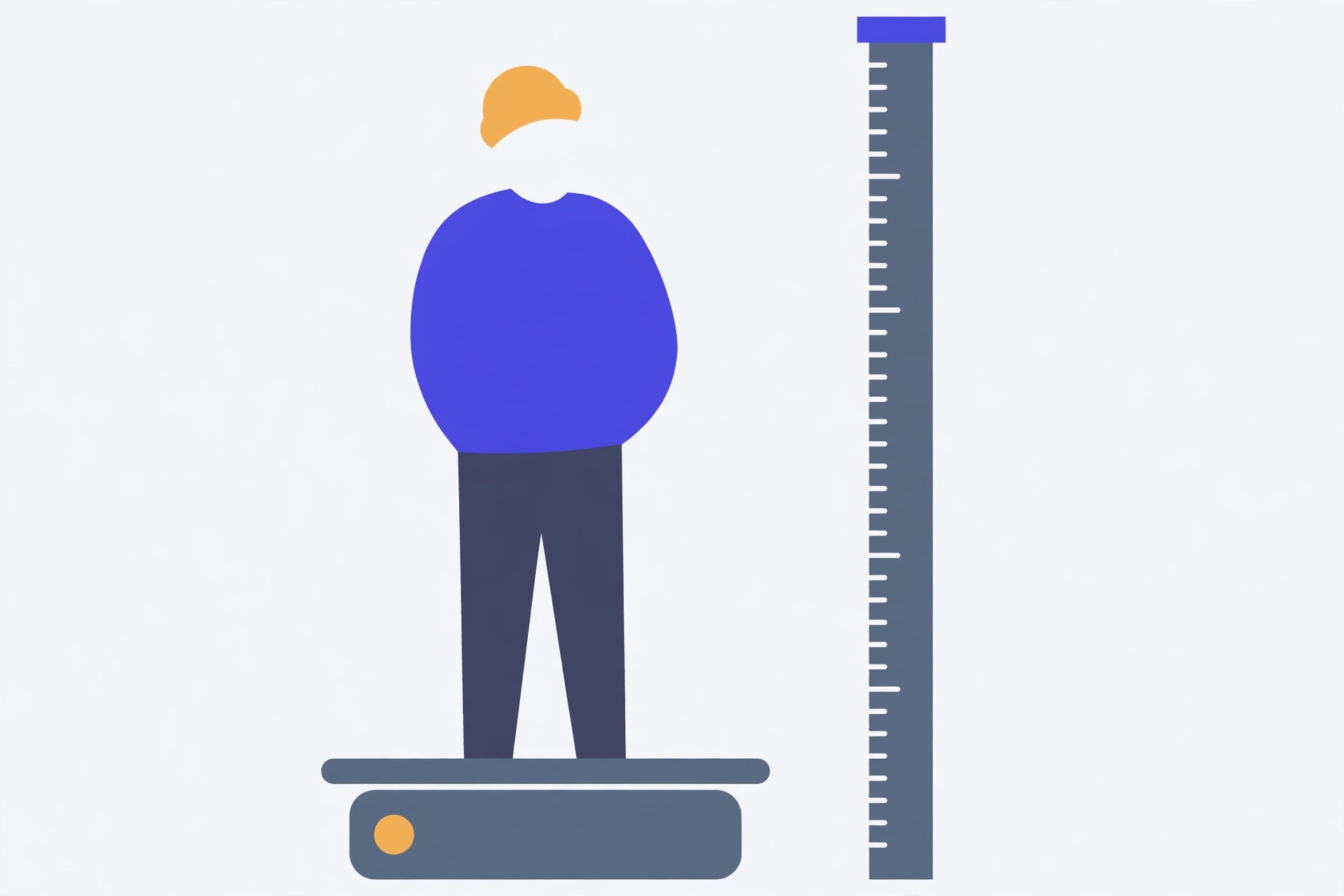
The BMI Calculator takes a height and a weight and returns BMI = kg/m^2, or 703 x lb/in^2 in imperial units after converting to metric first. The categories it reads against are under 18.5 underweight, 18.5-24.9 healthy, 25-29.9 overweight and 30 or above obesity. Getting a result you can trust is mostly a measuring job. Weigh yourself in the morning in light clothing and without shoes. Measure height barefoot against a flat wall, standing straight. Then set the toggle to Metric (cm/kg) or Imperial (ft-in/lb), enter the numbers in the matching fields, click Calculate BMI, and read the number together with its range. Check the distance to the nearest boundary too: height is squared, so a 2 cm slip moves the result more than most people expect.
Measure first, calculate second
BMI is a general screening number, not a diagnosis and not medical advice. It sorts a height and a weight into a broad range, and that is all it does. This guide covers running the calculation cleanly and reading what comes back, not what your number should be.
Start with the two inputs, because the calculator can only work with what you hand it. A bathroom scale on carpet reads low and drifts, so put it on a hard, flat floor. Weigh in the morning, after the bathroom and before breakfast, in light clothing and no shoes. Your weight moves by a kilo or two across a normal day, so a morning reading is the most repeatable one you can take at home. Write the number down.
Height deserves more care than it usually gets. Stand barefoot on a hard floor with your back to a flat wall, heels together, head level, looking straight ahead. Have someone lay a hardback book flat on your head, level with the floor, and mark where the underside touches the wall. Then measure floor to mark. Slouching or measuring over thick hair can each cost a centimetre or two, and the next sections show why that matters.
Run the calculation in seven steps
The calculator itself takes under a minute. The toggle at the top is the one choice that matters, because the fields change with it.
- Weigh yourself in the morning, in light clothing and without shoes, and write the number down.
- Measure your height barefoot against a flat wall, standing straight with your heels together.
- Set the calculator toggle to Metric (cm/kg) or Imperial (ft-in/lb) to match the units you measured in.
- Enter your height in the Height field and your weight in the Weight field for the system you picked.
- Click Calculate BMI and read the number together with the category range it falls in.
- Check how close the result sits to a category boundary before you treat the label as settled.
- Re-measure once if the result surprises you, since a small height error moves the result a lot.
Run the same numbers twice, a few days apart, at the same time of day. If both runs land in the same part of the range, the input is stable. If they jump around, the measuring is the problem, not the arithmetic.
Worked example: one person, both unit systems
Take 170 cm and 65 kg. Convert the height to metres first: 170 cm is 1.70 m. Square it: 1.70 x 1.70 = 2.89. Now divide the weight by that square: 65 / 2.89 = 22.49, which the calculator rounds to 22.5. That sits inside the 18.5-24.9 healthy range, clear of both edges.
Now the same job in imperial. Say you measured 5 ft 7 in and 150 lb. Add the feet and inches into one height: 5 ft is 60 in, plus 7 in gives 67 in. The imperial formula is BMI = 703 x lb/in^2 (the tool converts to metric first). Square the height: 67 x 67 = 4489. Multiply the weight by 703: 703 x 150 = 105450. Divide: 105450 / 4489 = 23.49, rounded to 23.5. Also healthy, and closer to the 24.9 top edge than the metric example.
Notice what the squaring does. At 170 cm, dropping the height entry to 168 cm changes the square from 2.89 to 2.8224, and the same 65 kg now gives 65 / 2.8224 = 23.03. Two centimetres of slouch added half a point. Weight errors move the result in a straight line; height errors get amplified by the squaring.
Mistakes that quietly move the number
The most common one is mixing systems halfway. You measure in centimetres, then leave the toggle on Imperial and type 170 into a feet field, or enter pounds into the Weight (kg) field. The calculator will still return a tidy number. Check the toggle and field labels before you click, every time.
Second: weighing at random times and comparing the results as if they were like for like. An evening weight after a large meal and a litre of water can sit 1.5 kg above your morning weight, and at 170 cm that alone shifts BMI by about half a point. Third: rounding your height up out of habit, using a figure from a licence or a clinic visit years ago. Measure it fresh. Fourth: reading the label and skipping the number. A result of 24.8 and a result of 19.0 both say healthy, but they sit in very different parts of the range, and only one is a rounding slip away from the next category.
Where the reading stops being reliable
The ranges were built for general adult populations, and some bodies sit awkwardly inside them. A strength athlete can carry enough muscle to land in the overweight range at a low body fat level, because the formula sees total mass and cannot tell muscle from fat. Pregnancy changes weight for reasons unrelated to the screening question the ranges were designed for. Older adults often lose height as well as muscle, so both inputs drift at once and the reading gets harder to interpret. The arithmetic stays correct; the interpretation is the shaky part.
The lines at 18.5, 25 and 30 are conventions drawn on a continuous scale. A result of 24.9 and a result of 25.1 describe nearly identical bodies, and ordinary measuring error can move you across that line in either direction. Treat anything within about half a point of a boundary as sitting on the boundary. For the bigger picture, including how this number compares with BMR and TDEE, see our earlier guide on BMI, BMR and TDEE as three separate numbers. This page stays with the operation: measure carefully, enter honestly, read the range with its edges in view.
The Verystep BMI Calculator has a Metric (cm/kg) / Imperial (ft-in/lb) toggle at the top. In metric you fill in Height (cm) and Weight (kg); in imperial you fill in Height (ft), Height (in) and Weight (lb). Click Calculate BMI and it shows your BMI number with the category range it falls in, worked out in your browser with nothing uploaded.
Last verified November 20, 2026 — Metric (cm/kg) / Imperial (ft-in/lb) toggle, Height (cm), Weight (kg), Height (ft), Height (in) and Weight (lb) fields and the Calculate BMI button checked against the live Verystep BMI Calculator, and both worked examples recomputed by hand: 170 cm / 65 kg gives 65 / 2.89 = 22.5, and 5 ft 7 in / 150 lb gives 703 x 150 / 4489 = 23.5, with the 168 cm sensitivity check giving 23.0.
Frequently asked questions
Which fields do I use in imperial mode?
Set the toggle to Imperial (ft-in/lb) and you get three fields: Height (ft), Height (in) and Weight (lb). Enter feet and inches separately. The tool converts to metric and applies BMI = 703 x lb/in^2, so 5 ft 7 in at 150 lb comes back as 23.5.
Why did my BMI change when only my height entry changed by 2 cm?
Because height is squared in the formula. At 65 kg, a height of 170 cm gives 65 / 2.89 = 22.5, while 168 cm gives 65 / 2.8224 = 23.0. A small slip in height moves the result more than the same slip in weight, which is why measuring height carefully matters so much.
My result is 24.9. Am I healthy or overweight?
24.9 is the top edge of the 18.5-24.9 healthy range, and 25.0 starts the overweight range. The two numbers describe almost the same body, and normal measuring error can cross that line either way. Read it as sitting on the boundary, re-measure carefully, and remember the calculator gives a general screening result, not a diagnosis.
When is the best time of day to weigh myself?
Morning is the most repeatable time: after the bathroom, before breakfast, in light clothing and without shoes. Weight shifts by a kilo or two across the day, so comparing a morning reading with an evening one mostly compares your meals, not your body.
Does a high BMI always mean too much body fat?
No. The formula uses total weight and cannot separate muscle from fat, so a muscular athlete can land in the overweight range with low body fat. Pregnancy and age-related height and muscle loss also make the reading harder to interpret. The number is a screening starting point, limits included.
More guides

The PPWR Empty Space Ratio: Why the 50% Cap Hits Your Shipping Box First
Ask a room of online sellers what the PPWR will change first and most will say labels. The duty with a number in it is quieter: from 2030 at the earliest, no more than half the volume of your shipping box may be empty — and the filler you stuff into it counts as empty.

Counting a Return Window: The EU 14-Day Cooling-Off Period Starts the Day After Delivery
A shop page says “14 days to return”. Fourteen days from when — the order, the dispatch, the delivery? And counted how — in calendar days or working days? EU law answers both questions, and the answers are not the ones most countdown banners use.

How to Check Gift Return Eligibility Without a Receipt
Black Friday is over, the gifts are changing hands, and some of them are the wrong size, the wrong color or the second one you own. There is no receipt — there never is with a gift — so the question is not “can I get my money back?” but “which route does this store actually offer someone in my position, and how long do I have?”