How to Check Gift Return Eligibility Without a Receipt
Black Friday is over, the gifts are changing hands, and some of them are the wrong size, the wrong color or the second one you own. There is no receipt — there never is with a gift — so the question is not “can I get my money back?” but “which route does this store actually offer someone in my position, and how long do I have?”

Every return policy is written for the buyer, who has a receipt, an order number and the card that paid. A gift recipient has none of those, and the refund can never travel back to a card that is not theirs — so the published no-receipt routes take exactly three shapes. Seven of the nine stores in the checker end in store credit: Target, Walmart, Best Buy, Kohl’s, Macy’s, Nordstrom and The Home Depot. Opened movies, music, games and software are exchange only at Target and Best Buy, at any date. And two routes cannot be done alone: Amazon’s Gift Returns Center starts from the 17-digit order number, and a Costco purchase lives on the giver’s membership. The second half of the puzzle is the clock. Windows run from the purchase, the delivery or the day the item was received — a different start point at each store — and the 2026 holiday extensions push several deadlines into January 2027. Check the route first, then the date: at the two “giver” stores the calendar is not your problem, and at Nordstrom there is no published deadline at all.
Three routes, no cash: how a no-receipt gift return actually works
Start from the one fact that shapes everything else. A refund follows the payment, and the payment was never yours. No store on this page pays cash to a recipient without a receipt, and none sends money back to the giver’s card on a recipient’s say-so. What the stores publish instead sorts into three routes — and which one your store runs matters more than the deadline, because two of the three make the deadline a side issue.

Route one is store credit, the common case. Target issues a merchandise return card — a government-issued ID is required to issue it, the funds never expire, and it spends in Target stores only. Walmart runs your government photo ID through its refund verification and, if accepted, offers an even exchange or a gift card at the item’s current shelf price. Best Buy reimburses returns lacking proof of purchase as store credit, a gift returned in store at the purchase price. Kohl’s, Macy’s, Nordstrom and The Home Depot run the same shape with a twist covered below: the credit is figured off the item’s lowest or current price, not what the giver paid.
Route two is exchange only, a rule about a category, not a store. Opened movies, music, video games and software go back at Target for the same title and at Best Buy for an identical item — no credit, no refund, at any date; a sealed copy follows the general route instead. Route three is the one nobody warns recipients about: the route exists, but it starts with something only the giver holds. Amazon’s Gift Returns Center is built for recipients — the refund lands on your own gift card balance — but it starts from the 17-digit order number, which sits on the gift receipt, the packing slip or in the giver’s order history. Costco’s guarantee is generous on paper, yet every purchase lives on the buying member’s account, where the counter looks it up; Costco publishes no route a recipient can walk alone. Kohl’s premium electronics and watches join this route too: 30 days, only with a receipt or an account lookup — the giver’s account.
Then the clock, which does not start where you would guess. Target, Kohl’s, Macy’s and The Home Depot count from the purchase date; Amazon from delivery; Best Buy from the day the item was received — by the giver, usually days before it reached you. You know only the day the gift changed hands, so the checker asks for that date and prints each store’s start point beside the count. On top sit the 2026 holiday extensions, each keyed to a purchase range: holiday purchases at Amazon, Walmart, Kohl’s and Macy’s run to January 31, 2027, Best Buy’s extended period to January 15, 2027, and Target’s electronics to January 24, 2027 (Apple products and phones at Target: January 8, 2027). Two stores refuse the deadline game entirely — Nordstrom publishes no time limit and decides case by case, Costco no deadline outside its 90-day electronics list — so the checker prints no countdown for them rather than inventing one.
Check your own gift, step by step
Before you start, you need three facts and nothing else: which store the gift came from (labels, store-brand names, price tags and the shipping box usually settle it — Kirkland Signature means Costco), what kind of item it is, and the date it reached you. The checker never asks for an order number, a gift receipt or a price, and nothing you type leaves the browser.
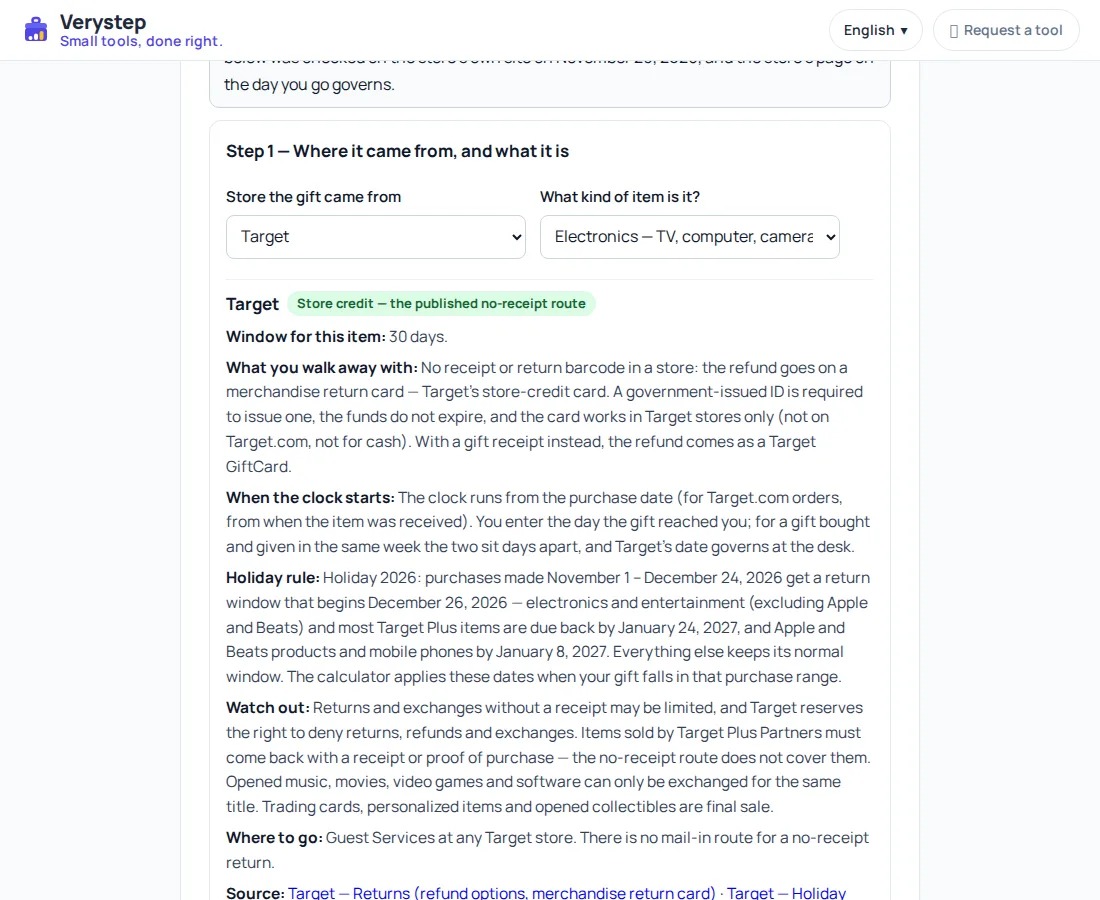
- Pick the store in the first dropdown and read its card before touching anything else. Expect a badge naming the route (store credit, exchange only, or “needs one thing from the giver first”), the window, what you walk away with, when the clock starts, and the watch-outs — the read that decides whether a deadline is even your problem.
- Pick the kind of item honestly: the general group (clothing, home goods, toys); electronics; a mobile phone or Apple product; or opened media. Expect the card to update — electronics and phones run on shorter clocks almost everywhere (30 and 14 days at Target and Walmart alike), and choosing “most gifts” for a phone buys you a wrong deadline.
- If the card offers a window choice, pick the one matching how the giver bought it: Best Buy runs 15 days standard against 60 for a Plus or Total member purchase, Kohl’s 90 against 120 on a Kohl’s Card, and Best Buy activatable devices stay at 14 either way. If you do not know, use the standard window.
- Type the date you received the gift, and, if you like, name the item in the optional box — that name prints on your checklist and nowhere else. Expect no calculation yet; nothing is saved, so a refresh wipes it.
- Click “Check my return” and read the verdict headline first: inside the window, exchange only, one thing standing between you and the return, or outside it. Then read the last day and the days left, counting today. If the holiday extension is the operative date, the result says so — the standard count closed earlier.
- Read the “Take these with you” list, print the checklist, and gather what it names: the item with tags, accessories and packaging as complete as you can make them, your photo ID, any gift receipt or packing slip that turns up — and, on a “giver” route, the one fact to collect first. A Best Buy gift in particular must go in person: returned by mail, it is credited to the purchaser, who gets an email about it.
Worked example: headphones from Target, received November 20
Take a pair of wireless headphones from Target, handed to you on Friday, November 20, 2026 — a Black Friday-week gift, no receipt, box opened but everything inside. Step 1 picks Target; step 2 picks electronics, and the card answers with the store-credit badge and a 30-day window: a merchandise return card, issued against a government ID, spent in store only, the clock running from the purchase date. Target offers no window choice, so step 4 enters the date received and the item name.
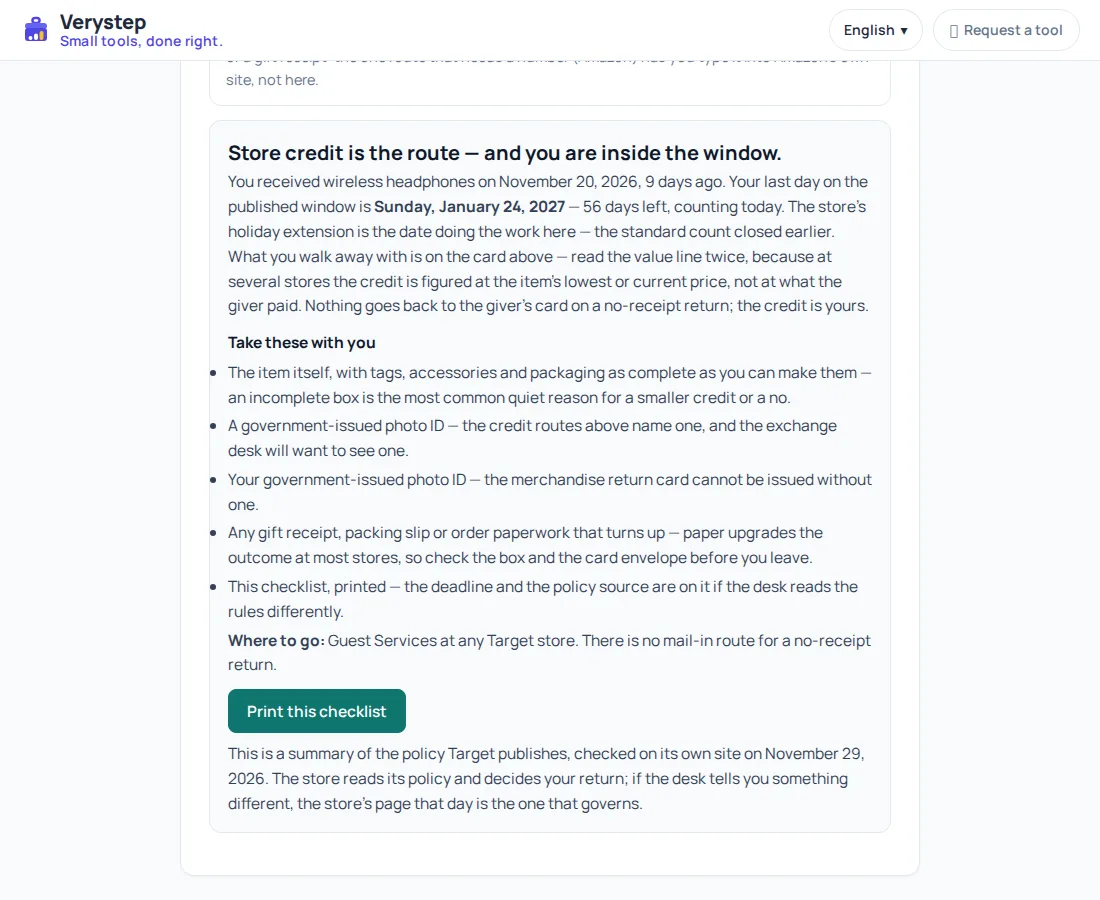
Click the button and the live checker’s verdict reads: “Store credit is the route — and you are inside the window.” It counts 9 days elapsed as of today, November 29. The standard 30-day count from November 20 would close on December 20, 2026 — but the result names a later last day, Sunday, January 24, 2027, with 56 days left counting today, and says why: the holiday extension is the date doing the work, because a purchase inside Target’s November 1 to December 24, 2026 range gets a window beginning December 26, with electronics due back by January 24, 2027. The checklist says Guest Services at any Target store, no mail-in route, and lists the complete item, your photo ID, and any paperwork that turns up. One footnote the card prints: Target counts from the purchase date, so if the giver bought the headphones days before handing them over, Target’s own last day sits a few days earlier than your printout — go well before January 24, not on it.
Two quick contrasts show the other shapes. A kitchen gadget from Amazon, received the same day, is not a deadline problem at all: the holiday window runs to January 31, 2027, and the verdict is the third route — the 17-digit order number stands between you and the return — after which the refund lands on your gift card balance, not the giver’s. A Macy’s sweater received back on September 20, 2026 shows the closed door: the standard 30 days ended October 20, and the holiday extension cannot rescue it, covering only purchases from October 5, 2026 onward; what remains is a manager’s courtesy, not a policy.
Limits and boundaries: what the verdict does and does not promise
The checker restates published policy; it does not rule on your return. The store reads its own policy at the desk and decides, and the discretion is printed, not hidden: Target, Walmart and Best Buy all state in writing that a return without a receipt may be limited or refused, Walmart limits the number and frequency of no-receipt returns and logs them against your ID, and Nordstrom’s case-by-case policy means no deadline to miss and no entitlement to cite. Inside the window means the published policy leaves the door open — nothing more. The retailer’s own current policy page governs on the day you go; every card was read on the store’s own site on November 29, 2026, and stores do rewrite these pages between seasons.
The money has limits too. The checker never prints a credit value, because at four stores the figure is the store’s own calculation: Kohl’s credits the lowest discounted sale price of the last 13 weeks, Macy’s the lowest selling price within the last 180 days (a Merchandise Only Certificate, in store only, expiring after 2 years), The Home Depot the lowest advertised price, Nordstrom the current price on the day. A gift that went on sale after it was bought credits at the sale figure; Best Buy is the exception, at the purchase price. Marketplace items follow the seller’s policy almost everywhere — Target Plus Partner items require proof of purchase outright — and named carve-outs stay carved out: Sephora at Kohl’s takes no no-receipt returns, Macy’s Last Act is final sale, Costco gift cards and tickets are non-refundable. Scope: US retail, nine stores. This guide is general information about published policies, not consumer-law advice and not a returns service — the checker files nothing, contacts no store, and takes no documents from you.
Sources: the nine store cards in the Gift Return Checker, each built from the store’s own help or policy page, checked November 29, 2026 — Target Returns (merchandise return card; 90 / 30 / 14-day windows) and its Holiday extended return window 2026 article (electronics by Jan 24, 2027; Apple & Beats and phones by Jan 8, 2027); Walmart Returns hub (ID-verified exchange or gift card at current shelf price; holiday purchases to Jan 31, 2027); Amazon “Return a Gift” and Return Policy (Gift Returns Center, 17-digit order number, refund to the recipient’s gift card balance; holiday purchases until Jan 31, 2027, Apple-brand until Jan 15, 2027); Best Buy Return & Exchange Policy (no-proof store credit; 15 / 60 / 14 days from receipt; holiday to Jan 15, 2027); Costco return policy help article (satisfaction guarantee, 90-day electronics list, purchases on the member’s account); Kohl’s Return Policy (merchandise credit at the lowest discounted 13-week sale price; 90 / 120 days; holiday through Jan 31, 2027); Macy’s “What to expect after a return” and Holiday 2026 Return Policy (store credit at the lowest selling price in 180 days; 30 days; holiday until Jan 31, 2027); Nordstrom Returns & Exchanges (case by case, no published deadline, gift card at current price); The Home Depot Return Policy (store credit at the lowest advertised price; 90 days). Where this summary and a store’s page differ, the store’s page governs.
The Verystep Gift Return Checker covers nine US stores — Target, Walmart, Amazon, Best Buy, Costco, Kohl’s, Macy’s, Nordstrom and The Home Depot. Pick the store, pick the kind of item, type the date the gift reached you, and it reads back that store’s published no-receipt route, applies the 2026 holiday extension where one exists, names your last day, and builds a one-page checklist to print. It never asks for an order number or a gift receipt, and nothing you type is uploaded or saved.
Last verified November 29, 2026 — every store fact is the corresponding card of the live Gift Return Checker at https://verystep.com/gift-return-checker/ , whose nine policies were opened and checked on the stores’ own help and policy pages the same day (Target, Walmart, Amazon, Best Buy, Costco, Kohl’s, Macy’s, Nordstrom, The Home Depot; full source list in the guide’s Sources paragraph). Worked example run on the live tool on November 29, 2026 and read back verbatim: store Target, category electronics, item “wireless headphones”, date received November 20, 2026 → verdict “Store credit is the route — and you are inside the window”, 9 days elapsed, last day Sunday, January 24, 2027, 56 days left counting today, holiday extension named as the operative date; the ES edition of the tool returned the same figures (20 de noviembre de 2026, hace 9 días, domingo 24 de enero de 2027, 56 días). Date arithmetic independently recomputed with python datetime: November 20, 2026 + 30 days = December 20, 2026 (the standard count the holiday extension displaces); January 24, 2027 − November 29, 2026 = 56 days; November 20, 2026 was a Friday and January 24, 2027 is a Sunday. Contrasts from the tool’s own published examples, rechecked against its cards: Amazon general item received November 20, 2026 → “needs the giver” route (17-digit order number), holiday deadline January 31, 2027 (63 days left on November 29); Macy’s item received September 20, 2026 → standard 30-day last day October 20, 2026, 40 days past on November 29, holiday extension inapplicable (range starts October 5, 2026). Standing caution, printed in the guide: policies change, and the retailer’s own current policy page governs on the day you go. General information only — not consumer-law advice.
Frequently asked questions
Can I get cash back for a gift I return without a receipt?
No published route at any of the nine stores pays cash to a recipient without a receipt. Walmart’s own refunds page lists an even exchange, a gift card or a manufacturer repair for a verified no-receipt return — cash is not among them — and the other stores are store credit, exchange only, or a route through the giver’s account. Anyone offering to turn a no-receipt return into cash for a fee is selling something the stores do not publish.
Will the person who gave me the gift find out?
On the routes built for recipients, mostly no: Amazon’s gift return refunds your gift card balance, not the giver’s payment method. One exception is printed on the Best Buy card — a gift returned by mail is credited to the purchaser and Best Buy emails them, which is why a Best Buy gift should go back in a store, where the credit is yours. At Costco the giver is part of the route itself, so there is nothing to hide behind there.
Why is the store credit less than the price on the tag?
Because four of the nine stores price a no-receipt return off the item’s recent lows, not off what anyone paid: Kohl’s uses the lowest discounted sale price of the last 13 weeks, Macy’s the lowest selling price within the last 180 days, The Home Depot the lowest advertised price, and Nordstrom the current price on the day. A gift that went on sale after it was bought credits at the sale figure. Best Buy is the exception — a gift returned in store credits at the purchase price.
A gift receipt turned up after all. Does it change anything?
Yes, and almost always for the better. A gift receipt is the store’s own invitation to recipients: at Target it turns the merchandise return card into a Target GiftCard, at Kohl’s it takes you off the lowest-13-week-price credit, and everywhere it removes the ID-and-verification dance. If one surfaces in the box or the card envelope, lead with it and ignore the no-receipt outcome on the card.
The gift has been opened. Can it still go back?
Usually, with one sharp exception. Opened movies, music, games and software are exchange-only at Target (same title) and Best Buy (identical item) — sealed copies follow the general route instead. Elsewhere, stores expect the item back complete with its accessories, and an incomplete box is the most common quiet reason for a smaller credit or a refusal at the desk.
More guides

The PPWR Empty Space Ratio: Why the 50% Cap Hits Your Shipping Box First
Ask a room of online sellers what the PPWR will change first and most will say labels. The duty with a number in it is quieter: from 2030 at the earliest, no more than half the volume of your shipping box may be empty — and the filler you stuff into it counts as empty.

Counting a Return Window: The EU 14-Day Cooling-Off Period Starts the Day After Delivery
A shop page says “14 days to return”. Fourteen days from when — the order, the dispatch, the delivery? And counted how — in calendar days or working days? EU law answers both questions, and the answers are not the ones most countdown banners use.

GPSR: The EU Responsible Person — Four Routes to a Name the EU Can Reach
A marketplace asks you to upload a “responsible person” before it will list your product. That field is not platform paperwork — it is Article 16 of the GPSR, and there are exactly four ways to fill it.