The PPWR Empty Space Ratio: Why the 50% Cap Hits Your Shipping Box First
Ask a room of online sellers what the PPWR will change first and most will say labels. The duty with a number in it is quieter: from 2030 at the earliest, no more than half the volume of your shipping box may be empty — and the filler you stuff into it counts as empty.

Article 24 of Regulation (EU) 2025/40, headed “Obligation related to excessive packaging”, sets the only hard percentage in the packaging minimisation chapter: “economic operators who fill grouped packaging, transport packaging or e-commerce packaging shall ensure that the maximum empty space ratio, expressed as a percentage, is 50 %”. The ratio is pure volume. Empty space is the total volume of the outer packaging minus the volume of the sales packaging inside it, and the ratio is that empty space divided by the total volume. Space taken up by paper cuttings, air cushions, bubble wrap or foam is empty space by definition — filler protects the product, but it does not shrink the number. The cap bites on 1 January 2030, or three years after the Commission’s calculation-method act enters into force, whichever is later; that act is due by 12 February 2028. Sales packaging plays by a different, earlier rule: no percentage, just empty space cut to the minimum necessary by 12 February 2028. If you fill the box — or your fulfilment provider does it for you — this is your line to measure against, and you can measure it today with a tape and four multiplications.
Article 24, in its own words: a cap on volume, owed by whoever fills the box
Start with the sentence itself, because summaries of it go wrong both ways — a stricter 40% figure circulates, and so does a 2026 start date. Article 24(1) of Regulation (EU) 2025/40 reads: “By 1 January 2030 or 3 years from the entry into force of the implementing acts adopted pursuant to paragraph 2, whichever is the latest, economic operators who fill grouped packaging, transport packaging or e-commerce packaging shall ensure that the maximum empty space ratio, expressed as a percentage, is 50 %.” Three things in that sentence decide most real cases. The duty sits with whoever fills the packaging, not whoever made the carton. It covers three formats, not e-commerce alone. And its date is a latest-of-two formula: 1 January 2030 is the floor, and the date slides if the methodology act arrives late.
The measurement is defined in Article 24(3): “empty space shall mean the difference between the total volume of grouped packaging, transport packaging or e-commerce packaging and the volume of sales packaging contained therein”, and “empty space ratio shall mean the ratio of the empty space as defined in point (a) and the total volume of the grouped packaging, transport packaging or e-commerce packaging”. Note the yardstick. You do not measure the bare product; you measure the sales packaging it travels in — the product’s own box, bottle or blister pack, at its outer dimensions. E-commerce packaging is itself a defined term (Article 3(1), point (8)): transport packaging used to deliver products to the end user in online or other distance sales. The mailer bag and the shipping carton are squarely inside it.
Then comes the sentence that breaks most packing routines: “Space filled by filling materials, such as paper cuttings, air cushions, bubble wraps, sponge fillers, foam fillers, wood wool, polystyrene or Styrofoam chips, shall be considered as empty space.” The Commission’s guidance on the Regulation — Commission Notice C/2026/3084, published in the Official Journal on 10 June 2026 — settles the who question the same way: the ratio “needs to be complied with by the natural or legal person using or filling such packaging”. If a fulfilment provider packs your orders, the two of you need a contract conversation, because the text points at the hands on the box.
Why a volume rule rewrites the filler strategy, not just the box shelf
Most packing benches run on a simple instinct: a bigger box plus more filler equals fewer damaged goods. Article 24 does not ban filler, and nothing in it asks you to ship fragile goods unprotected. What it removes is filler’s old side benefit. Under a weight rule, a handful of air cushions costs almost nothing. Under this volume rule, every litre of cushion is a litre of empty space on the wrong side of the ratio — protection still works, but it no longer disguises an oversized carton. The lever that moves the number is the gap between the carton’s volume and the sales packaging’s volume, and that gap is set when the carton range is chosen, months before any single order is packed.
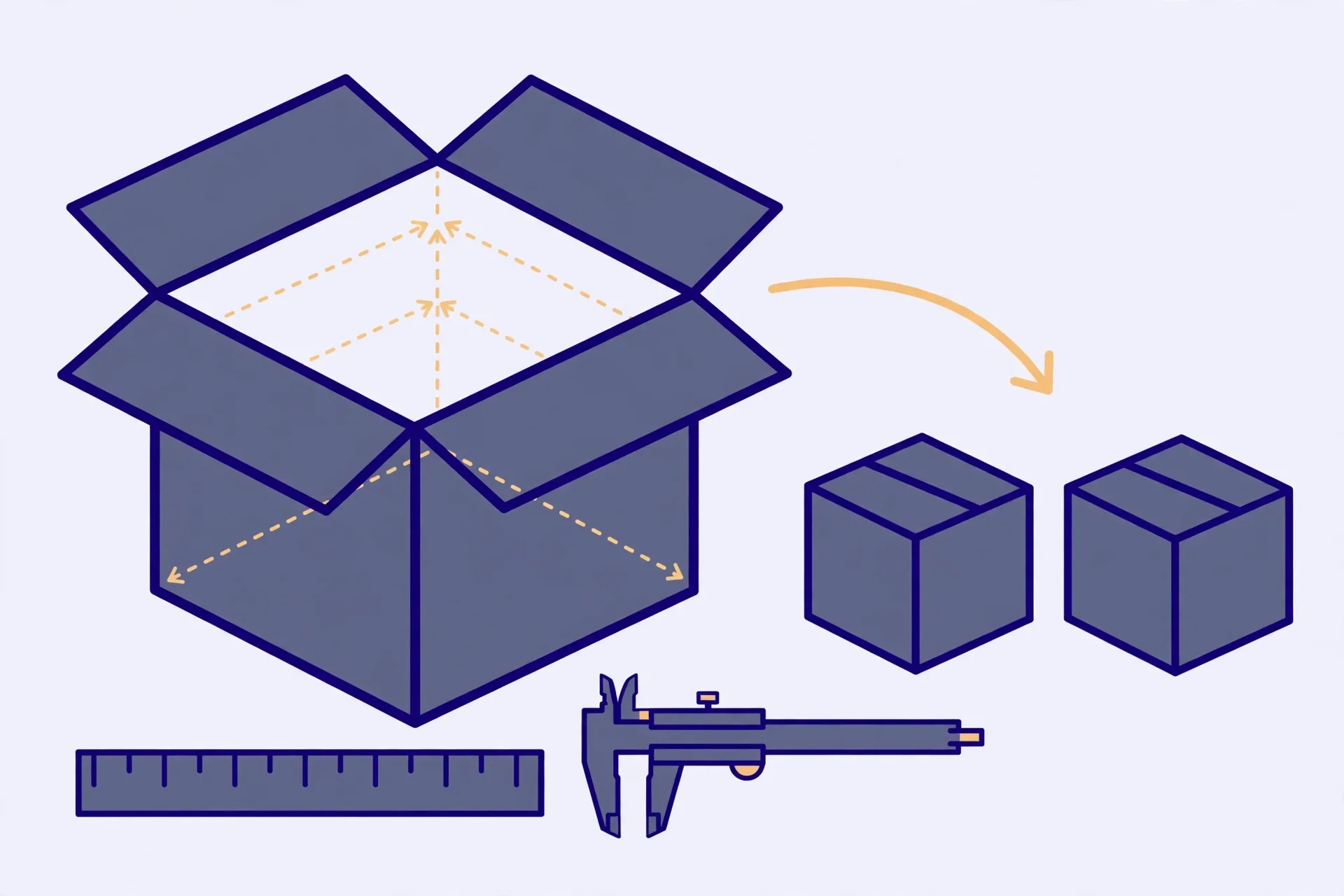
That flips the order of work. The bench question stops being “how much filler does this order need?” and becomes “which of our cartons keeps this product mix at or under half empty?” Sellers with three carton sizes and a long tail of products will find the failures cluster in one place: small, sturdy products dropped into the medium carton because the small one ran out. The Regulation knows measurement has awkward edges, which is why Article 24(2) gives the Commission until 12 February 2028 to set the calculation method, taking into account irregular shapes, parcels holding more than one sales unit, liquids, easily damaged contents, small products that larger ones can crush, and the minimum space a shipping label needs. Those are problems the method may allow for — not exemptions you can claim today.
Place the duty in your own case with the checker, step by step
The checker does not compute your ratio — no tool can, until the methodology act exists. What it fixes is the frame the ratio sits in: who you are under the Regulation, which countries your packaging reaches, and which dated duties, the Article 24 line included, are heading for you. Have three facts ready: where your business is really established (a seat with legal personality, not a branch), what you actually do in the chain, and every Member State where your products reach a distributor or an end user.
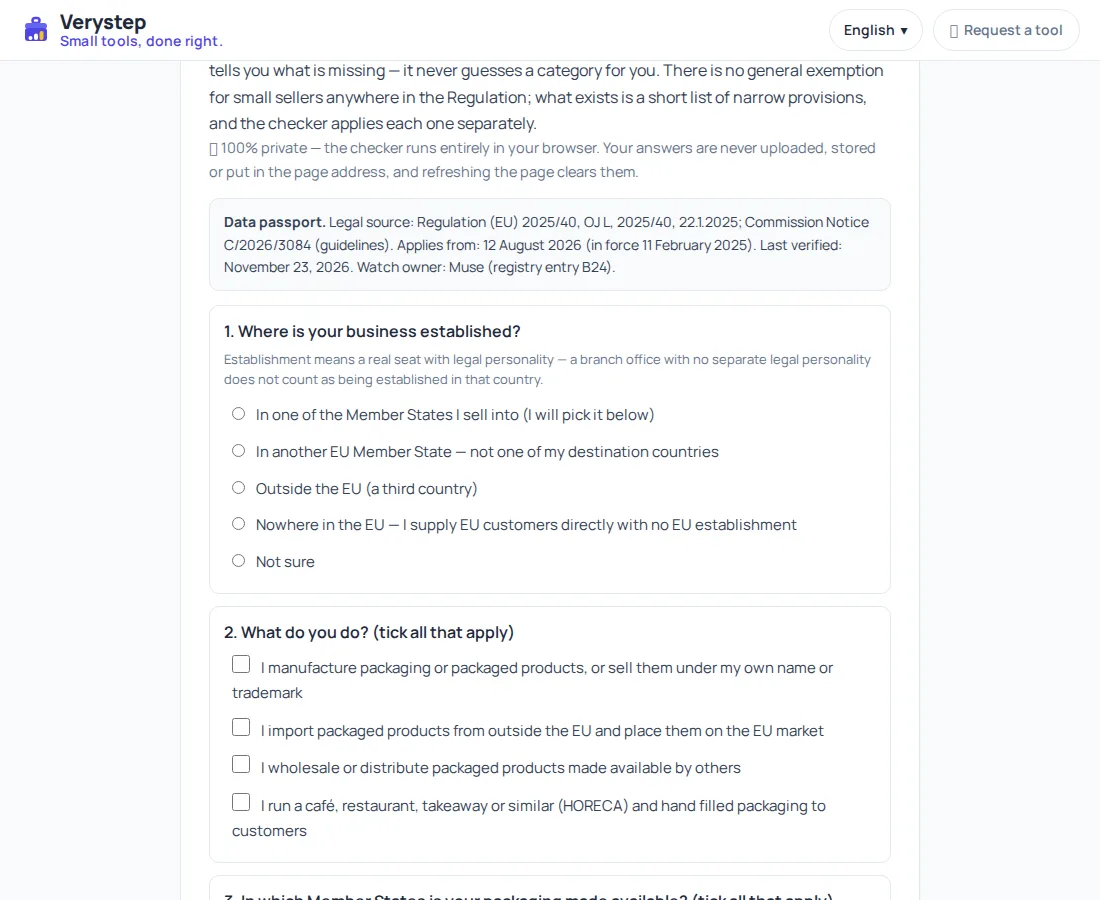
- Answer question 1, where your business is established, and if you pick “in one of the Member States I sell into”, name that country in the field that opens below it. Expect this answer to steer everything after it: establishment is what separates an importer from a cross-border direct seller in the Regulation’s definitions.
- Answer question 2, what you do, ticking every line that applies — making or own-brand selling, importing, distributing, handing filled packaging to customers. If you sell online under your own name, expect the own-brand line to apply even when a contract packer fills the boxes; ticking two boxes is normal, not a mistake.
- Answer question 3 by ticking every Member State where your packaging is made available, then complete the four short questions inside each country row that opens: who first provides the packaging there, your tonnage band, whether you are registered, and whether a representative is appointed. Expect one row per country — producer duties are decided country by country, with no single EU registration to hide behind.
- Work through the remaining questions: what your buyers do with the products, which kinds of packaging are involved — tick e-commerce packaging, and transport or grouped too if you fill those — and whether you hand drinks or ready-to-eat food to customers. Then complete any conditional block that opens, such as the micro-enterprise test or the supplier question. Expect blocks to appear only when an earlier answer makes them relevant.
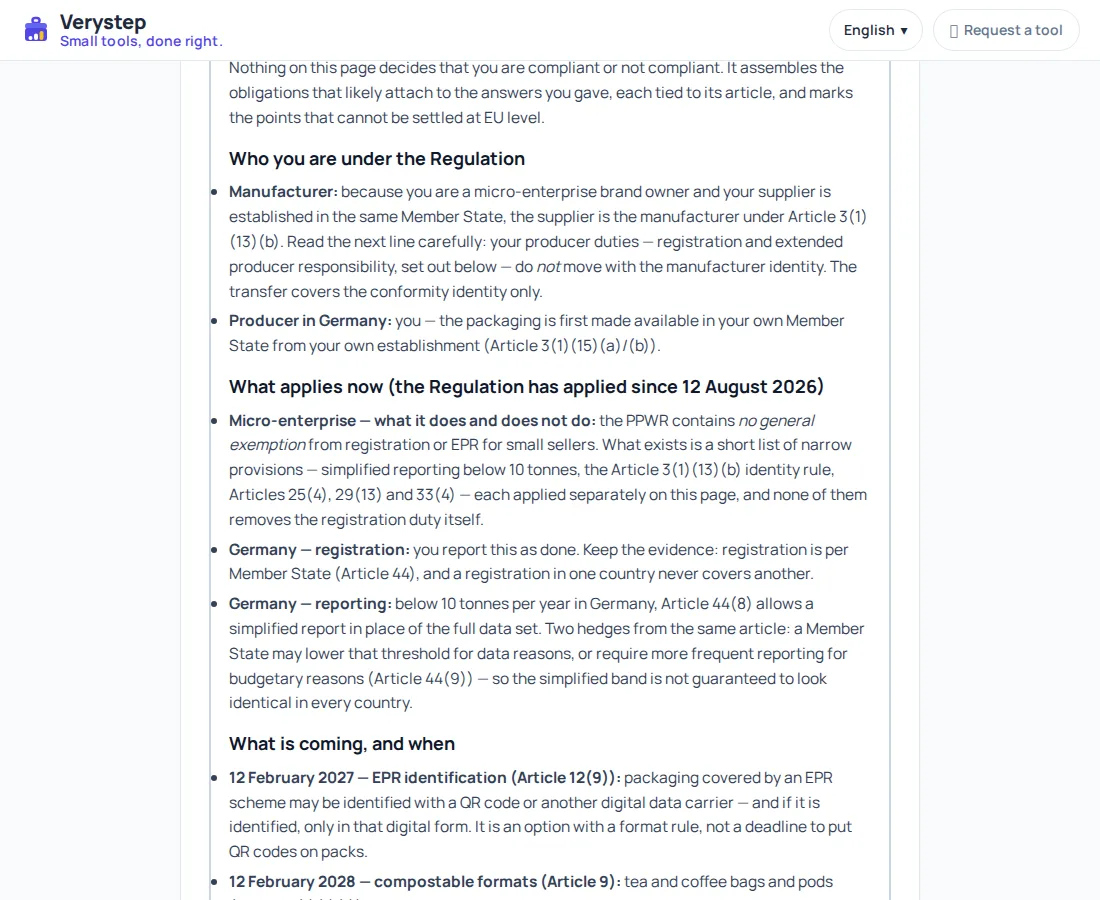
- Press “Show my obligations” and read the result in its own order: Needs checking, Who you are, What applies now, What is coming, Verify country by country. In What is coming, find the dated empty-space line and note its form: 1 January 2030 or three years after the methodology act, whichever is later. Where a point stays open, the result names the missing fact instead of guessing.
- Take the country check path for each destination and clear the open points with that country’s register or competent authority. Expect the checker to stay at EU level throughout: it cannot confirm a registration, a fee or a filing in any one Member State, and it never calls you compliant.
Worked example: one carton, two product boxes, and a 75% problem
Take a parcel a small webshop ships every day. The shipping carton measures 40 × 30 × 20 cm inside, and it carries two units of the same product, each in a sales box of 20 × 15 × 10 cm. The rest of the carton is crumpled paper. Run Article 24(3) over it, step by step.
Step one, the total volume of the e-commerce packaging: 40 × 30 × 20 = 24,000 cm³, which is 24 litres. Step two, the volume of the sales packaging inside: one sales box is 20 × 15 × 10 = 3,000 cm³, and there are two of them, so 2 × 3,000 = 6,000 cm³. Step three, the empty space: 24,000 − 6,000 = 18,000 cm³. The crumpled paper sits inside that 18,000 — Article 24(3) counts it as empty space, so it changes nothing. Step four, the ratio: 18,000 ÷ 24,000 = 0.75, expressed as a percentage, 75%. Against a maximum of 50%, this parcel fails by a wide margin, and no amount of extra paper would move it a single point.
Now fix it the way the Regulation pushes you to: shrink the carton, keep the load. The same two sales boxes in a 30 × 25 × 16 cm carton give a total volume of 12,000 cm³. Empty space is 12,000 − 6,000 = 6,000 cm³, and the ratio is 6,000 ÷ 12,000 = 50% exactly — at the cap, with no headroom at all. A slightly tighter carton, 30 × 24 × 15 cm, totals 10,800 cm³: empty space 4,800 cm³, ratio 4,800 ÷ 10,800 = 44.4%, and the parcel passes with room to spare. The shortcut in the arithmetic is worth memorising: at a 50% cap, the carton’s total volume may be at most twice the volume of the sales packaging inside it. Twice 6,000 is 12,000 — exactly the borderline carton above.
Limits and boundaries: what is not settled, and what this guide is not
First, the measuring method is not final. The definitions in Article 24(3) are in the Regulation itself, and the hand calculation above follows them word for word. But the implementing act due by 12 February 2028 will set the official methodology, including how it treats irregular shapes, mixed loads and label space — and the cap’s start date moves with that act. Treat today’s ratios as a planning measure taken with the Regulation’s own formula, not as a certified test result.
Second, two nearby rules are easy to confuse with this one. Sales packaging has no 50% ratio: under Article 24(4), whoever fills it must, by 12 February 2028, reduce its empty space “to the minimum necessary for ensuring the packaging functionality, including product protection” — a judgement standard, not a number. And Article 24(5) exempts two situations from the paragraph 1 cap: using sales packaging as e-commerce packaging (shipping in the product’s own box, with a label) and using reusable packaging inside a re-use system. Both still have to meet Article 10 minimisation. The Commission reviews the ratio and the exemptions by 12 February 2032 (Article 24(6)).
Third, the checker and this guide both work at EU level. Neither decides whether you are the producer for a given country, what a national register will accept, or what a penalty would be; Member States set those. This guide is general information about a published regulation, not legal advice. If packaging is a material cost line in your business, have EU packaging counsel or the destination country’s register confirm your position before the dated duties land.
Sources: Regulation (EU) 2025/40 of 19 December 2024 on packaging and packaging waste, Official Journal L, 2025/40, 22 January 2025 — Article 24(1), (2), (3), (4), (5) and (6) and Article 3(1), point (8), quoted and checked against the official English text on EUR-Lex (CELEX 32025R0040); Commission Notice C/2026/3084, guidance document for Regulation (EU) 2025/40, published in the Official Journal on 10 June 2026, section on Article 24 (the person using or filling the packaging complies). The checker’s data passport records the same two sources. General information only — not legal advice.
The Verystep PPWR Packaging Compliance Checker asks ten questions — where your business is established, what you do, and every Member State your packaging reaches — and assembles the duties that already apply to you, the dated duties still coming (the Article 24 empty-space line among them), and the register to verify each point with, country by country. It works at EU level only, it never quotes fees, and it runs entirely in your browser: your answers are never uploaded or stored.
Last verified November 29, 2026 — Article 24 of Regulation (EU) 2025/40 quoted verbatim from the official English text on EUR-Lex (CELEX 32025R0040): paragraph 1 (50% maximum, 1 January 2030 or 3 years from the entry into force of the paragraph 2 implementing acts, whichever is the latest), paragraph 2 (methodology acts due by 12 February 2028, with the listed special cases), paragraph 3 (empty space = total volume minus the volume of the sales packaging contained; ratio = empty space over total volume; filling materials counted as empty space), paragraph 4 (sales packaging minimum-necessary rule by 12 February 2028), paragraph 5 (exemptions for sales packaging used as e-commerce packaging and reusable packaging in a re-use system, Article 10 still applying), paragraph 6 (Commission review by 12 February 2032); Article 3(1), point (8) definition of e-commerce packaging. Commission Notice C/2026/3084 (guidance document, Official Journal, 10 June 2026) verified as the Commission guidance the checker’s data passport cites; its Article 24 passage states the ratio must be complied with by the natural or legal person using or filling the packaging — the separate Article 24(2) implementing act on methodology is a different, still-outstanding act, and no date for it beyond the 12 February 2028 deadline is stated in the guide. Worked example recomputed twice: 40 × 30 × 20 = 24,000 cm³; 20 × 15 × 10 = 3,000 cm³, × 2 = 6,000 cm³; empty space 18,000 cm³; ratio 75%. Right-sized: 30 × 25 × 16 = 12,000 cm³, ratio exactly 50%; 30 × 24 × 15 = 10,800 cm³, empty 4,800 cm³, ratio 44.4%. Live PPWR checker checked at https://verystep.com/ppwr-checker/ and its ES/PT/FR/DE versions: ten questions (establishment, roles, destination Member States with four per-country answers, buyers, packaging types, HORECA, conditional micro-enterprise / supplier / representative / unpacking blocks), “Show my obligations” button, result read as Needs checking / Who you are / What applies now / What is coming / Verify country by country, EU level only, no fees, answers never uploaded. General information only — not legal advice.
Frequently asked questions
Is the PPWR empty space cap 40% or 50%?
50%. Article 24(1) of Regulation (EU) 2025/40 says the maximum empty space ratio, expressed as a percentage, is 50% for grouped, transport and e-commerce packaging. The 40% figure that circulates in blog posts and vendor material does not appear in the Article.
Does bubble wrap or paper filler reduce my empty space ratio?
No. Article 24(3) states that space filled by filling materials — paper cuttings, air cushions, bubble wraps, sponge and foam fillers, wood wool, polystyrene or Styrofoam chips — is considered empty space. Filler still protects the product; it just does not count as filled volume.
When does the 50% cap actually start?
On 1 January 2030, or three years after the implementing acts that set the calculation methodology enter into force, whichever is later. The Commission must adopt those acts by 12 February 2028, so 2030 is the earliest possible start, not a guaranteed one.
My fulfilment provider packs my orders. Whose duty is it?
The text points at whoever fills the packaging: Article 24(1) binds the economic operators who fill grouped, transport or e-commerce packaging, and the Commission’s guidance (Notice C/2026/3084) says the ratio must be complied with by the person using or filling the packaging. If a provider packs for you, settle in the contract who measures, who chooses carton sizes, and who keeps the records.
Does the 50% ratio apply to my product’s own box too?
No. The product’s own box is sales packaging, and Article 24(4) gives it a different rule: by 12 February 2028, whoever fills it must reduce empty space to the minimum necessary for the packaging’s functionality, including product protection. No fixed percentage — and if you ship in that box as-is, Article 24(5) exempts you from the paragraph 1 ratio, though Article 10 minimisation still applies.
More guides

Counting a Return Window: The EU 14-Day Cooling-Off Period Starts the Day After Delivery
A shop page says “14 days to return”. Fourteen days from when — the order, the dispatch, the delivery? And counted how — in calendar days or working days? EU law answers both questions, and the answers are not the ones most countdown banners use.

How to Check Gift Return Eligibility Without a Receipt
Black Friday is over, the gifts are changing hands, and some of them are the wrong size, the wrong color or the second one you own. There is no receipt — there never is with a gift — so the question is not “can I get my money back?” but “which route does this store actually offer someone in my position, and how long do I have?”

GPSR: The EU Responsible Person — Four Routes to a Name the EU Can Reach
A marketplace asks you to upload a “responsible person” before it will list your product. That field is not platform paperwork — it is Article 16 of the GPSR, and there are exactly four ways to fill it.