GPSR: The EU Responsible Person — Four Routes to a Name the EU Can Reach
A marketplace asks you to upload a “responsible person” before it will list your product. That field is not platform paperwork — it is Article 16 of the GPSR, and there are exactly four ways to fill it.

Article 16(1) of Regulation (EU) 2023/988, the General Product Safety Regulation, states the gate plainly: “A product covered by this Regulation shall not be placed on the market unless there is an economic operator established in the Union who is responsible for the tasks set out in Article 4(3) of Regulation (EU) 2019/1020 in respect to that product.” The four routes to that operator sit in Article 4(2) of Regulation (EU) 2019/1020: “(a) a manufacturer established in the Union; (b) an importer, where the manufacturer is not established in the Union; (c) an authorised representative who has a written mandate from the manufacturer”; or “(d) a fulfilment service provider established in the Union with respect to the products it handles, where no other economic operator as mentioned in points (a), (b) and (c) is established in the Union”. The named operator does real work — Article 16(2) adds regular checks that the product matches its technical documentation — and its name and contact details go on the product, packaging, parcel or an accompanying document under Article 16(3). Sell online and Article 19 puts the same name in the offer itself.
Why the rule exists: an address inside the Union that an authority can act on
Picture a market surveillance officer in Munich or Lyon holding a product that hurt someone. The maker sits outside the Union, the sale happened online, and the parcel crossed three borders. Who does the officer write to — who can hand over the technical documentation and take corrective action? The responsible-person rule exists so that question always has an answer with an EU address attached.
Article 16(1) of the GPSR writes it as a condition of market access, not a courtesy: “A product covered by this Regulation shall not be placed on the market unless there is an economic operator established in the Union who is responsible for the tasks set out in Article 4(3) of Regulation (EU) 2019/1020 in respect to that product.” The same paragraph adds that “Article 4(2) and (3) of that Regulation shall apply to products covered by this Regulation”, which is the bridge to the four routes below. The Regulation has applied since 13 December 2024 — current law, not a deadline still approaching.
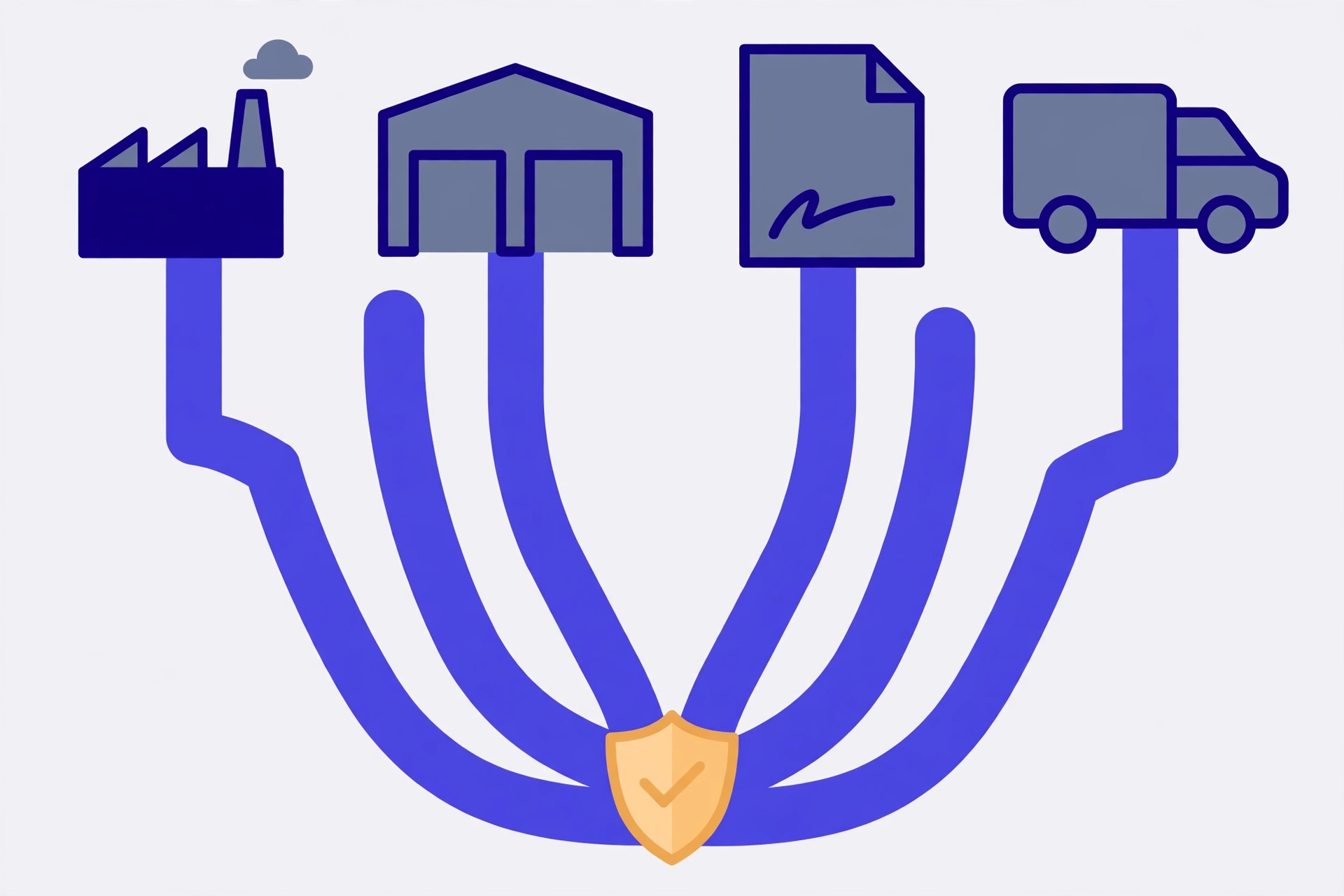
The job is not ceremonial. Article 4(3) of Regulation (EU) 2019/1020 lists tasks such as keeping documentation available to authorities and cooperating on corrective action. Article 16(2) of the GPSR then adds its own layer: the operator “shall regularly check” “that the product complies with the technical documentation referred to in Article 9(2)” of the GPSR and with the identification and information requirements in Article 9(5), (6) and (7), and “shall, upon request by the market surveillance authorities, provide documented evidence of the checks performed”. A name that cannot do any of that will not hold up when an authority asks.
The four routes, in the order the law lists them
Article 4(2) of Regulation (EU) 2019/1020 defines who the operator can be. Route one is “a manufacturer established in the Union” — make the product inside the EU and you are your own responsible person. Route two is “an importer, where the manufacturer is not established in the Union”: the EU business that brings the product in carries the role as part of its own importer duties. Route three is “an authorised representative who has a written mandate from the manufacturer designating the authorised representative to perform the tasks set out in paragraph 3 on the manufacturer's behalf” — a service you appoint by contract, and the written mandate is part of the definition, not an optional extra. Route four is “a fulfilment service provider established in the Union with respect to the products it handles, where no other economic operator as mentioned in points (a), (b) and (c) is established in the Union”. Read the tail of that sentence twice: the fulfilment route is residual — it covers the dispatch operator only for products it actually handles, and only when no manufacturer, importer or authorised representative in the Union already fills the role.
Whichever route you land on, Article 16(3) of the GPSR fixes where the name shows up: “The name, registered trade name or registered trade mark, and contact details, including the postal and electronic address, of the economic operator referred to in paragraph 1 shall be indicated on the product or on its packaging, the parcel or an accompanying document.” One of those four places, every unit, with no carve-out for small sellers.
Run the checker and pin down your route, step by step
Before you start, gather three facts: what the product is and who it is for, how it reaches EU buyers (your own webshop, a marketplace, an importer, a fulfilment warehouse), and the name and address of any EU business already in that chain. The responsible-person question is the fourth of five; the first three decide whether it applies to you at all.
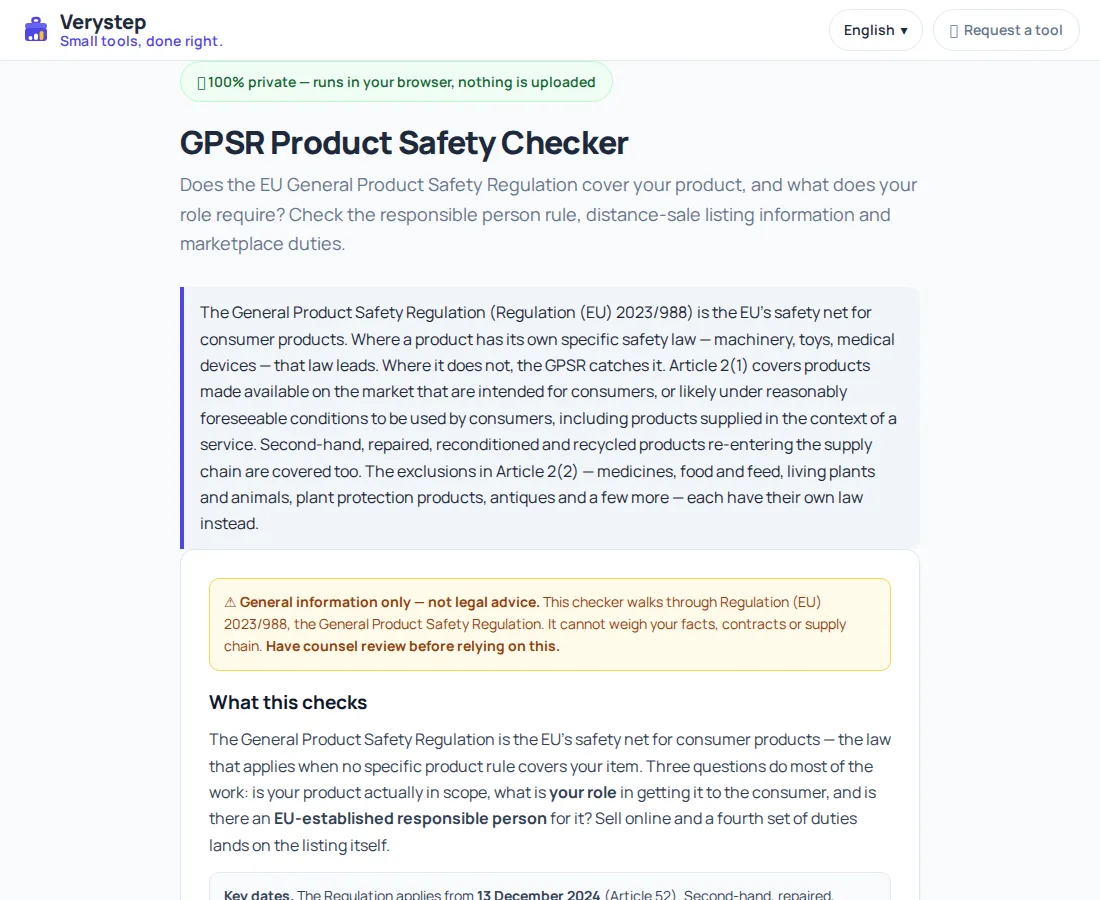
- Answer the first question — whether yours is a consumer product made available in the EU, under Article 2(1): products intended for consumers, or likely under reasonably foreseeable conditions to be used by them. A professional-only product, or an excluded category such as medicines or food, ends the GPSR part of the check here.
- Answer the second question — your role: manufacturer inside or outside the EU, importer, distributor, fulfilment service provider, marketplace, or several at once. The role you pick shapes the duty list in your result; a manufacturer who also sells at a distance wears both hats.
- Answer the third question — whether you sell to EU consumers at a distance, online, by phone or by catalogue. A Yes switches on the Article 19 offer duties tested in the last question; a No leaves them aside, while the safety duties, Article 16 included, still apply.
- Answer the fourth question — whether an EU-established operator is responsible for this product, working through the four routes in order: EU manufacturer, importer, authorised representative with a written mandate, or your EU fulfilment provider for the products it handles. A No is the blocking finding of the check: under Article 16(1) the product shall not be placed on the market until one route is real.
- Answer the fifth question — whether every distance-sale offer shows all four Article 19 items: the manufacturer’s name and postal and electronic address; the responsible person’s name and addresses where the manufacturer is outside the Union; information identifying the product, including a picture and its type; and any warning or safety information in a language the consumer can easily understand. Answer per listing, not per shop.
- Read the result as a work list: it separates what is satisfied from what is missing, by role. Keep it with your product file — the route you picked and the mandate or contract behind it are the paper trail if a marketplace or an authority asks.
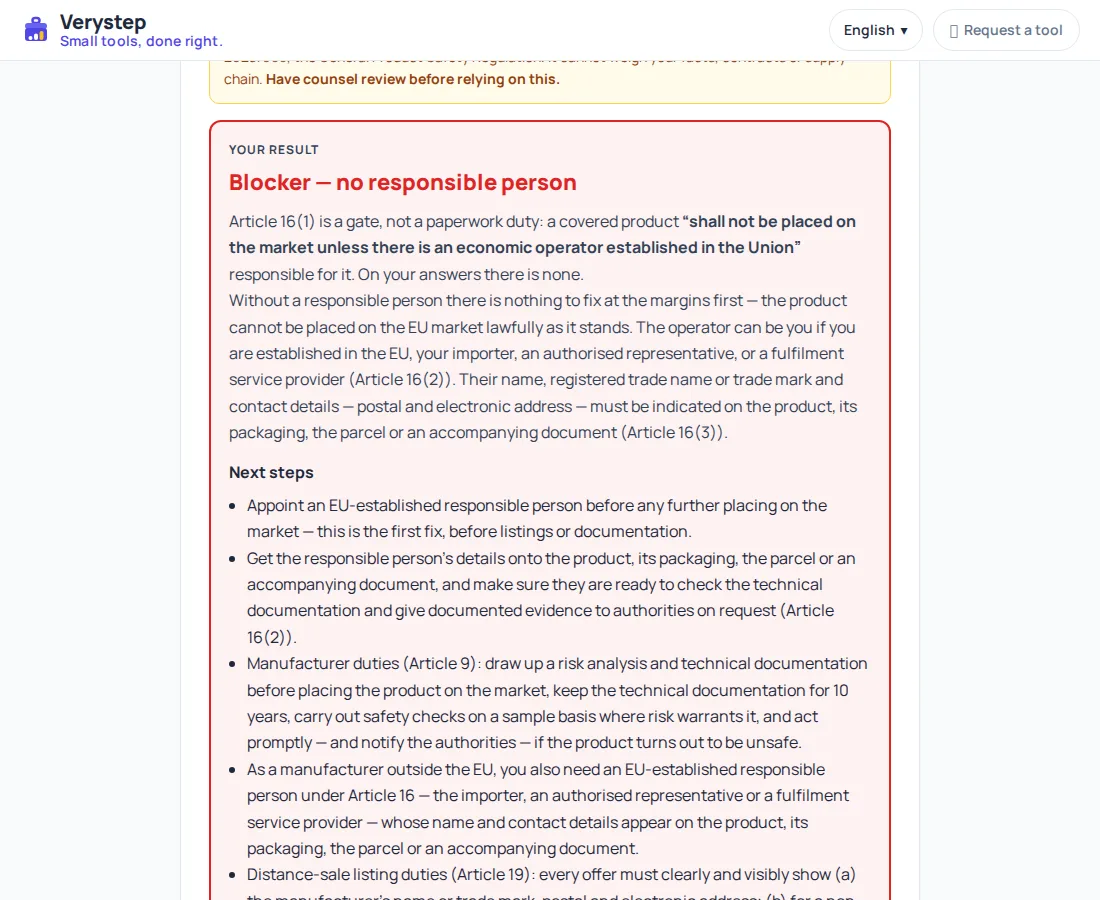
Nothing leaves your device: the checker runs in your browser, and a result link exists only if you click to create one.
Worked example: a non-EU seller, one webshop, one marketplace
Take a persona seller, not a real company. A maker in Shenzhen produces a silicone kitchen spatula set — a plain consumer product, no sector-specific EU law of its own — and sells it two ways: from its own webshop, parcels posted directly from China, and through a large marketplace, with stock at that marketplace’s fulfilment centre in Poland.
Run the routes in order. Route (a): the manufacturer is not established in the Union. Route (b): there is no importer — nobody in the EU buys the sets to place them on the market; the seller sells in its own name, straight to consumers. Route (c) is where the webshop sales land: the seller appoints an authorised representative established in the Union, with a written mandate covering the Article 4(3) tasks. For the marketplace stock, route (d) is also in play, because the fulfilment provider is established in the Union and handles those units — but only “where no other economic operator as mentioned in points (a), (b) and (c) is established in the Union”. Once the authorised representative exists, that condition fails, so one name — the representative — covers both channels, and the seller uploads that name to the marketplace. This is also why the marketplace asks: the offer itself must carry the name, as the next paragraph shows.
What appears where. On the product side, Article 16(3): the representative’s name, postal and electronic address go on the packaging or the parcel. In every online offer, Article 19: point (a), the manufacturer’s name and postal and electronic address; point (b), “where the manufacturer is not established in the Union, the name, postal and electronic address of the responsible person”; point (c), a picture, the product type and its identifier; point (d), the warning and safety information, in the language of the Member State where the product is offered. The webshop page and the marketplace listing carry the same four items — the duty follows the offer, not the channel.
Limits and boundaries: what this name is not
First, do not merge this role with the sector-specific names that sound like it. Cosmetics law requires its own “responsible person” for each cosmetic product, and medical-device law works with its own authorised representative; those are separate legal creatures under separate regulations. An Article 16 operator does not fill those roles, and holding one of those roles does not by itself make a business your GPSR responsible person. Where a product has its own harmonisation law, that law leads and the GPSR steps back.
Second, the appointment has to be real. Route (c) exists only with a written mandate, and the operator — whichever route — must actually perform the Article 4(3) tasks and the Article 16(2) checks. Renting a mailbox address from a service that never sees your documentation gives you the shape of compliance without the substance, and the first authority request for “documented evidence of the checks performed” is where that gap shows.
Third, scope discipline: this guide covers the responsible-person rule and the offer information tied to it. It does not settle whether your product is safe, what its technical documentation must contain, or how a recall would run. Penalties are set by each Member State, so there is no single EU fine figure to quote.
Sources: Regulation (EU) 2023/988 (General Product Safety Regulation), Articles 2, 9, 16, 19 and 52, official text on EUR-Lex; Regulation (EU) 2019/1020 on market surveillance, Article 4(1)–(4), official text on EUR-Lex; European Commission, Product Safety pages (ec.europa.eu). General information only — not legal advice.
The Verystep GPSR Product Safety Checker asks five questions — whether your product is in scope, what your role is, whether you sell at a distance, whether an EU-established responsible operator is in place under Article 16, and whether each offer shows the four Article 19 items — and lays out what your answers require. It runs entirely in your browser; your answers are never uploaded or stored, and a result link is created only when you click for one. General information only — not legal advice.
Last verified November 28, 2026 — Regulation (EU) 2023/988 quoted verbatim from the official text on EUR-Lex: Article 16(1) (“A product covered by this Regulation shall not be placed on the market unless there is an economic operator established in the Union who is responsible for the tasks set out in Article 4(3) of Regulation (EU) 2019/1020 in respect to that product”), Article 16(2) (the operator “shall regularly check” compliance with the Article 9(2) technical documentation and the Article 9(5), (6) and (7) requirements, and “shall, upon request by the market surveillance authorities, provide documented evidence of the checks performed”), Article 16(3) (name and contact details “indicated on the product or on its packaging, the parcel or an accompanying document”) and Article 19, points (a) to (d) (distance-sale offer information; point (b): “where the manufacturer is not established in the Union, the name, postal and electronic address of the responsible person”). Note: Article 19 is a single unnumbered paragraph with points (a)–(d); there is no Article 19(2). The four routes are quoted from Regulation (EU) 2019/1020, Article 4(2), points (a) to (d), official text on EUR-Lex — the GPSR itself names no list; Article 16(1) applies Article 4(2) and (3) of that Regulation to GPSR products. Application date 13 December 2024 per Article 52, as stated on the live checker page. The live GPSR Product Safety Checker checked at /gpsr-checker/: five questions in the order product scope (Article 2(1)), role, distance sales, responsible person (Article 16, with the Article 16(3) placement of name and contact details), and listing information (the four Article 19 items); the “General information only — not legal advice” notice; in-browser processing with a result link created only on click. Sources: Regulation (EU) 2023/988 — EUR-Lex, https://eur-lex.europa.eu/eli/reg/2023/988/oj ; Regulation (EU) 2019/1020 — EUR-Lex, https://eur-lex.europa.eu/eli/reg/2019/1020/oj ; European Commission — Product Safety, ec.europa.eu. General information only — not legal advice.
Frequently asked questions
I sell from outside the EU through a marketplace. Why does it demand a responsible person before listing?
Because the duty sits in the Regulation, not in platform policy. Article 16(1) of the GPSR bars placing a covered product on the market without an EU-established responsible operator, and Article 19(b) requires the offer itself to show that person’s name and addresses when the manufacturer is outside the Union. The marketplace collects the details at upload because its listings are where the information has to appear.
My EU fulfilment warehouse handles my stock. Is that my route?
It can be, with two conditions from Article 4(2)(d) of Regulation (EU) 2019/1020: the provider must be established in the Union and the route covers only “the products it handles”, and it applies only “where no other economic operator as mentioned in points (a), (b) and (c) is established in the Union”. If you already have an importer or an authorised representative, the fulfilment route closes and that operator is the name to use.
Can I just print a friend’s EU address, or a virtual office, as the responsible person?
No. The role carries tasks, not just an address: the operator performs the Article 4(3) tasks of Regulation (EU) 2019/1020 and the regular checks in Article 16(2) of the GPSR, and must produce documented evidence of those checks on request. Route (c) exists only with a written mandate from the manufacturer. An address with nobody performing the tasks behind it does not satisfy Article 16(1).
Does the responsible person replace my own duties as the seller?
No. Article 16(2) opens with “Without prejudice to any obligations of economic operators under this Regulation” — the appointment adds an EU-established operator; it does not subtract yours. If you are the manufacturer, your manufacturer duties stand in full, and the same is true for importers and distributors under their own articles.
What exactly must my online listing show?
The four Article 19 items: (a) the manufacturer’s name or trade mark, postal and electronic address; (b) where the manufacturer is not established in the Union, the responsible person’s name, postal and electronic address; (c) information identifying the product, including a picture, its type and any other product identifier; and (d) any warning or safety information, in a language consumers can easily understand as the Member State of sale determines.
More guides

The PPWR Empty Space Ratio: Why the 50% Cap Hits Your Shipping Box First
Ask a room of online sellers what the PPWR will change first and most will say labels. The duty with a number in it is quieter: from 2030 at the earliest, no more than half the volume of your shipping box may be empty — and the filler you stuff into it counts as empty.

Counting a Return Window: The EU 14-Day Cooling-Off Period Starts the Day After Delivery
A shop page says “14 days to return”. Fourteen days from when — the order, the dispatch, the delivery? And counted how — in calendar days or working days? EU law answers both questions, and the answers are not the ones most countdown banners use.

How to Check Gift Return Eligibility Without a Receipt
Black Friday is over, the gifts are changing hands, and some of them are the wrong size, the wrong color or the second one you own. There is no receipt — there never is with a gift — so the question is not “can I get my money back?” but “which route does this store actually offer someone in my position, and how long do I have?”