Counting a Return Window: The EU 14-Day Cooling-Off Period Starts the Day After Delivery
A shop page says “14 days to return”. Fourteen days from when — the order, the dispatch, the delivery? And counted how — in calendar days or working days? EU law answers both questions, and the answers are not the ones most countdown banners use.

For distance and off-premises sales in the EU, the cooling-off period is set by Directive 2011/83/EU. Article 9(1) gives the consumer “a period of 14 days to withdraw from a distance or off-premises contract, without giving any reason”. For goods, Article 9(2)(b) anchors that period to “the day on which the consumer or a third party other than the carrier and indicated by the consumer acquires physical possession of the goods”. Under the EU rules for computing periods, the day of the event itself is not counted, so the count opens on the day after delivery: delivery day is day zero, the next day is day 1, and day 14 is the last day to tell the seller you are withdrawing. The count runs in calendar days — Saturdays, Sundays and holidays inside the window count like any other day — and only the final day gets protection: if day 14 falls on a weekend or a public holiday, the deadline extends to the next working day. Two consequences follow. A seller page that counts in working days, or that counts delivery day as day 1, produces a different deadline from the statutory one, and where the two conflict the statutory count is the floor the seller cannot go below. And a seller’s own longer window — 30 days, say — is a separate, voluntary promise that stacks on top of the statutory 14; it never replaces or shortens them.
The mechanism: day zero, fourteen calendar days, one protected last day
Three separate rules combine to produce your deadline, and mixing any two of them up is how people lose a day — or a week. The first rule is the anchor. Article 9(2) of Directive 2011/83/EU states that, “Without prejudice to Article 10, the withdrawal period referred to in paragraph 1 of this Article shall expire after 14 days from”, and for sales contracts point (b) completes the sentence: “the day on which the consumer or a third party other than the carrier and indicated by the consumer acquires physical possession of the goods”. Not the order date, not the dispatch date, not the day the tracking page first moved. Possession — the day the parcel is physically in your hands, or in the hands of someone you named to receive it. If one order arrives in several deliveries, point (b)(i) moves the anchor to the last good: the period runs from the day you take possession of the final item, not the first.
The second rule is the counting convention. EU periods expressed in days are computed under Regulation (EEC, Euratom) No 1182/71, whose basic rule is that the day on which the event occurs is not counted. Applied here, delivery day is day zero. The day after delivery is day 1, and the period expires at the end of day 14. This is why the Commission’s Your Europe consumer pages describe the window as 14 days starting from the day after you receive the goods. It is also why counting delivery day itself as day 1 — a very common shop-banner habit — silently steals a day: it pulls the deadline one day earlier than the statute allows.
The third rule concerns the unit and the last day. The 14 days are calendar days. A window that opens on a Saturday runs straight through both weekends inside it; nothing pauses for a Sunday. The only adjustment comes at the very end: under the same EU computation rules, reflected in the Your Europe guidance, if the last day of the period is a Saturday, a Sunday or a public holiday, the period extends until the end of the next working day. Weekends shorten nothing in the middle of the count and add their protection only at the edge.

Now place a seller’s own policy next to the statute. Many shops voluntarily offer 30 days, or 60, or a window that runs “from delivery”. That promise stacks on top of the statutory floor: during the first 14 days you hold the EU right of withdrawal, with its own consequences — no reason needed, and the seller bound by the Directive’s refund rules. After day 14, whatever time remains is governed by the seller’s own terms alone: they may ask for a reason, offer store credit instead of a refund, or set conditions the statute would not allow. A longer banner is genuinely more time, but it is not more of the same right. And the stacking only runs one way — a voluntary window can add to the statutory 14 days, never subtract from them. A page that states “10 working days” is stating roughly two calendar weeks minus the weekends, which can land before day 14; to the extent that page is read as the limit of your rights, it understates the floor, and the statutory count prevails.
One more provision belongs in the mechanism, because it changes the count entirely when it applies. Article 10(1) covers the case where the seller never told you about the right of withdrawal in the first place: “the withdrawal period shall expire 12 months from the end of the initial withdrawal period, as determined in accordance with Article 9(2)”. If the seller supplies the missing information later, Article 10(2) resets the clock instead: the period “shall expire 14 days after the day upon which the consumer receives that information”. A missing notice does not start your 14 days quietly ticking — it extends them by up to a year.
Count your own window with the calculator, step by step
Before you start, you need two facts: the delivery date — the day you, or someone you named, physically took possession of the goods, from the tracking record or the courier’s delivery confirmation — and the deadline wording on the seller’s page, noted exactly as written (“14 days”, “14 working days”, “30 days from delivery”). The calculator takes a start date and an end date and returns the gap between them; order does not matter, so you cannot get a negative answer by swapping them.
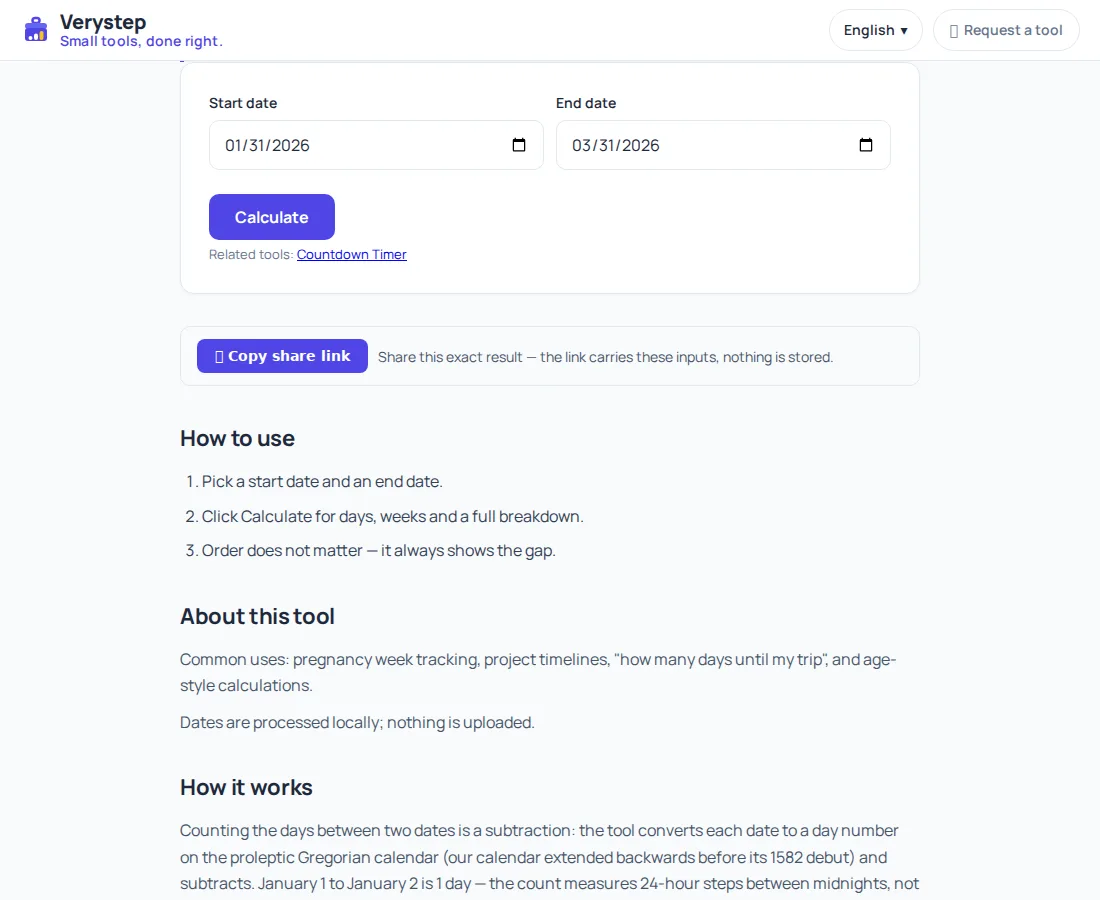
- Type the delivery date in the Start date field — for the worked example below, Friday 4 December 2026. Expect a plain date picker; nothing is calculated yet, and nothing you type leaves the browser.
- Type your candidate deadline in the End date field. If you are testing the statutory window, use the date you believe is day 14 — Friday 18 December 2026 in the example. Expect both fields to sit side by side with the Calculate button ready.
- Click Calculate and read the total in days first. From 4 December to 18 December 2026 it shows 14 days. Expect the count to be exclusive — the full days between the two dates — which is precisely the statutory arithmetic: the delivery day itself is not inside the count, so a result of exactly 14 means the end date is day 14, the last day of the window.
- Read the weeks line next: 14 days shows as exactly 2 weeks. That is a useful cross-check against any banner that says “two weeks” — the two phrasings are the same length, and both are calendar counts.
- Now test the seller’s version. If the page counts delivery day as day 1, its deadline lands one day earlier, on 17 December; enter 4 December and 17 December and the calculator shows 13 days — one short of the statutory 14, which is the discrepancy made visible. If the page says “14 working days”, count the working days by hand alongside: between 5 and 18 December 2026 there are only 10 working days, so a working-day count and a calendar count cannot describe the same window.
- Finally, check the last day’s weekday. If your day 14 falls on a Saturday, a Sunday or a public holiday where you live, the deadline extends to the next working day — rerun the calculator with that later date to confirm the extended gap (the extension example below shows 16 days from delivery to the extended deadline, of which 14 are the statutory count and 2 are the weekend the rule steps over).

Worked example: a Friday delivery, counted day by day
A parcel is delivered on Friday 4 December 2026 — you signed for it that afternoon, so 4 December is the day of physical possession and, by the counting rule, day zero. The period opens the next day: Saturday 5 December is day 1. The count then runs in calendar days, straight through the weekend — Sunday 6 December is day 2, Monday 7 December day 3, and so on: day 7 is Friday 11 December, day 8 Saturday 12 December, and day 14 is Friday 18 December 2026. The calculator confirms the span directly: start 2026-12-04, end 2026-12-18, result 14 days, shown as exactly 2 weeks. Because day 14 is an ordinary Friday, no end-of-period extension applies — 18 December 2026 is the last day to send the seller your withdrawal statement. Note what “send” means here: under Article 11(2), you have exercised the right in time if the communication is sent before the period expires; the goods themselves travel under a separate 14-day clock that starts when you communicate the decision.
Change one fact and watch the extension rule work. Suppose the same parcel had been delivered a day later, on Saturday 5 December 2026. Day zero moves with it: day 1 is Sunday 6 December, and day 14 lands on Saturday 19 December. A deadline cannot expire on a Saturday, so the period extends over Sunday 20 December to the next working day, Monday 21 December 2026. The calculator shows the delivery-to-deadline span as 16 days (5 December to 21 December) — the statutory 14, plus the two weekend days the extension stepped over. Same goods, same right, two extra calendar days of usable window, purely from where the weekends fell.
Now stack the seller’s own promise on top. Say this shop voluntarily offers 30 days from delivery. Counted the same way — day zero on 4 December, day 1 on 5 December — its day 30 is Sunday 3 January 2027, and the calculator confirms 30 days from 4 December to 3 January. That window does not move the statutory deadline: your EU right of withdrawal still ends on 18 December, and from 19 December to 3 January you are relying on the shop’s terms alone. Two windows, two sets of rules, one calendar — the count is how you tell which one you are standing in on any given day.
Limits and boundaries: what the count does not decide
The calculator counts days between two dates on the real calendar, leap years included. It does not know which day you took possession, whether your order arrived in one delivery or three, or what your seller promised — those are facts you supply. It also cannot apply the public-holiday half of the extension rule for you, because holidays differ by country and region; check your local calendar for the specific date. And it measures the withdrawal window only: the separate 14-day period for sending the goods back after you withdraw, the refund timetable, and any diminished-value questions are different clocks with different start days, set by Articles 13 and 14.
Scope limits matter as much as arithmetic. The 14-day right in Article 9 covers distance and off-premises contracts between a trader and a consumer, and Article 16 lists exceptions — personalised goods, sealed goods unsealed after delivery for health or hygiene reasons, rapidly perishable goods, and others — for which no withdrawal right exists at all, however carefully you count. Purchases in a physical shop carry no EU cooling-off right; any window there is purely the seller’s own policy. Member States transpose the Directive into national law, and details such as holiday calendars sit at national level. This guide explains how the statutory count works, using the Directive’s own text. It is general information, not legal advice; for a disputed deadline, the national transposition and the facts of your delivery decide.
Sources: Directive 2011/83/EU of 25 October 2011 on consumer rights, Article 9(1), Article 9(2)(b) including point (b)(i) on multiple goods delivered separately, Article 10(1) and 10(2), and Article 11(2), official English text on EUR-Lex (CELEX 32011L0083), quoted verbatim above; Regulation (EEC, Euratom) No 1182/71 on rules for periods, dates and time limits (day of the event not counted; extension when the last day is a Saturday, Sunday or public holiday); Your Europe, the European Commission’s consumer portal, guidance on the 14-day cooling-off period for online and distance purchases. Last verified 2026-11-29.
The Verystep Date Duration Calculator takes a start date and an end date and shows the gap in days, in weeks, and as a full calendar breakdown. Order does not matter, leap years are handled by real calendar dates, and the count is exclusive — the number of full days between the two dates, which is exactly the arithmetic a 14-day window needs: delivery date in, candidate deadline in, and 14 means you are on the last statutory day. It runs entirely in your browser; the dates you type are never uploaded or stored.
Last verified November 29, 2026 — Directive 2011/83/EU Articles 9, 10 and 11(2) read in the official English text on EUR-Lex (CELEX 32011L0083) and quoted verbatim; period-computation rules per Regulation (EEC, Euratom) No 1182/71 and the European Commission’s Your Europe consumer guidance. All arithmetic recomputed with python datetime: delivery Friday 4 December 2026, day 1 = Saturday 5 December, day 14 = Friday 18 December 2026 (calculator span 2026-12-04 to 2026-12-18 = 14 days = exactly 2 weeks); working days between 5 and 18 December 2026 = 10; delivery-day-as-day-1 counting would end Thursday 17 December 2026 (span 13 days); extension example: delivery Saturday 5 December 2026, day 14 = Saturday 19 December, extended to Monday 21 December 2026 (span 16 days); voluntary 30-day window from the same delivery ends Sunday 3 January 2027 (span 30 days). The live Date Duration Calculator checked at https://verystep.com/dates/ : two date fields (Start date, End date), a Calculate button, results in days, weeks and a full breakdown, order-independent, exclusive counting by default (inclusive = result + 1) — the exclusive count matches the statutory convention that the day of possession is not counted. General information only — not legal advice.
Frequently asked questions
Does the 14-day cooling-off period start on the day of delivery?
No. Delivery day is day zero — the day you take physical possession anchors the period under Article 9(2)(b), but the EU counting rules do not count the day of the event itself. Day 1 is the day after delivery, and day 14 is the last day to notify the seller.
Are weekends and holidays inside the window counted?
Yes. The 14 days are calendar days, so Saturdays, Sundays and holidays inside the window count like any other day. The only adjustment is at the end: if day 14 itself falls on a weekend or a public holiday, the deadline extends to the next working day.
A shop page says “14 working days”. Which count wins?
The statutory one. The Directive’s floor is 14 calendar days counted from the day after possession, and a seller cannot shorten it by restating it in working days — 14 working days and 14 calendar days are different windows, and between a Friday delivery and day 14 there may be only 10 working days. Read the working-day wording as the seller’s own returns logistics if you like, but your withdrawal right follows the calendar count.
The seller never mentioned any right to cancel. Does my window still end after 14 days?
No. Under Article 10(1), if the trader did not provide the required information on the right of withdrawal, the period expires 12 months after the end of the initial 14-day period. If the information arrives later, Article 10(2) gives you 14 days from the day you receive it.
My order arrived in two deliveries a week apart. When does the clock start?
From the last one. Article 9(2)(b)(i) anchors the period to the day you take physical possession of the last good in the order, so a split delivery moves day zero — and the whole window — to the second parcel’s delivery date.
More guides

The PPWR Empty Space Ratio: Why the 50% Cap Hits Your Shipping Box First
Ask a room of online sellers what the PPWR will change first and most will say labels. The duty with a number in it is quieter: from 2030 at the earliest, no more than half the volume of your shipping box may be empty — and the filler you stuff into it counts as empty.

How to Check Gift Return Eligibility Without a Receipt
Black Friday is over, the gifts are changing hands, and some of them are the wrong size, the wrong color or the second one you own. There is no receipt — there never is with a gift — so the question is not “can I get my money back?” but “which route does this store actually offer someone in my position, and how long do I have?”

GPSR: The EU Responsible Person — Four Routes to a Name the EU Can Reach
A marketplace asks you to upload a “responsible person” before it will list your product. That field is not platform paperwork — it is Article 16 of the GPSR, and there are exactly four ways to fill it.