BMI, BMR and TDEE: Three Numbers, Three Different Jobs
One is a ratio, one is an idling cost, one is a daily total. Compare them as if they were the same kind of number and every one of them will mislead you.
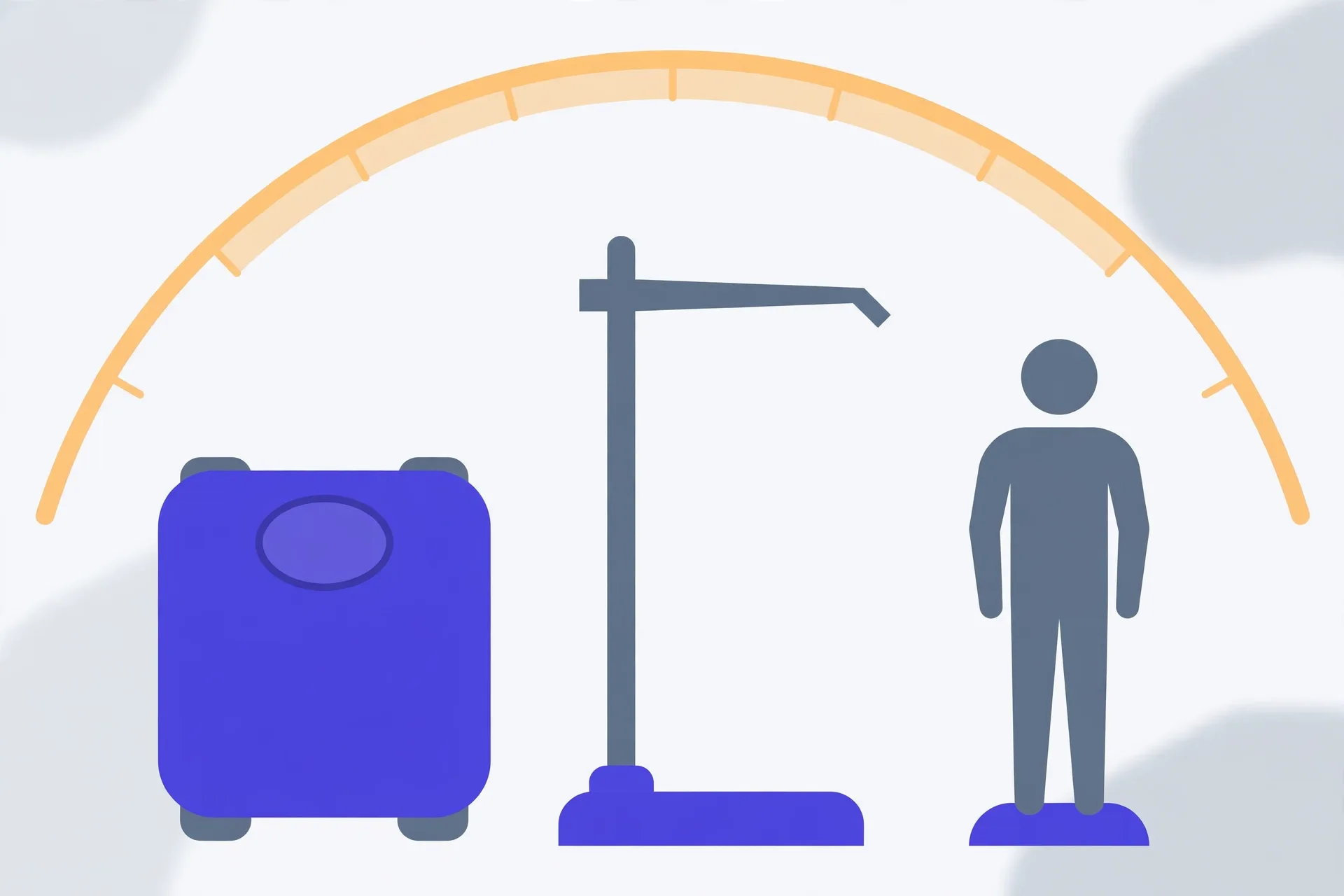
BMI, BMR and TDEE answer three different questions. BMI is weight divided by height squared (65 kg at 170 cm gives 22.5), read against adult bands from below 18.5 to 30 and above — a screening ratio that cannot tell muscle from fat. BMR estimates the energy your body burns at complete rest, usually with the Mifflin-St Jeor equation (about 1,402 kcal a day for that same person, aged 30). TDEE is BMR scaled by an activity factor from 1.2 to 1.9, totalling the day you actually live. Estimates, all three — useful in order, none of them a diagnosis. This guide is not medical advice.
Three numbers, three different questions
People talk about BMI, BMR and TDEE as if they were three scores for the same thing. They aren't. Each answers a different question, and mixing them up produces most of the confusion.
BMI asks: how does this person's weight compare with their height? It's a size ratio. BMR asks: how much energy does this body burn just staying alive, lying still, doing nothing? TDEE asks the follow-up: once that person gets up and lives a normal day, how much energy do they actually use in total?
Size, baseline, total. Keep those jobs separate and each number is easy to read. Blur them and you'll compare a ratio with a calorie count, which never ends well.
BMI: weight, scaled by height
Body Mass Index is one short formula: weight in kilograms divided by height in metres, squared. BMI = kg / m². The imperial version — 703 × lb / in² — is the same relationship with a conversion constant folded in.
Worked example, from the calculator below: 170 cm tall, 65 kg. Convert the height to metres (1.70), square it (1.70 × 1.70 = 2.89), then divide: 65 / 2.89 = 22.5. That's the BMI.
| BMI (adults) | Category |
|---|---|
| Below 18.5 | Underweight |
| 18.5 – 24.9 | Healthy weight |
| 25.0 – 29.9 | Overweight |
| 30.0 and above | Obesity |
Why square the height? Because taller bodies carry more mass even at the same build, and dividing by height squared roughly corrects for that. It's an approximation, and was always meant as one: a cheap screening number needing two measurements anyone can take. No blood test, no scan, no appointment.
What BMI can't see
Here's the catch, and it isn't a small one. BMI doesn't measure fat. It can't tell muscle from fat, doesn't know where weight sits on the body, and says nothing about fitness or blood pressure. A strength athlete can land in the "overweight" band while being very fit. Same formula, very different bodies.
The standard adult bands also aren't used for children and teenagers, whose BMI is read against age- and sex-specific percentiles — growing bodies change proportions constantly. Pregnancy breaks the premise too: the weight measured isn't all the person's own tissue.
So read BMI the way it's meant to be read: a starting point and a screening flag, not a verdict on anyone's health. This guide explains the arithmetic only. It isn't medical advice, and no number here substitutes for a healthcare professional who knows your situation.
BMR: the cost of staying alive
Now switch from size to energy. Your basal metabolic rate is the energy your body spends at complete rest — heart beating, lungs working, temperature steady, cells repairing themselves. No steps, no workouts, no digesting a big lunch. Just the idling cost of being alive.
Nobody measures a true BMR at home; that takes laboratory conditions. Calculators instead estimate it from an equation fitted to measured data — most widely used today, the Mifflin–St Jeor equation:
For men: BMR = (10 × weight in kg) + (6.25 × height in cm) − (5 × age in years) + 5.
For women: BMR = (10 × weight in kg) + (6.25 × height in cm) − (5 × age in years) − 161.
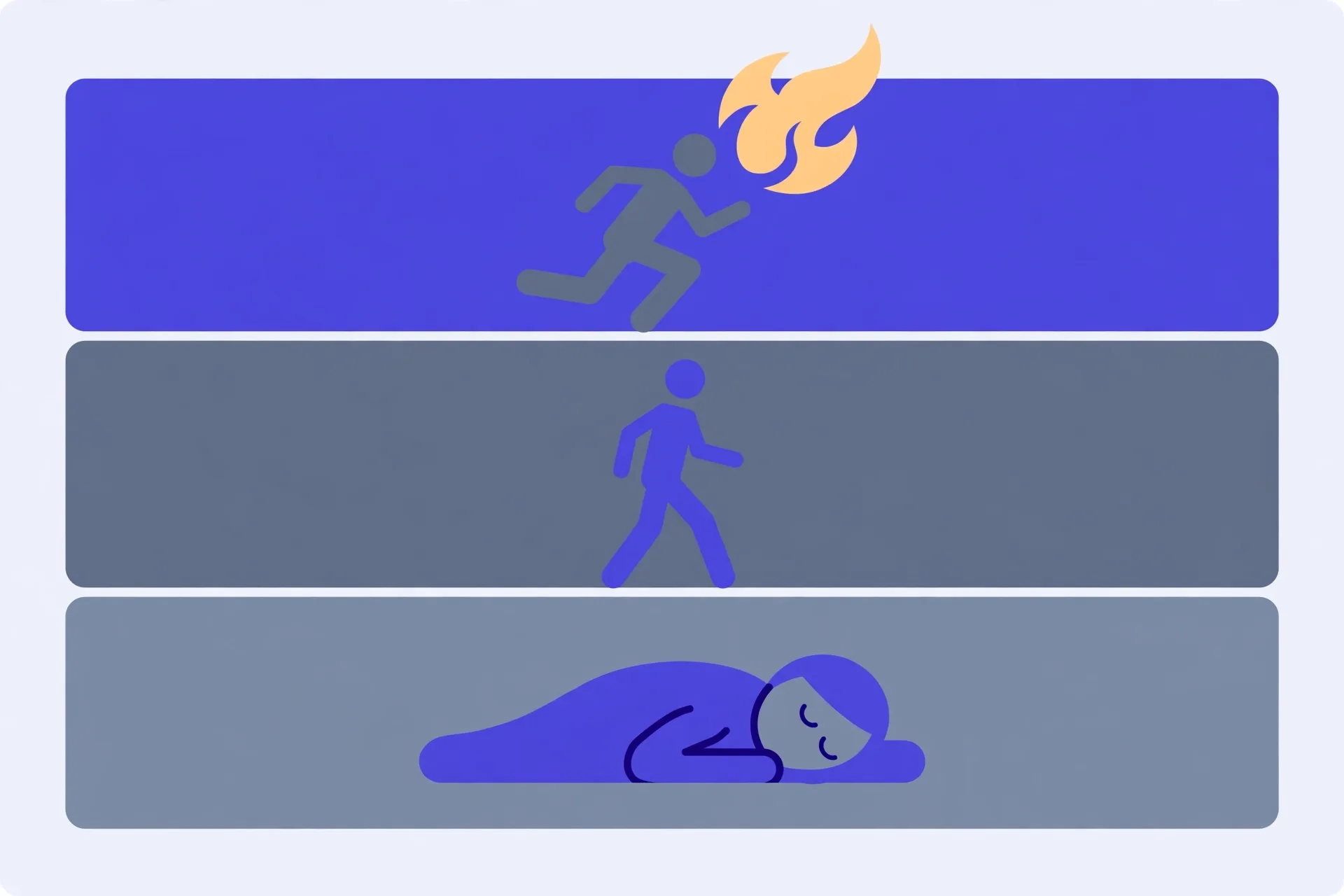
Same person as before — 65 kg, 170 cm — and say she's 30. Her estimated BMR is (10 × 65) + (6.25 × 170) − (5 × 30) − 161 = 650 + 1,062.5 − 150 − 161 ≈ 1,402 kcal a day. A man of the same size and age gets +5 instead of −161, so about 1,568. Weight and height push the result up; age pulls it down slowly. The equation knows nothing about your muscle mass, which is why it's an estimate — a useful anchor, not a meter reading.
TDEE: BMR plus the day you actually live
Total daily energy expenditure is exactly what the name says: everything. Start with BMR, then add moving around, exercise, fidgeting, carrying shopping — plus a smaller slice for digesting food itself, which also burns energy. For most people the resting layer is still the biggest piece; activity is what varies wildly between us.
Because nobody logs every fidget, calculators estimate TDEE the blunt way: multiply BMR by an activity factor.
| Typical day | Activity factor |
|---|---|
| Sedentary — desk job, little exercise | 1.2 |
| Lightly active — light exercise 1–3 days a week | 1.375 |
| Moderately active — exercise 3–5 days a week | 1.55 |
| Very active — hard exercise 6–7 days a week | 1.725 |
| Extra active — physical job or training twice a day | 1.9 |
Our example again: a BMR of about 1,402 × 1.55 for a moderately active routine gives a TDEE of roughly 2,173 kcal a day. Pick the sedentary row instead and the same body "needs" only about 1,682. That gap — nearly 500 kcal from one judgement call — is why two calculators hand you different TDEEs from identical measurements. They aren't disagreeing about you. They're disagreeing about the row you picked. Be honest about a normal week, not your best week.
Putting the three to work, in order
- Work out your BMI first, and treat it as a screening signal only. It describes size relative to height — nothing more specific than that.
- Estimate your BMR with the Mifflin–St Jeor equation. Write it down as "about", not "exactly": it's a population average wearing your measurements.
- Multiply by the activity factor matching your ordinary week for a TDEE estimate. Weekdays and weekends wildly different? A weekly average is more honest than either extreme.
- Compare like with like over time. Same formula, same activity row, same method — that shows a trend. Swapping calculators mid-stream manufactures jumps that never happened.
- If a number worries you, take it to a healthcare professional rather than another calculator. These tools do arithmetic. They don't know you.
Three numbers, three jobs. BMI sizes you, BMR baselines you, TDEE totals your day. None of them is a diagnosis — and used in that order, with their limits in plain view, each one is genuinely useful.
The Verystep BMI Calculator takes your height and weight — metric or imperial — and returns your BMI against the standard adult categories, with the healthy range shown. It runs in your browser; your height and weight are never uploaded or stored. Treat the result as the screening signal this guide describes, not as a diagnosis.
Last verified October 30, 2026 — BMI formula, worked example and adult categories are those used by the calculator below; the Mifflin-St Jeor equation and activity factors are the standard published forms described in the guide. Not medical advice.
Frequently asked questions
What's the difference between BMI, BMR and TDEE?
BMI is a size ratio — weight relative to height squared, with no energy involved. BMR is an energy estimate: the kilocalories your body burns at complete rest just staying alive. TDEE is BMR scaled up for activity, an estimate of your total energy use across a real day.
What is a healthy BMI?
On the standard adult scale, 18.5 to 24.9 is the healthy-weight band, with below 18.5 classed as underweight, 25.0-29.9 as overweight and 30.0 and above as obesity. The bands are a screening guide for adults — they don't apply directly to children, and they don't account for muscle mass or body composition.
How accurate is the Mifflin-St Jeor equation?
It's the most widely used BMR estimator because it tracks measured values well for most adults, but it remains an equation fitted to population data. It knows your weight, height, age and sex — nothing about your muscle mass or individual variation — so treat its output as a solid estimate, not a measurement.
Why do two TDEE calculators give me different numbers?
Usually because of the activity factor. TDEE is BMR multiplied by a factor from 1.2 (sedentary) to 1.9 (extra active), and that choice is a judgement call about your typical week. Same body, same BMR, different row — a gap of several hundred kilocalories is easy to produce.
My BMI says overweight but I lift weights. Should I worry?
BMI can't distinguish muscle from fat, so muscular people routinely land in the overweight band while being fit — the calculator below says the same thing on its own page. A BMI outside the healthy band is a prompt to look closer, ideally with a healthcare professional, not a conclusion by itself.
More guides

Time Zone Math: Why Your Meeting Keeps Landing at 3 A.M.
Nobody on your team is bad at arithmetic. The offset they memorised quietly expired — that's the whole story behind the 3 a.m. meeting.
JSON Without Tears: Structure, and the Five Errors Everyone Makes
One missing comma can break a whole API call — and the error message will blame the wrong line. Here's the tree underneath the text, and the five mistakes that account for nearly every broken file.

IBAN Explained: How to Read, Check and Trust an IBAN
It's the longest number on the invoice, and two of its digits exist purely to catch your typos. Here's how to read the rest.