Printing for France? The Triman + Info-Tri Checkpoints Before Your Packaging Goes to Press
Two marks, one legal pair. The Triman tells a French shopper that sorting rules apply; the Info-Tri next to it tells them what to do with each element. Miss either one at print stage and the fix is a reprint.

Since 1 January 2022, products placed on the French market for households and covered by extended producer responsibility (EPR) must carry a sorting sign. Article 17 of the AGEC law (loi n° 2020-105 du 10 février 2020) created Article L541-9-3 of the Code de l’environnement; Decree No. 2021-835 spells the system out. The first paragraph sets the sign: « Tout produit mis sur le marché à destination des ménages soumis au I de l’article L. 541-10, à l’exclusion des emballages ménagers de boissons en verre, fait l’objet d’une signalétique informant le consommateur que ce produit fait l’objet de règles de tri. » The second paragraph adds the sorting information: « Cette signalétique est accompagnée d’une information précisant les modalités de tri ou d’apport du déchet issu du produit. Si plusieurs éléments du produit ou des déchets issus du produit font l’objet de modalités de tri différentes, ces modalités sont détaillées élément par élément. » In practice: the Triman plus an Info-Tri panel, detailed element by element, printed on the pack — with narrow, size-based exceptions that let one or both marks move online instead.
One pair, two jobs: the Triman signals, the Info-Tri instructs
France did not invent a single “recycling logo”. It built a pair, and each half does a different job. The Triman — the small human figure with three arrows — is the signalétique, the sign. Its whole message is: this product is covered by sorting rules. It says nothing about which bin or whether anything is recyclable. The sorting content sits next to it in the Info-Tri, a standardised panel that names each element of the product or packaging and states its sorting or drop-off instruction — this tray to the yellow bin, that film to the bin as well, this part to a collection point. The statute divides the work the same way: paragraph one creates the sign, paragraph two the information, “détaillées élément par élément” — detailed element by element — whenever elements sort differently.
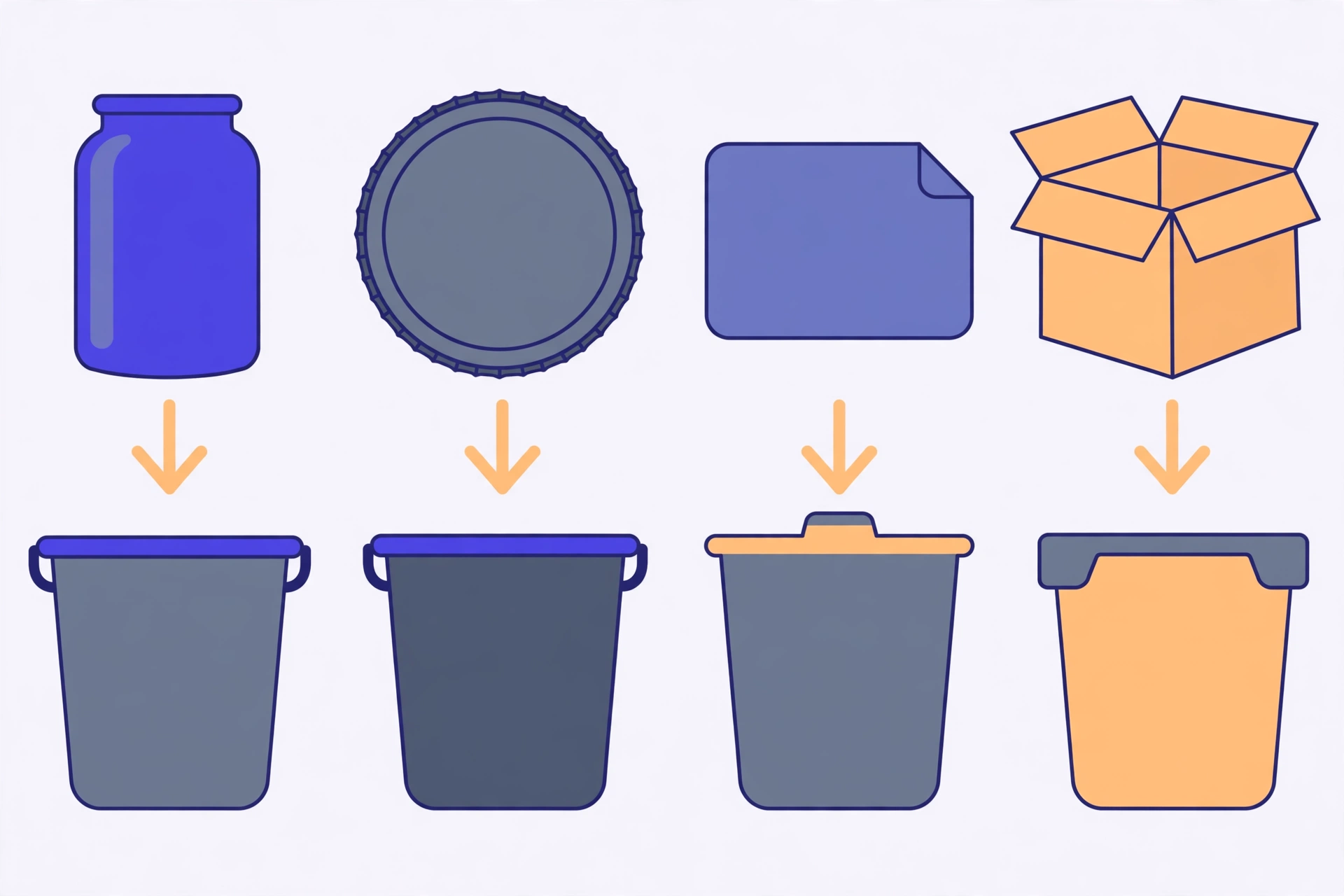
That element-by-element rule is what print files get wrong. A pack is rarely one material: a jar has a lid, a label, sometimes a seal; an online order adds a mailer. If those elements sort differently, each needs its own line — one generic panel does not comply.
Scope: household products under EPR, one glass exemption, and the duty follows the market
The duty has three gates, and all three must open. First, the product is placed on the market “à destination des ménages” — aimed at households. Second, it is “soumis au I de l’article L. 541-10”: it sits under one of the French EPR schemes listed there — household packaging is the everyday case, but the same logic reaches other EPR families. Third, the single carve-out written into the paragraph itself: “à l’exclusion des emballages ménagers de boissons en verre”. A glass drinks bottle sits outside L541-9-3; a glass jar of jam does not — jam is food, not a drink, and the exemption covers drinks packaging, not glass as a material.
Who carries the duty? Whoever places the product on the French market — including the foreign distance seller whose parcels land with French households. Selling from abroad does not move the obligation to the customer, the carrier or the marketplace; the check belongs before the print run, while the artwork can still change.
Run the checker before you brief the printer, step by step
Have four facts ready: where the product is sold and to whom, which EPR scheme covers it, what the packaging is made of, and a ruler measurement of the largest face of the smallest pack — plus whether anything printed accompanies it. The checker asks its four questions in this order.
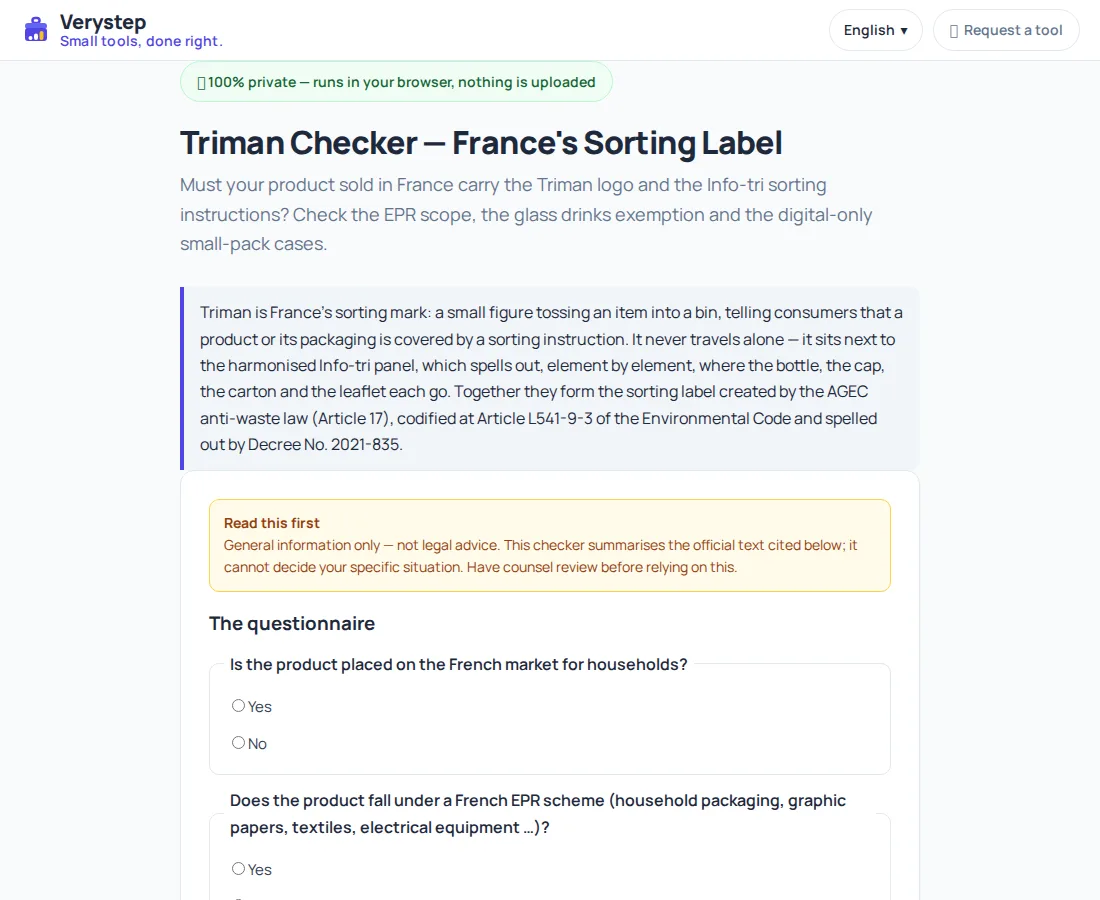
- Answer the first question: is the product placed on the French market for households? A No ends the check — L541-9-3 speaks only to products “à destination des ménages”.
- Answer the second question: is the product under a French EPR scheme — the I of Article L. 541-10, as household packaging usually is? A No also ends the check; a Yes puts the pair in play.
- Answer the third question: is the product solely glass drinks packaging? A Yes is the one exemption in the paragraph. Judge by contents, not material: a glass jar of jam is not drinks packaging, so it answers No.
- Answer the fourth question, in two halves: is the largest face under 10 cm² — under 20 cm² if cylindrical or spherical — and is the product sold with no accompanying document? Both must hold for full dematerialisation under Article R.541-12-21.
- Read the outcome tier. Under the thresholds, with no accompanying document, both marks may be dematerialised — online instead of printed. Between 10 and 20 cm² (20 to 40 cm² cylindrical or spherical), the Triman stays printed and only the Info-Tri may go digital. Above that, or with a document in the box, both print. A digital mark must be reachable at the moment of purchase; a link that resolves only after delivery does not count.
- Take the tier back to your artwork: request the current official files from your eco-organisme (Citeo, Adelphe or Léko), place them element by element, and keep the result with the print file.
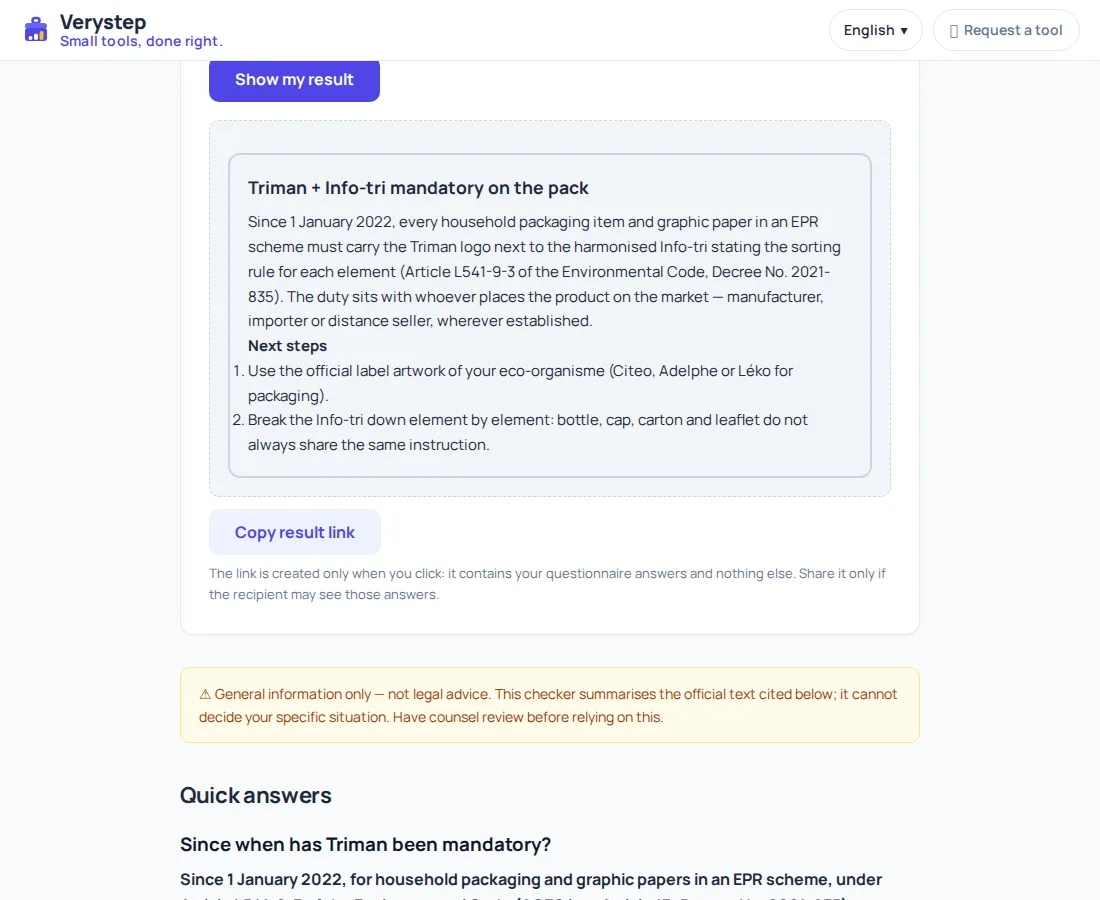
Nothing leaves your device: the tool runs in your browser, with a result link only if you click to create one.
Worked example: bottled jam, sold online to French households
Take a persona seller, not a real company. A small producer outside France sells jam in glass jars through its own webshop to French households, each order in a cardboard mailer. Placed on the French market for households? Yes. Under a French EPR scheme? Yes — household packaging. Solely glass drinks packaging? No, and this is the trap: the jar is glass, but jam is not a drink, so the exemption for “emballages ménagers de boissons en verre” does not apply.
Now the element-by-element pass. The glass jar: one element, with its instruction. The metal lid: a separate element. The paper label: an element of its own where its instruction differs. The cardboard mailer appears too — shipping packaging is part of the product as delivered. Four elements, four lines: one “recycle this pack” panel would fail paragraph two even with a perfect Triman beside it.
The small-pack variant shows why the fourth question carries a ruler. A mini jar added as a gift item measures 8 cm² on its largest face and ships with no accompanying document: both halves of the threshold test hold, so both its marks may be dematerialised — online, reachable at the moment of purchase. A trial pack at 15 cm² lands in the middle band: Triman printed, only Info-Tri online. Three print decisions, each from a measurement, not a preference.
Limits, the Green Dot confusion, and where the artwork really comes from
First limit: this guide applies L541-9-3 and the R.541-12-21 thresholds as written; sector-specific layouts and disputed scheme questions go to your eco-organisme or to counsel, not to a four-question tool.
Second, the mark behind the most expensive confusion is not French at all. The Green Dot — Der Grüne Punkt, the round green-and-white yin-yang of arrows — is a financing mark: it shows the producer contributed to a producer-responsibility scheme that funds packaging collection. Shoppers widely misread it as “recyclable” or “sort here”, and sellers printed it as if it were a sorting instruction. It is neither: it is not the Triman, and printing it for France does not discharge the L541-9-3 duty by one millimetre. A Green Dot with no Triman + Info-Tri is a contribution receipt where the law asked for a sign and an instruction.
Third, do not draw the sign yourself. The official artwork comes from your scheme’s eco-organisme: Citeo, Adelphe or Léko for household packaging. A designer’s close copy risks wrong proportions, colours and layout.
Sources: Code de l’environnement, Article L541-9-3 (created by Article 17 of loi n° 2020-105 du 10 février 2020, the AGEC law; in force since 1 January 2022) and Article R.541-12-21, on legifrance.gouv.fr; Décret n° 2021-835; Citeo, Info-Tri guidance; Ministère de la Transition écologique, ecologie.gouv.fr. General information only — not legal advice.
The Verystep Triman Checker asks four questions — whether your product is placed on the French market for households, whether it sits under a French EPR scheme, whether it is solely glass drinks packaging, and whether its largest face falls under the small-pack thresholds with no accompanying document — and shows whether both marks stay printed, only Info-Tri may go digital, or both may be dematerialised. It runs entirely in your browser; your answers are never uploaded or stored, and a result link is created only when you click for one. General information only — not legal advice.
Last verified November 27, 2026 — Article L541-9-3 of the Code de l’environnement, paragraphs 1 and 2, quoted character-for-character from the official text on legifrance.gouv.fr (« Tout produit mis sur le marché à destination des ménages soumis au I de l’article L. 541-10, à l’exclusion des emballages ménagers de boissons en verre, fait l’objet d’une signalétique informant le consommateur que ce produit fait l’objet de règles de tri. » ; « Cette signalétique est accompagnée d’une information précisant les modalités de tri ou d’apport du déchet issu du produit. Si plusieurs éléments du produit ou des déchets issus du produit font l’objet de modalités de tri différentes, ces modalités sont détaillées élément par élément. »); the Article R.541-12-21 dematerialisation thresholds (largest face under 10 cm², or under 20 cm² for cylindrical or spherical packs, with no accompanying document → both marks may go digital; 10 to 20 cm², or 20 to 40 cm² cylindrical or spherical → Triman stays printed, only Info-Tri may go digital; the digital label online and reachable at the moment of purchase) checked against the Ministry FAQ summary and the live checker’s own text; entry into force on 1 January 2022, Article 17 of the AGEC law (loi n° 2020-105 du 10 février 2020) as the creating provision and Decree No. 2021-835 checked on legifrance.gouv.fr; Info-Tri construction and element-by-element guidance checked against Citeo’s Info-Tri guidance and the Ministère de la Transition écologique pages on ecologie.gouv.fr. The live Triman Checker checked in both languages (EN /triman-checker/, FR /fr/triman-checker/): four questions in the order French-market household placing, French EPR scheme, solely glass drinks packaging, largest-face thresholds with no accompanying document; the “General information only — not legal advice” notice; in-browser processing with a result link created only on click. Sources: Code de l’environnement, Art. L541-9-3 and Art. R.541-12-21 — legifrance.gouv.fr ; loi n° 2020-105 du 10 février 2020 (AGEC), Article 17 — legifrance.gouv.fr ; Décret n° 2021-835 — legifrance.gouv.fr ; Citeo — guide Info-Tri, citeo.com ; Ministère de la Transition écologique — ecologie.gouv.fr . Not legal advice.
Frequently asked questions
Does the Green Dot on my packaging satisfy the French rule?
No. The Green Dot (Der Grüne Punkt) is a financing mark showing a contribution to a producer-responsibility scheme; it is widely misread as “recyclable” or “sort here”, but it carries no sorting instruction and is not a sorting sign. France requires its own pair under Article L541-9-3: the Triman sign plus the Info-Tri information. One does not replace the other.
My product is in a glass jar. Am I exempt?
Only glass drinks packaging is excluded — the statute carves out “les emballages ménagers de boissons en verre”. A glass jar of jam, a pot of mustard or a jar of sauce is food packaging, not drinks packaging, so the exemption does not apply and the Triman + Info-Tri pair is required like for any other household packaging.
My pack is very small. Can both marks go online instead of being printed?
Sometimes. Under Article R.541-12-21, if the largest face is under 10 cm² — under 20 cm² for a cylindrical or spherical pack — and the product is sold with no accompanying document, both the Triman and the Info-Tri may be dematerialised. Between 10 and 20 cm² (20 to 40 cm² cylindrical or spherical), the Triman stays printed and only the Info-Tri may go digital. Either way, the digital label must be online and reachable at the moment of purchase.
I sell from outside France through my own webshop. Is this really my duty?
Yes. The duty attaches to whoever places the product on the French market for households, and a foreign distance seller shipping to French households is that person. Selling from abroad, through a marketplace or via a fulfilment service does not transfer the sign duty to the customer or the platform.
Can my designer recreate the Triman in our brand style?
No. The Triman and the Info-Tri are validated official artwork supplied by your EPR scheme’s eco-organisme — Citeo, Adelphe or Léko for household packaging. Restyling, redrawing or resizing the sign outside the official construction risks a non-compliant pack; request the current files and place them as supplied.
More guides

The PPWR Empty Space Ratio: Why the 50% Cap Hits Your Shipping Box First
Ask a room of online sellers what the PPWR will change first and most will say labels. The duty with a number in it is quieter: from 2030 at the earliest, no more than half the volume of your shipping box may be empty — and the filler you stuff into it counts as empty.

Counting a Return Window: The EU 14-Day Cooling-Off Period Starts the Day After Delivery
A shop page says “14 days to return”. Fourteen days from when — the order, the dispatch, the delivery? And counted how — in calendar days or working days? EU law answers both questions, and the answers are not the ones most countdown banners use.

How to Check Gift Return Eligibility Without a Receipt
Black Friday is over, the gifts are changing hands, and some of them are the wrong size, the wrong color or the second one you own. There is no receipt — there never is with a gift — so the question is not “can I get my money back?” but “which route does this store actually offer someone in my position, and how long do I have?”