Shoe Size Conversion US / UK / EU / JP — and Why Brands Disagree
Your foot doesn’t change at the border. The label does — four systems counting the same foot four different ways.
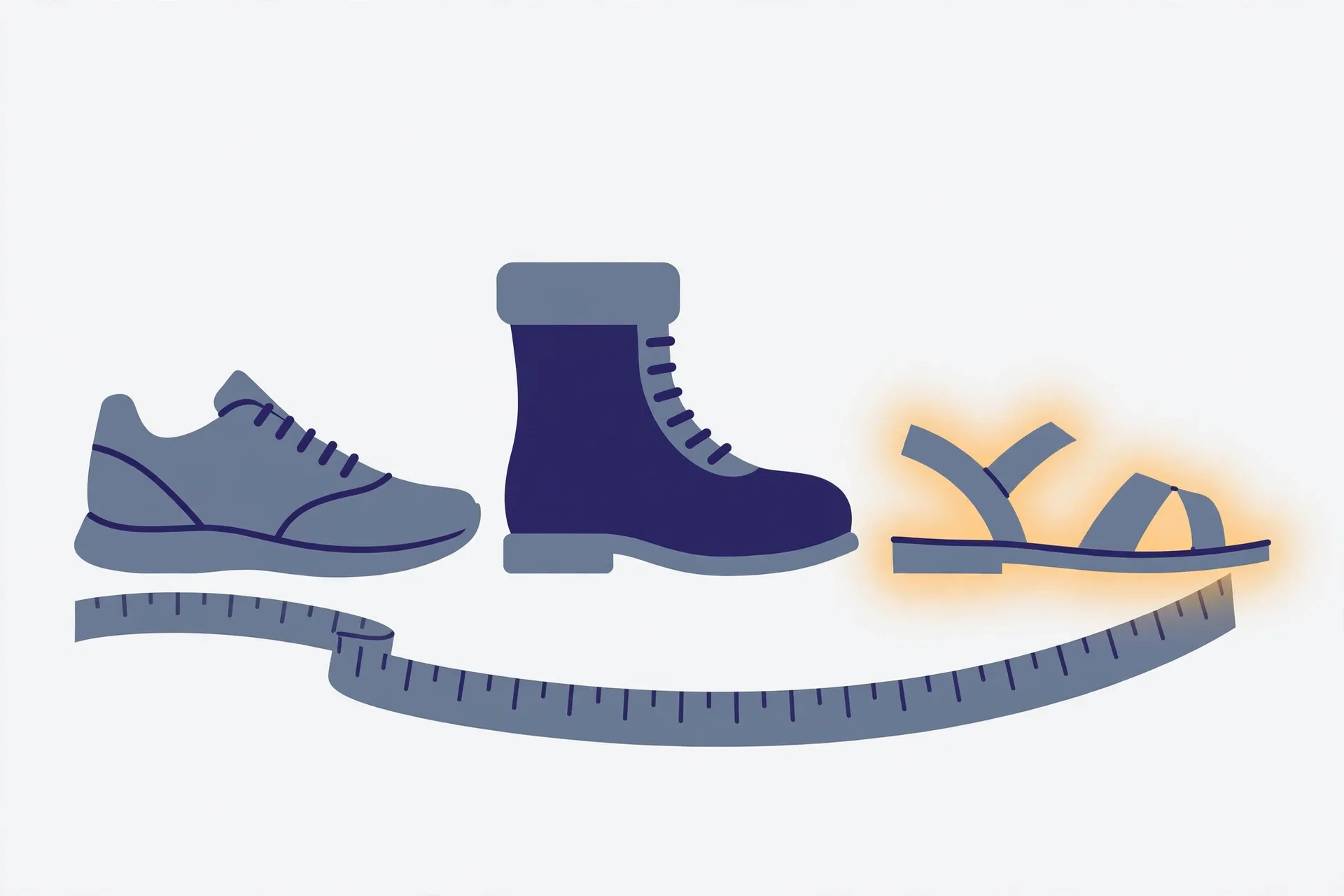
A 27 cm foot is a US men’s 9, a UK 8.5, an EU 42.5 and a Japanese 27. US men’s runs exactly half a size above UK men’s, while US women’s runs two above UK women’s — mixing those offsets up is the classic conversion error. EU sizes count Paris points: EU ≈ (foot length in cm + about 1 cm) × 1.5. JP and CN sizes simply state the foot length in centimetres. There is no enforced global standard, brands build on different lasts, and rounding does the rest — so convert through centimetres, measure in the evening, and let the brand’s own centimetre column have the last word.
One foot, four different numbers
Your foot does not change at the border. The label does. A foot that measures 27 cm heel to toe is, on the standard chart, a US men’s 9, a UK 8.5, an EU 42.5 and a Japanese 27. Four systems, four numbers, one foot — and none of the numbers is wrong. They are just counting different things, starting from different places, in steps of different sizes.
That is the whole secret of shoe conversion. There is no enforced global standard that every brand must follow, so each system grew up on its own: the US and UK count in barleycorn-sized steps from a zero point nobody agrees on, the EU counts in Paris points, and Japan simply writes down the length of your foot in centimetres. Once you see what each number is actually measuring, the charts stop looking arbitrary — and the disagreements between brands start to make sense too.
The chart, anchored on centimetres
Centimetres are the honest column, because they describe your foot rather than a label. Japanese and Chinese sizes use that column directly. Here is the men’s chart, integers only — half sizes sit halfway between the rows:
| US Men | UK | EU | Foot (cm) / JP |
|---|---|---|---|
| 6 | 5.5 | 38.5 | 24 |
| 7 | 6.5 | 39.5 | 25 |
| 8 | 7.5 | 41 | 26 |
| 9 | 8.5 | 42.5 | 27 |
| 10 | 9.5 | 44 | 28 |
| 11 | 10.5 | 45 | 29 |
| 12 | 11.5 | 46 | 30 |
| 13 | 12.5 | 47.5 | 31 |
The women’s chart runs on its own scale, not a shifted copy of the men’s. A 25 cm foot is a US women’s 8, a UK 6 and an EU 39 — compare that with the men’s row for the same 25 cm (US 7, UK 6.5, EU 39.5) and you see why “just subtract one and a half” rules of thumb keep failing people. For the same foot, a US women’s size is about one number above the US men’s size, and the UK gap between the two scales is wider still: US women’s runs two above UK, where US men’s runs only half a size above UK men’s.
How each system counts
US and UK are cousins. Both step in thirds of an inch, and on the men’s scale the US number sits exactly half a size above the UK one — a US men’s 9 is a UK 8.5, a relationship this site’s converter treats as fixed because William settled it after checking the charts that disagreed. The women’s scales keep a different offset (US two above UK), which is the single most common source of conversion errors online: a chart that quietly uses the men’s offset for women’s shoes will be wrong by a size and a half.
The EU system counts Paris points, each worth two-thirds of a centimetre. The working formula is EU size ≈ (foot length in cm + about 1 cm of toe room) × 1.5. Try it on the anchor row: (27 + 1) × 1.5 = 42, against the chart’s 42.5. That half-size wobble is normal — the formula approximates, the chart is what brands print.
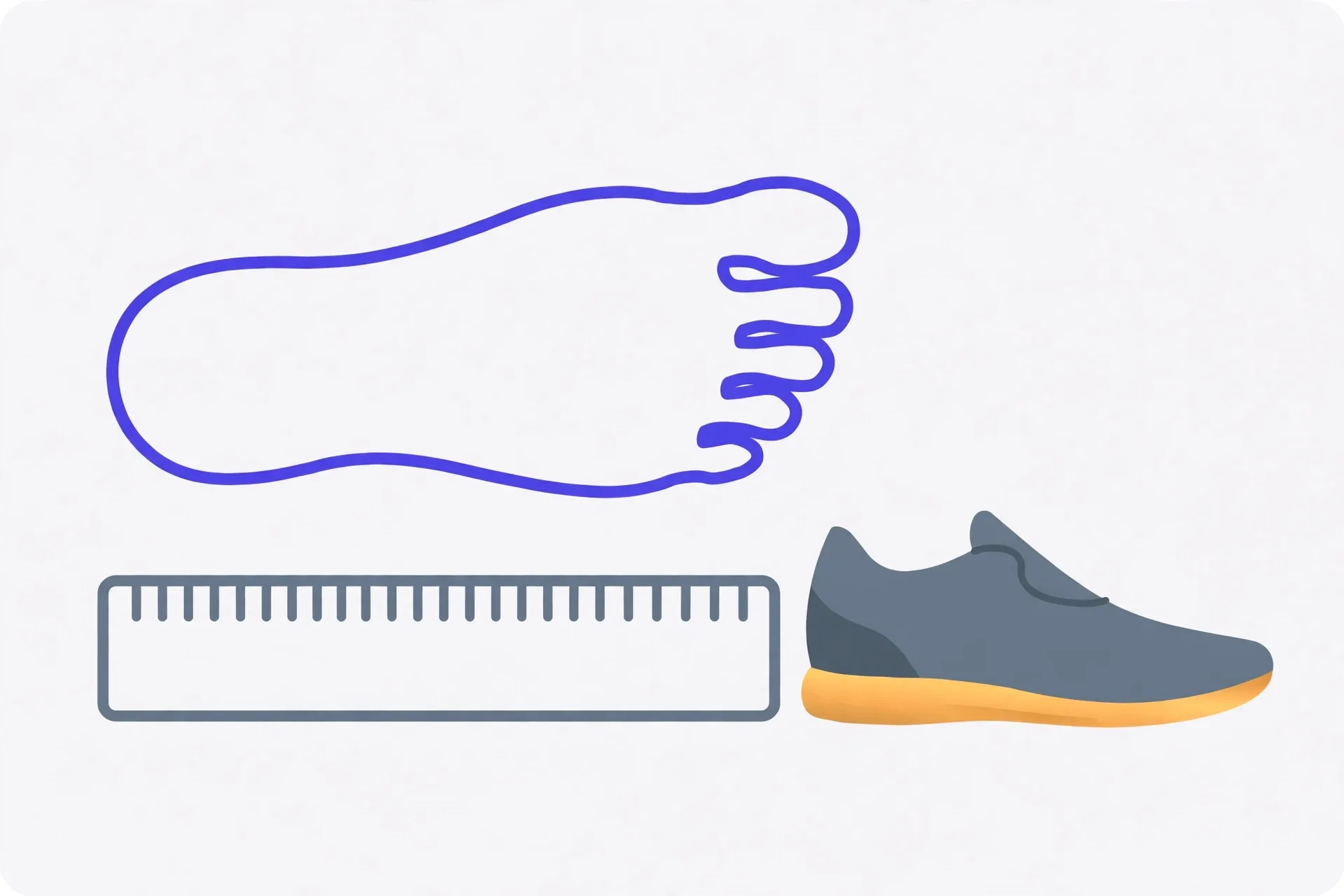
Japan and China skip the code entirely: the size is the foot length in centimetres. JP 27 means a 27 cm foot. If every system worked this way, this guide would be one paragraph long — and it is why the centimetre column is the safest thing to carry into any shop, in any country.
Kids’ sizes add one trap of their own: the US scale restarts. After US 13, sizes continue as youth 1, 2, 3 and up, so a US 1 on a kids’ chart is a big-kid size, not a toddler size. A bare “1” means nothing until you know which side of the restart it sits on.
Measure your foot properly
- Measure in the evening, standing, with your weight on the foot. Feet spread under load and swell during the day; a morning tracing under-reads.
- Put a sheet of paper against a wall, stand on it with your heel touching the wall, and mark the longest toe.
- Measure heel to mark in centimetres, then do the other foot. Most people have one foot slightly longer — size for that one.
- Read across the chart from the centimetre column, not from a size you half-remember from another brand.
- Between sizes, or buying boots and running shoes that fit close, go up. Toes need room that a conversion chart cannot see.
Why brands disagree anyway
If the charts are this tidy, why did your EU 42.5 from one brand fit and another brand’s pinch? Because a size label is a promise about a last — the foot-shaped form a shoe is built around — and every brand shapes its lasts differently. One maker’s 42.5 is long and narrow, another’s shorter and wider. Charts translate length; they say nothing about width, volume or toe shape.
Rounding does the rest. Real feet land between rows, brands that only stock whole sizes round in whichever direction suits their range, and intended fit differs by category: a racing shoe is meant to grip, a hiking boot to leave room for thick socks and swollen feet at mile ten. Two honest brands can label the same foot differently and both be right about how their shoe should feel.
So use the chart to get into the right row, then let the brand’s own size guide — most publish their centimetre column if you look — have the last word. If a shop cannot tell you what foot length in centimetres a size stands for, that is the same red flag as a ring listing with no millimetres: a number with nothing underneath it.
When you would rather not read across the rows by hand, the shoe size converter does the lookup for you: pick men, women or kids, enter the size you know, and read off the US, UK, EU and JP numbers side by side.
The Verystep Shoe Size Converter reads across the same charts used above — US, UK, EU and JP/CN for men, women and kids. Enter the size you know, or the centimetres you measured, and get every other system at once. It runs in your browser; nothing is stored.
Last verified October 26, 2026 — chart values and offsets are those used by the converter below (US men’s = UK + 0.5 as settled for this site; US women’s 8 → UK 6 / EU 39 at 25 cm; JP/CN = foot length in centimetres).
Frequently asked questions
What is a US men’s 9 in UK, EU and Japanese sizes?
UK 8.5, EU 42.5 and JP 27 — a 27 cm foot. It is the most useful anchor row in the men’s chart: US men’s sits half a size above UK, and the Japanese size is just the centimetres restated.
Why is my US women’s size so far from my UK size?
Because the women’s scales use a different offset from the men’s. US women’s runs two sizes above UK women’s (a US women’s 8 is a UK 6), while US men’s runs only half a size above UK men’s. Charts that apply the men’s offset to women’s shoes are wrong by a size and a half.
How do I work out my EU size from my foot length?
Add about a centimetre of toe room to your foot length in centimetres and multiply by 1.5 — the Paris-point formula. A 27 cm foot gives (27 + 1) × 1.5 = 42, close to the chart’s 42.5. Treat the formula as an estimate and read the exact row off a chart.
What does a Japanese shoe size mean?
The length of the foot the shoe is made for, in centimetres. JP 27 fits a 27 cm foot. Chinese sizes work the same way, which is why the converter labels the column JP / CN (cm).
Why does the same EU size fit in one brand and pinch in another?
A size label describes length on the brand’s own last — the form the shoe is built around. Lasts differ in width, volume and toe shape, brands round differently, and intended fit varies (racing shoes grip, hiking boots leave room). The chart converts length; only trying the shoe, or the brand’s own centimetre guide, settles fit.
More guides
BMI, BMR and TDEE: Three Numbers, Three Different Jobs
One is a ratio, one is an idling cost, one is a daily total. Compare them as if they were the same kind of number and every one of them will mislead you.

Time Zone Math: Why Your Meeting Keeps Landing at 3 A.M.
Nobody on your team is bad at arithmetic. The offset they memorised quietly expired — that's the whole story behind the 3 a.m. meeting.
JSON Without Tears: Structure, and the Five Errors Everyone Makes
One missing comma can break a whole API call — and the error message will blame the wrong line. Here's the tree underneath the text, and the five mistakes that account for nearly every broken file.