PPWR Timeline: In Force Since February 2025, Applicable From August 2026 — What the Gap Is For
“It is in force but it does not apply yet” sounds like a riddle. For the PPWR it is just the calendar — and the eighteen months in between are the most useful part of the whole Regulation.

Three dates run the PPWR. Regulation (EU) 2025/40 was published in the Official Journal on 22 January 2025, entered into force on 11 February 2025 — Article 71: it enters into force “on the twentieth day following that of its publication” — and applies from 12 August 2026: “It shall apply from 12 August 2026.” In force means the law exists and the machinery can be built; applicable means its duties bite on real packaging. The stretch between is not a holiday — Directive 94/62/EC and national law still govern it — it is the time left to work out who you are under the Regulation, register where you must, and get packaging ready. And check the date on each duty, not just the headline: Article 67(5), for instance, applies only from 12 February 2029.
Three dates, three different jobs
Start with the text itself. Article 71 of Regulation (EU) 2025/40, headed “Entry into force and application”, reads in full: “This Regulation shall enter into force on the twentieth day following that of its publication in the Official Journal of the European Union. It shall apply from 12 August 2026. However, Article 67(5) shall apply from 12 February 2029. This Regulation shall be binding in its entirety and directly applicable in all Member States.” Count twenty days from publication on 22 January 2025 and you land on 11 February 2025. Date three, 12 August 2026, sits some eighteen months later — a deliberate gap, written into the article itself.

The old law does not vanish early, either. Article 70(1) states: “Directive 94/62/EC is repealed with effect from 12 August 2026” — the same day the Regulation starts to apply, so there is no day with no packaging law at all. Even then, pieces linger on purpose: the Directive’s Article 9(1) and (2) keep applying, for the essential requirements named there, until 31 December 2029, and several reporting provisions run until 31 December 2028. The Regulation itself staggers duties well past 2026, too. The honest picture is not one deadline. It is a staircase.
Identity first: the Regulation asks who you are before it asks anything else
Here is the trap in reading the timeline alone. Knowing duties start on 12 August 2026 says nothing about which duties are yours, because the PPWR assigns obligations not to “businesses” in general but to roles, defined in Article 3(1) — and one company can hold several at once. A “manufacturer” (point (13)) manufactures packaging or a packaged product; crucially, someone who has packaging designed or manufactured under its own name or trademark counts as the manufacturer, even if a contract packer did the physical work. An “importer” (point (17)) is established in the Union and places packaging from a third country on the market. A “distributor” (point (18)) is anyone else in the chain, other than manufacturer or importer, that makes packaging available.
On top sits the role carrying the money duties: the “producer” (point (15)) — the manufacturer, importer or distributor who first makes packaging available on a Member State’s territory, sells directly to end users in another Member State, or unpacks packaged products without being an end user. Producer status is decided country by country, because “first time on the territory of that Member State” is a country-level test: sell the same jar into France and Poland and you may be producer in both, in one, or in neither. Hence the order of work — identity first, countries second, dates third.
Registration follows the same logic. Article 44(1) has each Member State run its own national register — there is no single EU register to join once. Article 44(2) obliges registration in each State where you first make packaging available, and Article 44(4) is blunt: producers “shall not make available” packaging where they, or their authorised representative where one applies, are not registered. Selling directly to end users in another Member State also triggers Article 45(3): an authorised representative for extended producer responsibility in that State. None of this gets sorted in the last week of July 2026 if representatives are still missing. That is what the window is for.
Run your own position through the checker, step by step
Before you start, have three facts at hand: where your business is established (a real seat with legal personality — a branch without its own does not count), what you actually do, and every Member State where your products reach a distributor or an end user. Ten questions follow; guess none of them, because “Not sure” is allowed and the result treats it honestly.
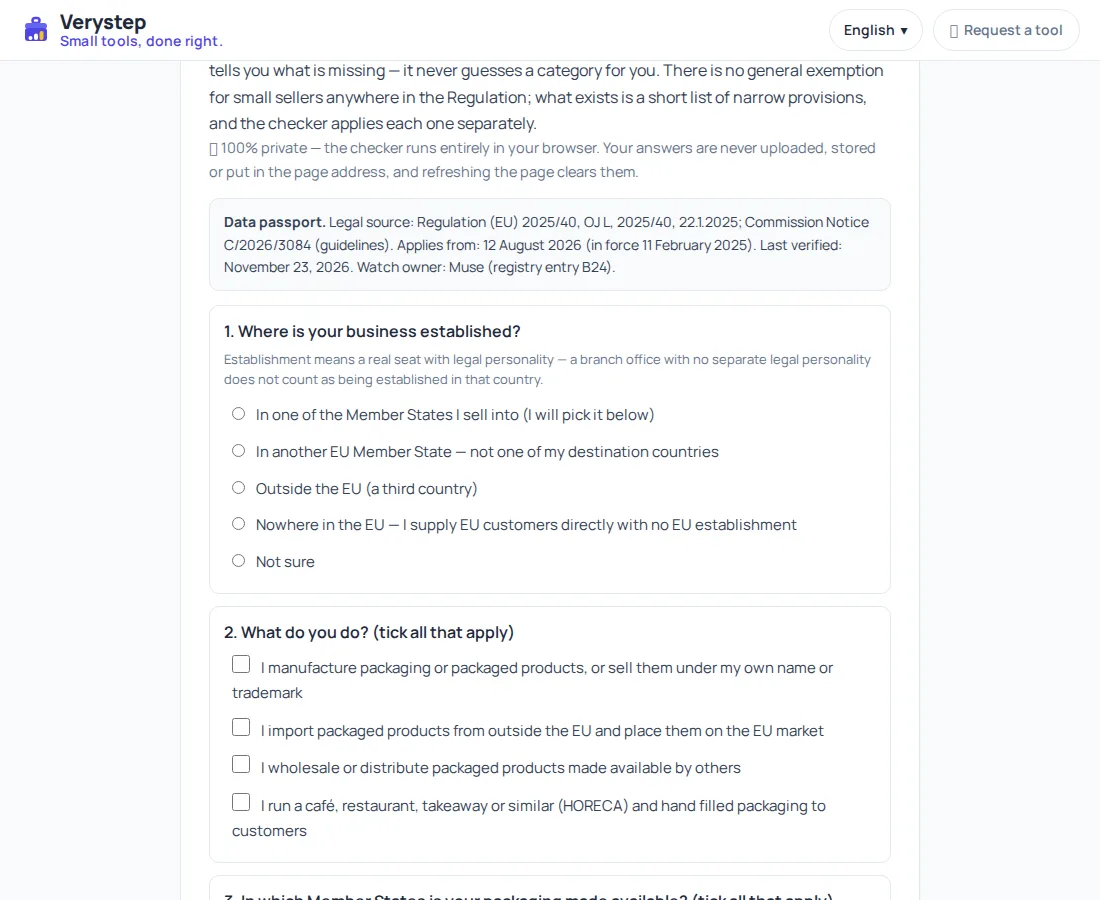
- Open the checker and answer Question 1, where your business is established, naming the country if you picked an EU establishment. Expect this answer to steer everything after it — establishment separates an importer from a direct cross-border seller.
- Answer Question 2, what you do, ticking every line that applies — manufacturing or own-brand selling, importing, distributing, handing filled packaging to customers. Ticking two lines is normal; the checker maps each to the Article 3 roles instead of forcing one box.
- Answer Question 3, the Member States where your packaging is made available. This is your registration map: producer duties are decided country by country, with no single EU registration to fall back on.
- Work through the remaining questions: what buyers do with the products, which packaging types are involved (sales, grouped, transport, e-commerce, food-contact, reusable), final-distributor food and drink sales, the micro-enterprise test, and where your packaging supplier sits. Each answer narrows which provisions can apply to you.
- Read the three-part result: duties that apply, dated duties still coming, per-country verification. Where an answer left a point open, the result names what is missing rather than guessing. Put its dates on your calendar — 12 August 2026 first.
- Verify each country from step 3 at its national register before relying on the result. The checker works at EU level only; it cannot confirm registration inside any one Member State, and it never quotes fees.
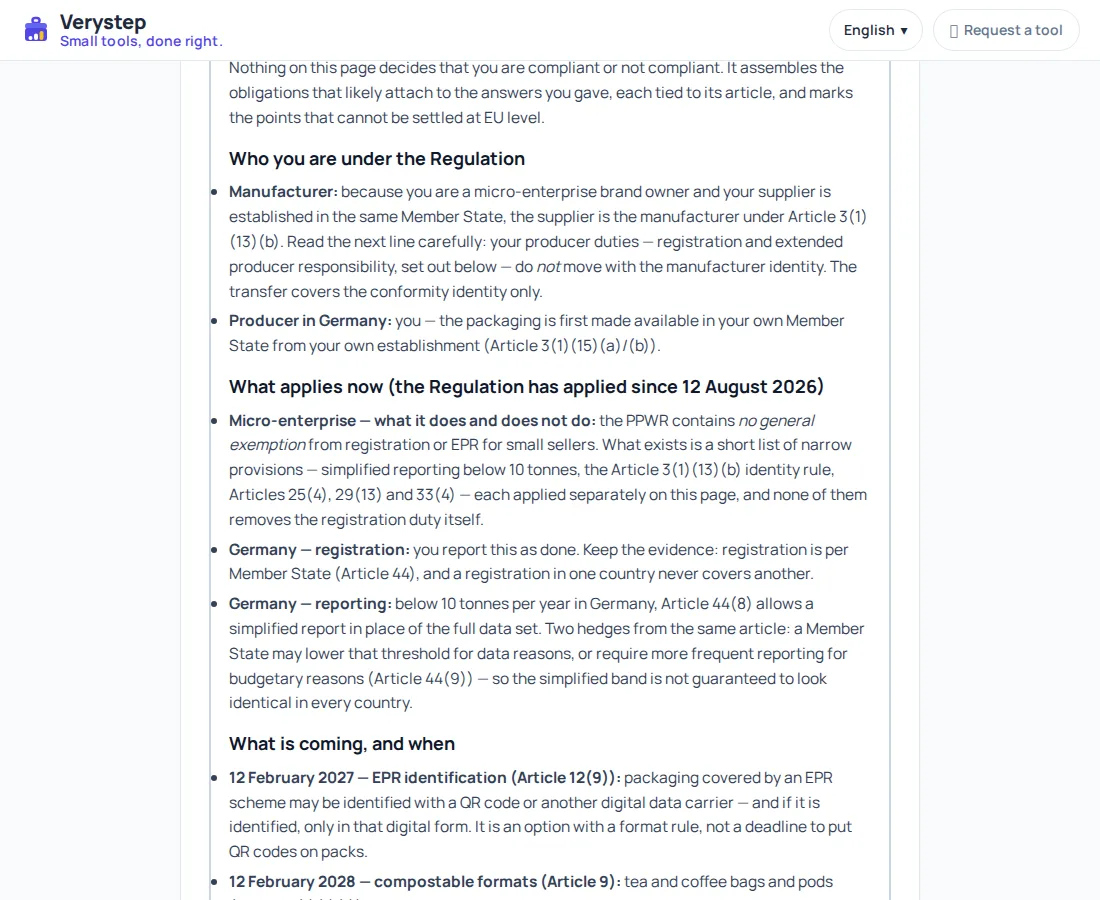
Nothing leaves your device while you do this: the checker runs in your browser, answers are not uploaded, stored or written into the page address, and refreshing the page clears them.
Worked example: a small own-brand seller, walked through in the right order
Meet a persona, not a real company. A two-person brand in the Netherlands sells jars of preserves under its own trademark; a Dutch contract packer fills them. It sells from its webshop to end users in the Netherlands, Germany and Belgium, each order in a cardboard mailer.
Identity first. The brand fills no jar itself, but the jars are made under its own name and trademark — so under Article 3(1), point (13)(a), it is the manufacturer, not a mere reseller. It imports nothing. Dutch sales make it producer at home under point (15)(b); German and Belgian orders, sold directly to end users in another Member State, are the point (15)(d) case. Same company, three country files.
Countries second. Each of the three runs its own register under Article 44 — three potential registrations, not one European one. For Germany and Belgium, direct sales to end users also trigger Article 45(3): an authorised representative in each, because the brand is not established there. The mailer counts too — e-commerce packaging is transport packaging.
Dates third. All of it is preparation-window work: representatives appointed and registrations filed before 12 August 2026, the day unregistered selling becomes a breach of Article 44(4). Later dated duties the checker lists go on the calendar now, not in 2029. Three steps, in that order — and a confusing regulation becomes a short list of appointments.
Limits and boundaries: what the dates do not tell you
First, “applies from 12 August 2026” is the general date, not a universal one. Individual provisions carry their own start dates. Anyone giving you a single deadline for “the PPWR” has not read Article 71 to its third sentence. Check the date on the duty in front of you.
Second, the window cuts both ways. Until 12 August 2026 the old framework — Directive 94/62/EC as transposed nationally, plus existing registration rules — still governs your packaging, and existing registrations do not automatically become PPWR registrations.
Third, this guide and the checker work at EU level. Neither decides borderline producer cases, and neither quotes fees or national thresholds. The result is a map of what to verify, country by country — not a compliance certificate.
Sources: Regulation (EU) 2025/40 of 19 December 2024 on packaging and packaging waste — full text on EUR-Lex (CELEX 32025R0040), Articles 3(1), 44, 45, 68, 70 and 71 quoted and checked in the official text; European Commission, Packaging waste page (environment.ec.europa.eu/topics/waste-and-recycling/packaging-waste_en). This guide is general information only — not legal advice. For a product line you depend on, have EU packaging counsel or the destination country’s register confirm your position.
The Verystep PPWR Packaging Compliance Checker asks ten questions — the first is where your business is established — and assembles three things: the duties that already apply to you, the dated duties still coming, and the official place to verify each point country by country. It works at EU level only, never quotes fees, and says so when your answers cannot settle a point. It runs entirely in your browser; your answers are never uploaded or stored. General information only — not legal advice.
Last verified November 25, 2026 — Article 71 of Regulation (EU) 2025/40 quoted verbatim from the EUR-Lex official text (CELEX 32025R0040): entry into force on the twentieth day following publication, application from 12 August 2026, Article 67(5) from 12 February 2029; publication in the Official Journal on 22 January 2025 and entry into force on 11 February 2025 as stated in the checker’s data passport; Article 70(1) repeal of Directive 94/62/EC with effect from 12 August 2026 and its dated exceptions checked in the same text; Article 3(1) points (13), (15), (17) and (18) definitions, Article 44(1), (2) and (4) per-Member-State registration, Article 45(3) authorised representatives and Article 68 penalty-rule deadline checked in the same text. The live PPWR Packaging Compliance Checker checked in all five languages (EN /ppwr-checker/, ES /es/comprobador-ppwr/, PT /pt/verificador-ppwr/, FR /fr/verificateur-ppwr/, DE /de/ppwr-verpackungsverordnung-checker/): ten questions, Question 1 on establishment, results split into duties that apply, dated duties coming and per-country verification, the “General information only — not legal advice” notice, in-browser processing with nothing stored, and the data passport (Regulation (EU) 2025/40, OJ 22.1.2025, in force 11 February 2025, applies from 12 August 2026, Commission Notice C/2026/3084). Sources: Regulation (EU) 2025/40 — EUR-Lex, https://eur-lex.europa.eu/legal-content/EN/TXT/?uri=CELEX:32025R0040 ; European Commission — Packaging waste, https://environment.ec.europa.eu/topics/waste-and-recycling/packaging-waste_en . Not legal advice.
Frequently asked questions
The PPWR entered into force in February 2025. Can I be fined under it already?
The Regulation exists as law since 11 February 2025, but Article 71 sets its application from 12 August 2026, and Member States have until 12 February 2027 under Article 68 to lay down their penalty rules. Duties that have not started applying cannot be breached yet — but the packaging law in force today, built on Directive 94/62/EC and national rules, still applies in the meantime.
Is the period until August 2026 an exemption for small sellers?
No. It is a preparation window for everyone, and the Regulation contains no general exemption for small sellers anywhere in its text. What exists is a short list of narrow provisions — the micro-enterprise point inside the manufacturer definition in Article 3(1), point (13)(b) is one example — each with its own conditions. Size alone does not switch the Regulation off.
Do I register once for the whole EU?
No. Article 44 has each Member State run its own national register, and Article 44(2) obliges you to register in each Member State where you first make packaging available. The national registers link to each other to make finding them easier, but the registrations themselves stay separate, country by country.
I only resell products packed by someone else. Am I a manufacturer, a producer, or neither?
Possibly a producer, even if you are not the manufacturer. Producer status under Article 3(1), point (15) can attach to a distributor who first makes packaged products available on a Member State’s territory or sells directly to end users in another Member State. And if the products carry your own name or trademark, point (13)(a) can make you the manufacturer as well. Roles stack; check each one.
What happens to Directive 94/62/EC, the old Packaging Directive?
Article 70(1) repeals it with effect from 12 August 2026 — the day the Regulation starts to apply — with named exceptions: parts of its Article 9 keep applying until 31 December 2029, and several reporting provisions until 31 December 2028. So the old law hands over on the same day, with a few tails running on deliberately.
More guides

The PPWR Empty Space Ratio: Why the 50% Cap Hits Your Shipping Box First
Ask a room of online sellers what the PPWR will change first and most will say labels. The duty with a number in it is quieter: from 2030 at the earliest, no more than half the volume of your shipping box may be empty — and the filler you stuff into it counts as empty.

Counting a Return Window: The EU 14-Day Cooling-Off Period Starts the Day After Delivery
A shop page says “14 days to return”. Fourteen days from when — the order, the dispatch, the delivery? And counted how — in calendar days or working days? EU law answers both questions, and the answers are not the ones most countdown banners use.

How to Check Gift Return Eligibility Without a Receipt
Black Friday is over, the gifts are changing hands, and some of them are the wrong size, the wrong color or the second one you own. There is no receipt — there never is with a gift — so the question is not “can I get my money back?” but “which route does this store actually offer someone in my position, and how long do I have?”