Selling Into Germany? Packaging Has Two Gates: LUCID Registration and Dual-System Participation
Most foreign sellers who get into trouble in Germany did half the job. They hold a shiny LUCID number — and no contract with a dual system. German law treats those as two separate duties, and it closes the road when either one is missing.

German packaging law is a two-track system, and the tracks do not substitute for each other. Track one is registration: § 6(1) of the VerpackDG obliges producers to register with the Central Agency Packaging Register (Zentrale Stelle Verpackungsregister, ZSVR) — “vor dem erstmaligen Bereitstellen”, before first making packaging available — in the public LUCID register. Track two is money: § 7(1) obliges producers of packaging subject to system participation to join one or more dual systems — “an einem oder mehreren Systemen zu beteiligen” — and the contract is taken out using the very registration number track one issued. § 13(1) then bans making packaging available if you are not properly registered, and bans it again, in a second sentence, if you have not participated. Since 1 July 2022 marketplaces have had to check both points before letting you sell, so a missing second track surfaces as a suspended listing, not as a quiet letter. Registration number in hand, no system contract signed: still not compliant.
Two tracks, two different jobs: a register entry is not a recycling contract
Start with who counts. Under German packaging law a “producer” is whoever first makes packaged goods available on the German market commercially — the maker, the importer, and just as much the foreign distance seller whose parcels land with German private end consumers. If that is you, the Zentrale Stelle Verpackungsregister (ZSVR) expects a chain of duties whose first two are built differently on purpose. Registration is transparency: your company, brands and packaging types become visible in the public LUCID register, and you receive a registration number. System participation is financing: you pay a dual system, per material and kilogram, to collect, sort and recycle the packaging households throw away. One duty tells the state who you are. The other pays for the bin lorry. Neither performs the other’s job.
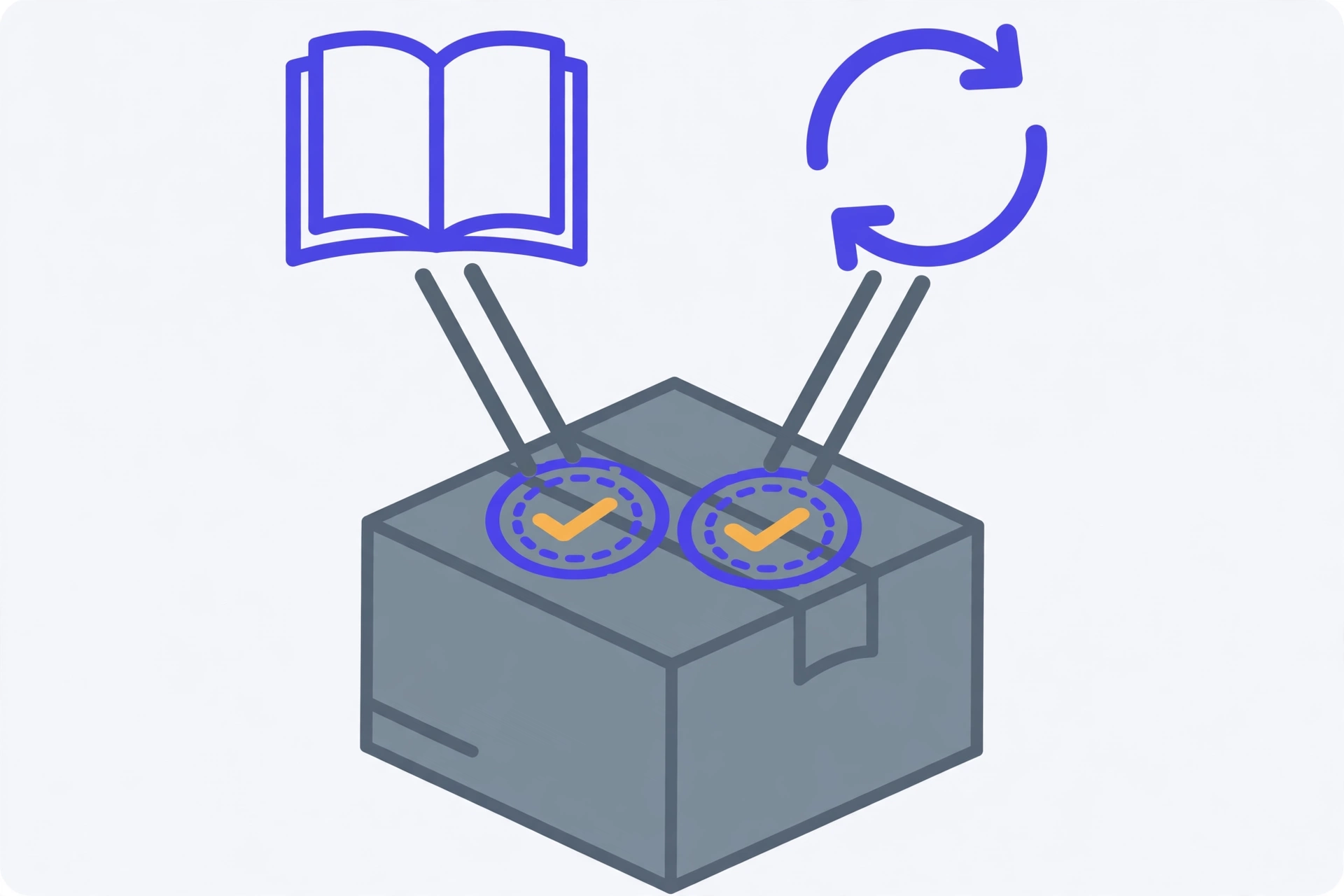
The statute keeps the tracks apart in its own wording. § 6(1) VerpackDG: producers must register “vor dem erstmaligen Bereitstellen” — before the first placing on the market — and registration carries no minimum quantity. § 7(1) then speaks only to producers of packaging that typically accumulates with private end consumers: they must participate “an einem oder mehreren Systemen” before making it available, stating “Materialart und Masse der zu beteiligenden Verpackungen sowie die Registrierungsnummer” — material type, mass, and the registration number. The number proves track one; the contract, confirmed back to you in writing by the system, proves track two.
Enforcement mirrors the split. § 13(1) VerpackDG contains two bans, not one: producers may not make packaging available if they are “nicht oder nicht ordnungsgemäß nach § 6 Absatz 1 Satz 1 registriert” — not, or not properly, registered — and they may not make packaging subject to system participation available if they have not participated under § 7(1). § 13(3) extends both bans to distributors. A seller can pass the first sentence and fail the second on the same parcel: both gates open, or the parcel does not lawfully move.
Why marketplaces made the second track impossible to skip
For years the weak point was distance selling: a foreign shop could ship into Germany, skip the fees its German competitors paid, and stay invisible. The 2022 amendment closed that gap from the platform side.
Since 1 July 2022, as the Federal Environment Agency (Umweltbundesamt) summarised the change, electronic marketplaces may only enable the offering of packaging subject to system participation if the obligated distance and online sellers have participated their packaging in a system and are registered in LUCID; fulfilment providers carry a matching duty. In practice the platform asks for your LUCID number at onboarding and checks it against the register; where the check fails, the offer does not go live — or comes down.That machinery still runs today: § 13(4) VerpackDG ties fulfilment providers to the registration check, and the ZSVR provides an automated data match against the register data those checks need. In commercial terms, the marketplace is now the first enforcement officer you meet: a missing system contract risks your German listings this week, on every platform at once.
Run your own position through the checker, step by step
Before you start, have four facts ready: whether your business places the packaged goods on the German market first (importers and distance sellers count), where your packaging ends up after use, your current paperwork — LUCID number, system contract, both or neither — and a rough annual tonnage.
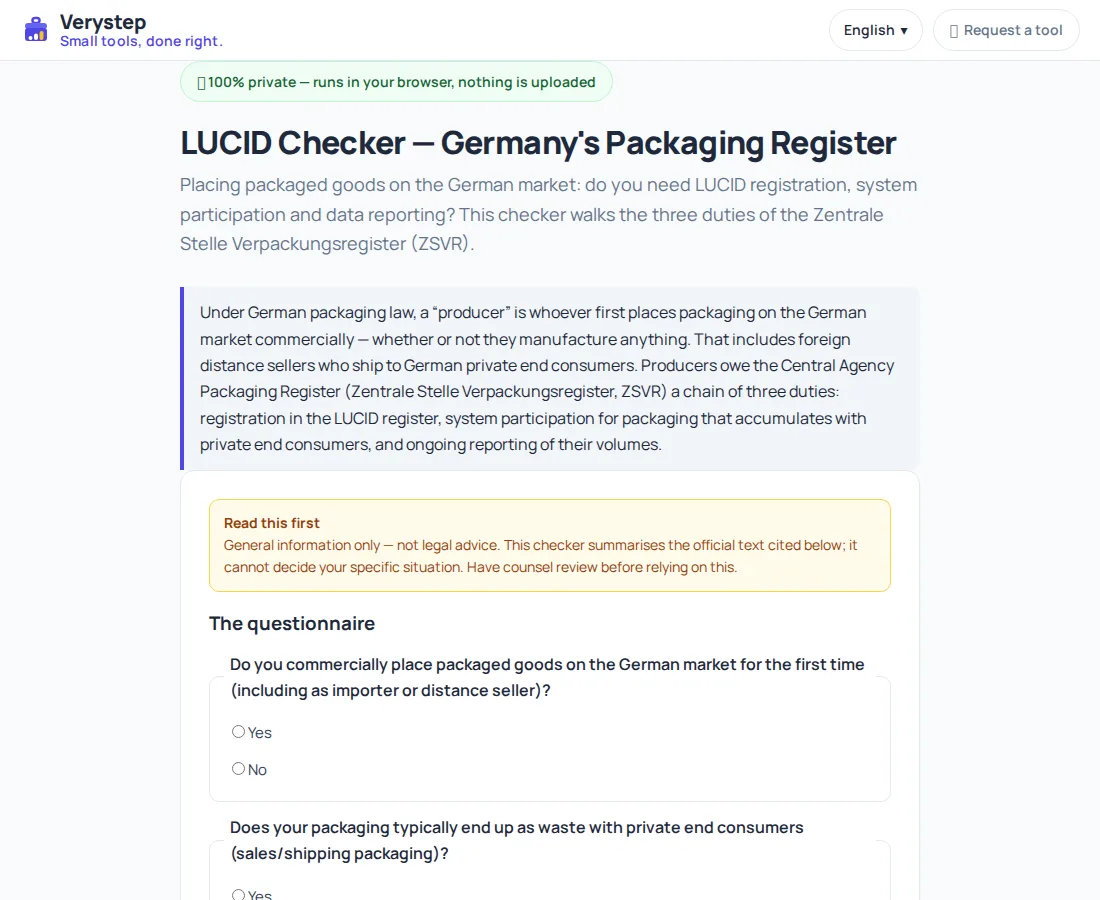
- Answer the first question: do you commercially place packaged goods on the German market for the first time, including as an importer or distance seller shipping to German end consumers? Expect a No to end the check early — the duties attach to the first placer.
- Answer the second question: does your packaging typically end up as waste with private end consumers — sales and shipping packaging — or only at commercial accumulation points? Use “Not sure” rather than guessing; packaging that demonstrably accumulates only commercially sits outside system participation.
- Answer the third question: are you already registered in LUCID and contracted with a dual system, registered only, or neither yet? This is the two-track question in one line — “Registered only” produces the warning this guide is about, because track one is done and track two is not.
- Answer the fourth question: do your annual volumes reach or exceed 80 tonnes of glass, 50 tonnes of paper, paperboard and cardboard, or 30 tonnes of the other materials? Reaching a threshold counts as Yes, because the exemption in § 10(4) VerpackDG covers only volumes below it — this decides whether an audited declaration of completeness joins your duties.
- Read your tier and its next steps, in order: authorised representative first if you have no establishment in Germany, then register, then contract, then report. Where the result flags a missing track, treat that flag as the next task, not a footnote.
- Cross-check the outcome against the public LUCID register and your system’s written participation confirmation before you rely on it — the two documents a marketplace will ask to see.
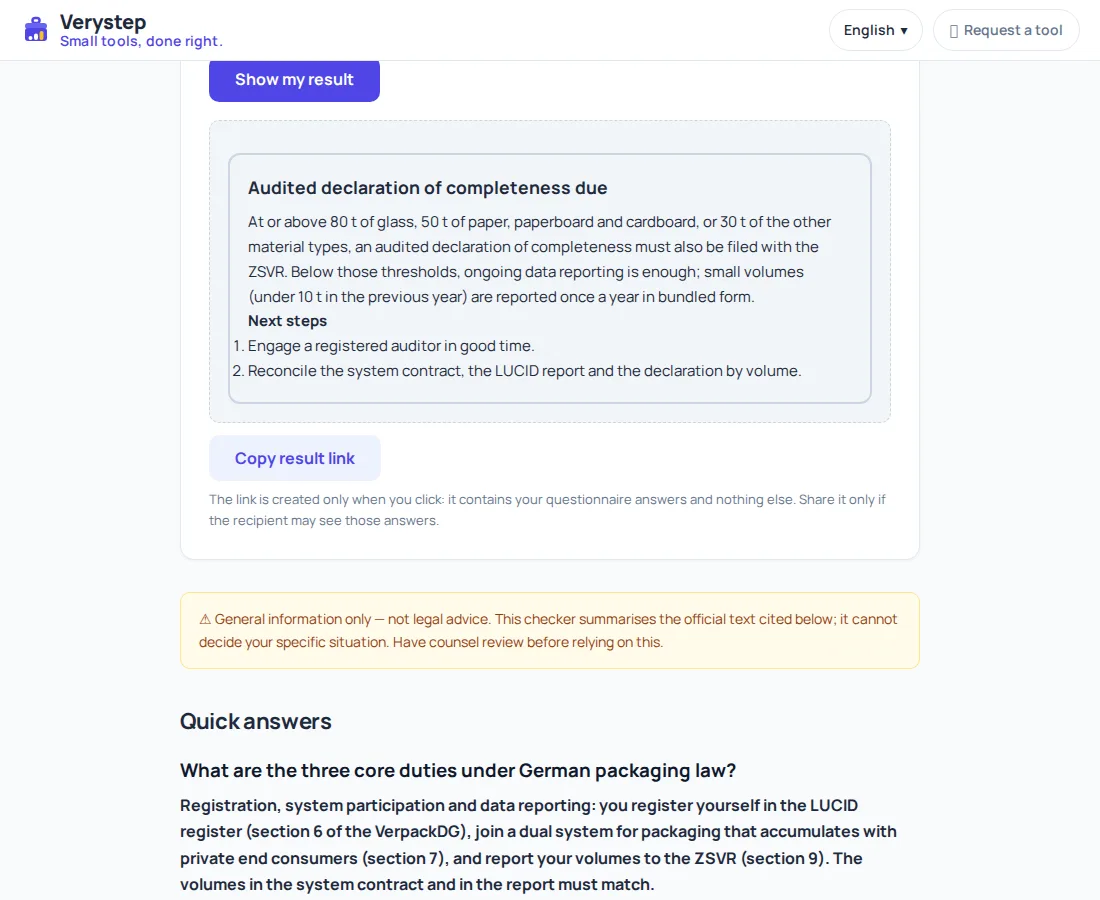
Nothing leaves your device: the checker runs in your browser, and the result link is created only when you click for one — it contains your answers and nothing else.
Worked example: a small foreign webshop, both tracks in the right order
Meet a persona, not a real company. A three-person webshop established outside Germany sells bottled sauces in glass jars to German households, each order in a cardboard mailer with paper filling. Volumes are modest: about 6 tonnes of glass, 2 tonnes of paper and cardboard a year — well under every declaration threshold.
Track zero comes first. Having no establishment in Germany, the shop must appoint an authorised representative established in Germany before its first shipment — § 5(2) VerpackDG. One duty stays stubbornly personal, though: LUCID registration. Neither the representative nor any service provider can register in the shop’s place, so the founder files it herself, before the first parcel ships, listing the brand and the packaging types — jars as sales packaging, mailer and filling as shipping packaging, all of it household-bound.
Track two follows, using what track one produced. With the number in hand, the shop signs a participation contract with a dual system, stating material type and mass — glass and paper/cardboard — exactly as § 7(1) prescribes, and receives the written confirmation. Only now do both § 13(1) sentences pass. Reporting runs on top: the volumes declared to the system and those reported to the ZSVR under § 9 must match, and at under 10 tonnes the shop reports bundled once a year, by 1 June (§ 9(2)). No audited declaration is due, and when the marketplace asks, the shop uploads number and confirmation — and the listings stay up.
Now delete one step and watch the outcome flip. Same shop, same number, no system contract: the marketplace check finds registration but no participation, the offers are blocked, and § 13(1), second sentence, makes the shipments themselves unlawful. The number was never the compliance — it was the key that lets you buy it.
Limits and boundaries: what this two-track picture leaves out
First, system participation is not universal. Packaging that demonstrably accumulates solely at commercial points sits outside § 7, and transport and reusable packaging carry their own take-back rules. The two-gate picture describes packaging reaching private end consumers — the distance-selling case — not every box in the economy.
Second, this guide follows the law currently in force. The VerpackG was replaced on 12 August 2026 by the VerpackDG, the act implementing Regulation (EU) 2025/40; existing LUCID registrations remained valid, and the three core duties continue under the new section numbers used here. Older guides still cite VerpackG paragraphs; check the date on anything you read.
Third, the checker and this guide summarise; they do not decide borderline cases or quote dual-system fees. Whether a packaging type is subject to system participation is a classification question the ZSVR’s catalogue answers — a disputed one is for counsel, not a four-question tool.
Sources: Verpackungsrecht-Durchführungsgesetz (VerpackDG) — official text on gesetze-im-internet.de, §§ 5, 6, 7, 9, 10 and 13 quoted and checked in the official wording; Zentrale Stelle Verpackungsregister (ZSVR), verpackungsregister.org; Umweltbundesamt, “Änderungen im Verpackungsgesetz zum 1. Juli 2022” (umweltbundesamt.de) — the marketplace and fulfilment verification duties in force since 1 July 2022. This guide is general information only — not legal advice. If Germany is a market you depend on, have packaging counsel confirm your position before your next shipment.
The Verystep LUCID Checker asks four questions — whether you place packaged goods on the German market commercially for the first time, whether your packaging ends up with private end consumers, whether you are registered and contracted, or only registered, or neither, and whether your volumes reach the declaration-of-completeness thresholds — and shows your tier with its next steps. It runs entirely in your browser; your answers are never uploaded or stored, and a result link is created only when you click for one. General information only — not legal advice.
Last verified November 26, 2026 — § 6(1) VerpackDG (registration before first making available, “vor dem erstmaligen Bereitstellen”), § 7(1) VerpackDG (participation “an einem oder mehreren Systemen”, stating material type, mass and the registration number), § 13(1) and (3) VerpackDG (the two distribution bans, for producers and distributors), § 13(4) VerpackDG (fulfilment-provider check and the ZSVR automated data match), § 9(2) VerpackDG (bundled annual report by 1 June below 10 tonnes) and the § 10(4) thresholds (80 t glass, 50 t paper/paperboard/cardboard, 30 t other materials) quoted and checked in the official text of the Verpackungsrecht-Durchführungsgesetz on gesetze-im-internet.de — the VerpackDG replaced the former VerpackG on 12 August 2026, and the live checker’s own text states the same succession; the marketplace and fulfilment verification duties in force since 1 July 2022 checked against the Umweltbundesamt’s official summary of the 2022 VerpackG amendment; ZSVR role and the LUCID register checked at verpackungsregister.org. The live LUCID Checker checked in both languages (EN /lucid-checker/, DE /de/lucid-checker/): four questions in the order first placing, private end consumers, registered-and-contracted status, completeness thresholds; registration described as strictly personal; authorised representative under § 5(2) VerpackDG for producers without a German establishment; the “General information only — not legal advice” notice; in-browser processing with a result link created only on click. Sources: VerpackDG — gesetze-im-internet.de, https://www.gesetze-im-internet.de/verpackdg/ ; Zentrale Stelle Verpackungsregister, https://www.verpackungsregister.org ; Umweltbundesamt — Änderungen im Verpackungsgesetz zum 1. Juli 2022, https://www.umweltbundesamt.de/themen/aenderungen-im-verpackungsgesetz-1-juli-2022 . Not legal advice.
Frequently asked questions
I have a LUCID registration number. Am I compliant?
Not on that alone. The number proves track one, registration under § 6 VerpackDG. If your packaging typically accumulates with private end consumers, § 7 also requires participation in a dual system, and § 13(1) bans making the packaging available when either duty is unmet. Registered-only is the most common half-finished state the checker flags.
Which comes first, registration or the system contract?
Registration. § 7(1) has you state your registration number when you participate, so the contract is built on the number. Both must be in place before the first placing on the market — § 6(1) says registration happens “vor dem erstmaligen Bereitstellen”, and § 7(1) sets the same “before” for participation.
I sell through a marketplace only. Does the platform’s check replace my own duties?
No — it exposes them. Since 1 July 2022 marketplaces may only enable offers where the seller is registered and system-participated, and they verify against the register. A failed check blocks your listings, but passing it does not transfer your duties to the platform: registration, the system contract and the data reports remain yours.
My packaging only reaches businesses, never households. Do I still need both tracks?
Registration, yes — it has no minimum quantity and is not limited to household packaging. System participation, no: § 7 covers packaging subject to system participation, meaning packaging that typically accumulates with private end consumers. Purely commercial accumulation points fall outside it, though take-back duties for those packaging types apply instead.
I am not established in Germany. Can my authorised representative register me in LUCID?
No. A producer with no German establishment must appoint an authorised representative established in Germany before first making packaging available (§ 5(2) VerpackDG), and the representative takes on the packaging-law duties — except registration, which is strictly personal. Neither a representative nor a service provider can register on your behalf.
More guides

The PPWR Empty Space Ratio: Why the 50% Cap Hits Your Shipping Box First
Ask a room of online sellers what the PPWR will change first and most will say labels. The duty with a number in it is quieter: from 2030 at the earliest, no more than half the volume of your shipping box may be empty — and the filler you stuff into it counts as empty.

Counting a Return Window: The EU 14-Day Cooling-Off Period Starts the Day After Delivery
A shop page says “14 days to return”. Fourteen days from when — the order, the dispatch, the delivery? And counted how — in calendar days or working days? EU law answers both questions, and the answers are not the ones most countdown banners use.

How to Check Gift Return Eligibility Without a Receipt
Black Friday is over, the gifts are changing hands, and some of them are the wrong size, the wrong color or the second one you own. There is no receipt — there never is with a gift — so the question is not “can I get my money back?” but “which route does this store actually offer someone in my position, and how long do I have?”