Verystep Guides Verystep Guides
Invoice Numbering and Late Fees: Keep the Sequence, Price the Delay
The number proves nothing is missing. The due date proves when late begins.

An invoice number must be unique and sequential: never reuse one, never skip one, and mark a mistake cancelled instead of deleting it — the unbroken sequence is the audit trail. Terms such as Net 30 set the due date from the issue date, and a late fee — flat, or a percentage per month — is measured against that date, and generally must be agreed in advance. On $1,000 at 1.5% per month, two months late costs $30.00 on the original balance, $30.23 if it compounds. Not legal, accounting or financial advice.
A number is not decoration
Every invoice needs a number — a unique one, following the one before it, that lets you find the invoice months later without digging through email.
That sounds like tidiness. It is more than that. Sequential, gapless numbering is how a set of invoices proves it is complete. If 041, 042 and 044 exist and 043 is nowhere, anyone checking will ask: what was 043? In many countries tax rules require sequential numbering for exactly that reason — the sequence is the audit trail.
So: never reuse a number, never skip one, and never delete a bad invoice. Duplicate by mistake? Keep a copy, mark it cancelled, and move on.
Pick a scheme once, then leave it alone
The format matters far less than keeping it. Common schemes:
| Scheme | Example shape | Works well when | Watch out for |
|---|---|---|---|
| Plain continuous | INV-001, INV-002, INV-003 | You invoice from one place and want the simplest possible log | It never resets, so keep the count somewhere you will not lose it |
| Year-prefixed | INV-2026-001, then INV-2027-001 | You want the year visible at a glance and a fresh start each January | Restarting the count is fine only because the year prefix keeps every number unique |
| Year-and-month | INV-202611-001 | You send a lot of invoices and sort by month | Longer numbers, and the same reset rule: uniqueness comes from the full string, not the final part |
Notice the pattern: whatever sits in front can change; the counting part may only move forward. Restarting at 001 in a new year is not reuse, as long as the prefix makes the full number different.
One honest note about the generator below: it puts the number you type onto a clean PDF. It does not keep your sequence for you — it runs in your browser and stores nothing. Keeping the next number straight, in a notebook or your accounting app, is still your job.
Payment terms start the clock
A late fee can only exist if “late” has a definition, and that definition is the payment term. It anchors everything to the issue date — the date on the invoice, not when you finished the work.
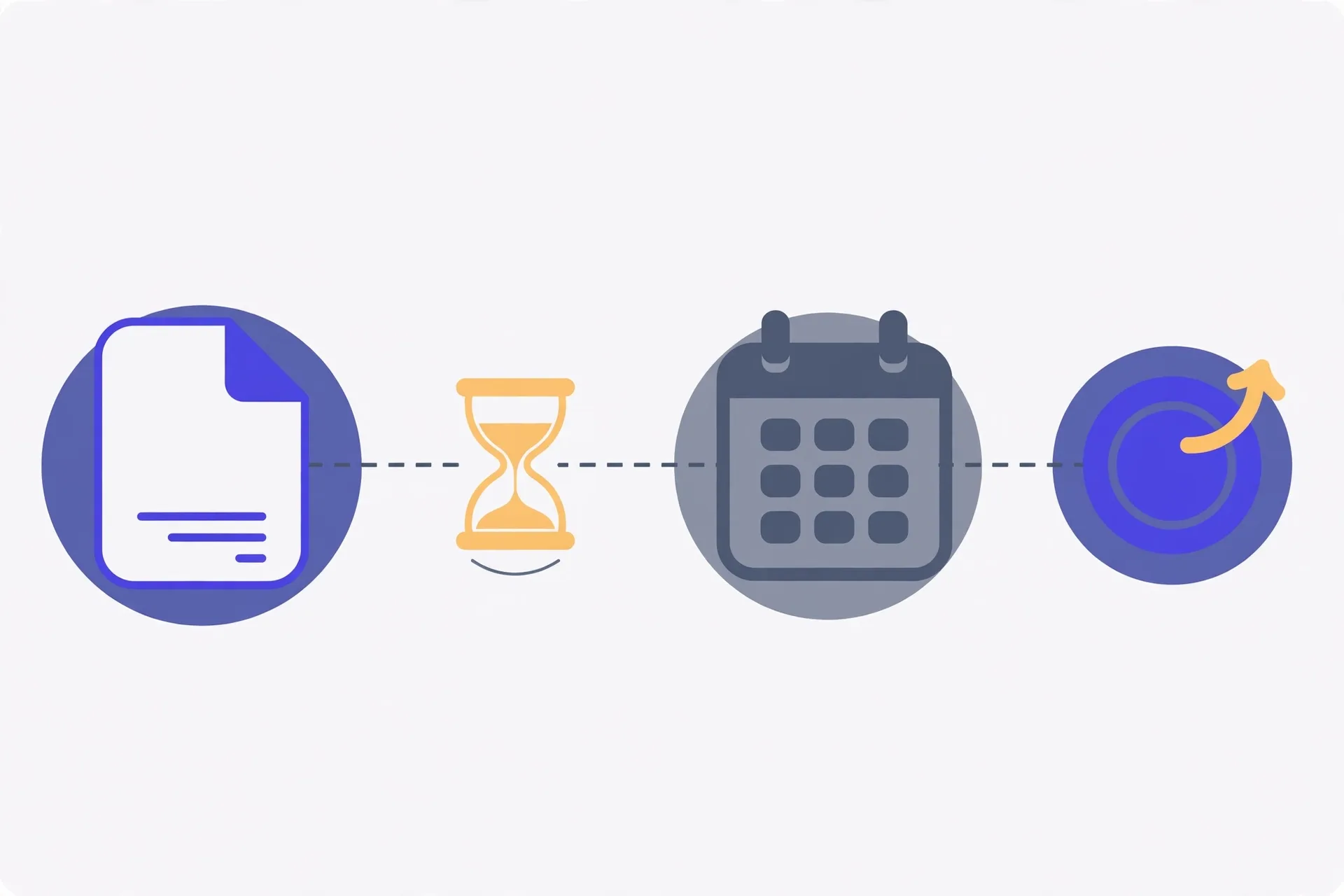
The common terms are short codes. “Due on receipt” means pay now. “Net 30” means the full amount is due 30 days after the issue date; Net 7, 14 and 60 work the same way. “EOM” pushes the due date to the end of the month. Whichever you choose, write both dates on the invoice — issue date and due date, as calendar dates. “Net 30” alone forces your client to do arithmetic you could have done for them.
A complete invoice carries the other parts too: seller and buyer details, line items, tax on the subtotal, and the total. In the EU, a VAT number belongs on there as well.
Late fees: two shapes, and one trap
When an invoice passes its due date unpaid, a late fee is the charge your terms promised for exactly that case. It comes in two basic shapes.
A flat fee is a fixed amount, charged once an invoice passes a set point — simple, and the same whatever the bill. A percentage fee scales with the bill: a percentage of the unpaid balance for each month it stays unpaid. That scaling is why percentage fees suit larger invoices.
Here is the trap, and it is pure arithmetic. Does the percentage apply only to the original balance, or to the balance plus fees already added? On $1,000 at 1.5% per month, two months late: on the original balance, $15 plus $15 — $30 total. On the growing balance, month two is 1.5% of $1,015 — $15.23, for $30.23 total. Small here; over many months the two methods drift far apart. Say which you mean: “on the outstanding balance” and “on the original total” are different promises.
Two more pieces belong in the clause: a grace period — a few days after the due date before the fee starts — and, if you want one, a cap. And the part people learn the hard way: a late fee generally has to be agreed before it can be charged. Put it in your contract, quote or invoice, before the work starts. A fee invented after a bill is overdue is one most clients will dispute, and local rules may limit what can be charged anyway. This guide explains the mechanism; it is not legal or accounting advice.
The discount that works the other way
The late fee has a mirror image: “2/10 Net 30”. Take 2% off if you pay within 10 days; otherwise the full amount is due in 30.
Run the maths and the little 2% turns out to be steep. Paying 20 days early to save 2% means giving up $98 now instead of $100 later — an effective annual rate of about 37% (2 ÷ 98 × 365 ÷ 20). That is why buyers with cash hunt for these terms, and sellers offer them only when fast payment is worth real money. Late fee and early discount are the same lever, pulled opposite ways.
Number it, send it, chase it — in order
- Take the next number from your log — not the last one you remember — and put it on the invoice with today’s date as the issue date.
- Choose the term, then write the actual due date on the invoice as a date, not just “Net 30”.
- List each item with quantity and unit price, add tax on the subtotal, and check the total before you send anything.
- If you charge late fees or offer an early discount, state the exact wording — rate, base, grace period — on this invoice.
- Generate the PDF below and send it, then record the number, client, total and due date in your log the same day.
- When the due date passes unpaid, follow your own clause, reference the original number on any reminder, and never renumber the original.
None of this makes a client pay. It removes every excuse built on confusion — a missing number, a guessed due date, a fee nobody agreed to. What is left is a plain, documented debt. Those are the ones that get settled.
The Verystep Invoice Generator takes your details, the client’s, the number and date you set, line items and a tax percentage, then downloads a clean PDF — total as the sum of the lines plus tax. It runs in your browser and stores nothing, so keep your numbering log with your own records. For convenience only; not accounting or tax advice.
Last verified November 11, 2026 — invoice parts, payment-term codes (Due on receipt, Net 7/14/30/60, EOM, 2/10 Net 30) and total arithmetic cross-checked against the invoice tool below; late-fee examples are worked arithmetic on stated rates, not a statement of any jurisdiction’s rules. Not legal, accounting or financial advice.
Frequently asked questions
Can I restart invoice numbers at 001 every year?
Yes, if the full number stays unique. INV-2026-001 and INV-2027-001 are different numbers, though both end in 001. Restarting a bare 001 reuses a number.
What should I do if I skip or duplicate a number by mistake?
Do not delete anything to hide it. Keep a copy, mark it cancelled in your log with a one-line note, and continue from the next number. A silent hole reads as a missing invoice.
How is a percentage late fee calculated?
Apply the rate in your terms to the base your terms name. At 1.5% per month on $1,000, one month is $15. On the original balance, month two is another $15; on the outstanding balance including fees, it is 1.5% of $1,015 — $15.23. The wording decides.
Can I add a late fee to an invoice that is already overdue?
Generally, it needs to have been agreed beforehand — in a contract, quote or on the invoice itself — and local rules may cap what can be charged. State your terms before the work starts, and get local advice for your situation.
What does 2/10 Net 30 mean?
Pay within 10 days and take 2% off; otherwise the full amount is due in 30 days. That 2% buys payment 20 days early, so its effective annual rate is about 37% — a strong incentive, not a courtesy discount.
More guides

How to Use an Auto Loan Calculator to Compare Two Offers
Two dealers can quote payments that look almost identical and still be selling you loans that cost hundreds of dollars apart. The calculator shows you where the gap hides.
How to Build a Debt Payoff Order: Avalanche vs Snowball, Step by Step
Paying extra money toward debt only works if the extra money has a target. This guide builds that target: an ordered list, made two different ways, so you can see exactly where each spare dollar goes.
How to Project Compound Growth (and Read the CAGR Mode)
This calculator does two jobs in one place: it projects a balance forward at a rate you set, and it works backwards from two balances to the steady rate that links them.