How to Run a Secret Santa Draw Without Spoilers
Most Secret Santa draws do not fail at the shopping. They fail in the first five minutes — someone draws themselves, a couple draws each other, or one screenshot of the full list does the rounds.
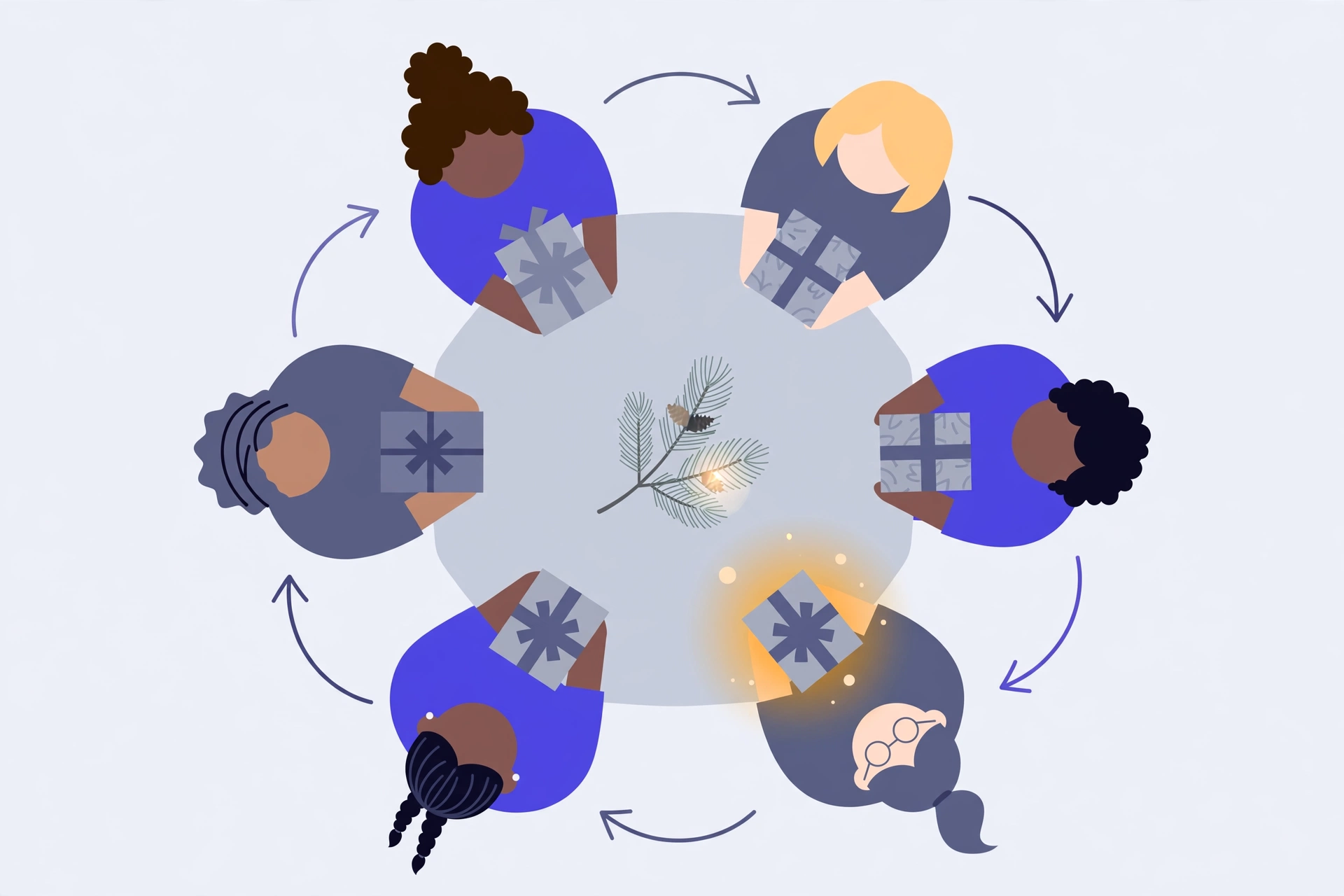
A good Secret Santa draw has three rules: nobody draws themselves, every exclusion you agreed is honoured, and nobody sees a pairing that is not theirs. In maths terms the draw is a derangement — a shuffle where every name moves and nobody stays in place — narrowed further by your exclusion pairs. The Verystep generator shuffles in your browser, retries up to 800 times until it finds an arrangement that breaks no rule, and then hands out one reveal link per person instead of a shared list. Each link holds only that person’s pairing, hidden until they tap to reveal. If your exclusions leave no valid arrangement at all, the tool says so rather than quietly breaking a rule — loosen one exclusion and draw again.
Why draws break: derangements, exclusions, and the empty set
A draw, stripped down, is this: you have a list of givers and the same list of receivers, and you match them up. Everybody gives once, everybody receives once. That matching is a permutation — a rearrangement of the names. Secret Santa adds one hard condition: nobody may stay matched to themselves. A permutation where no element stays in place is called a derangement, and that word explains half the trouble with paper slips. In a hat draw, self-draws happen all the time, someone sighs, the slips go back in, and the second attempt quietly leaks information: everyone now knows one pairing that did not happen.
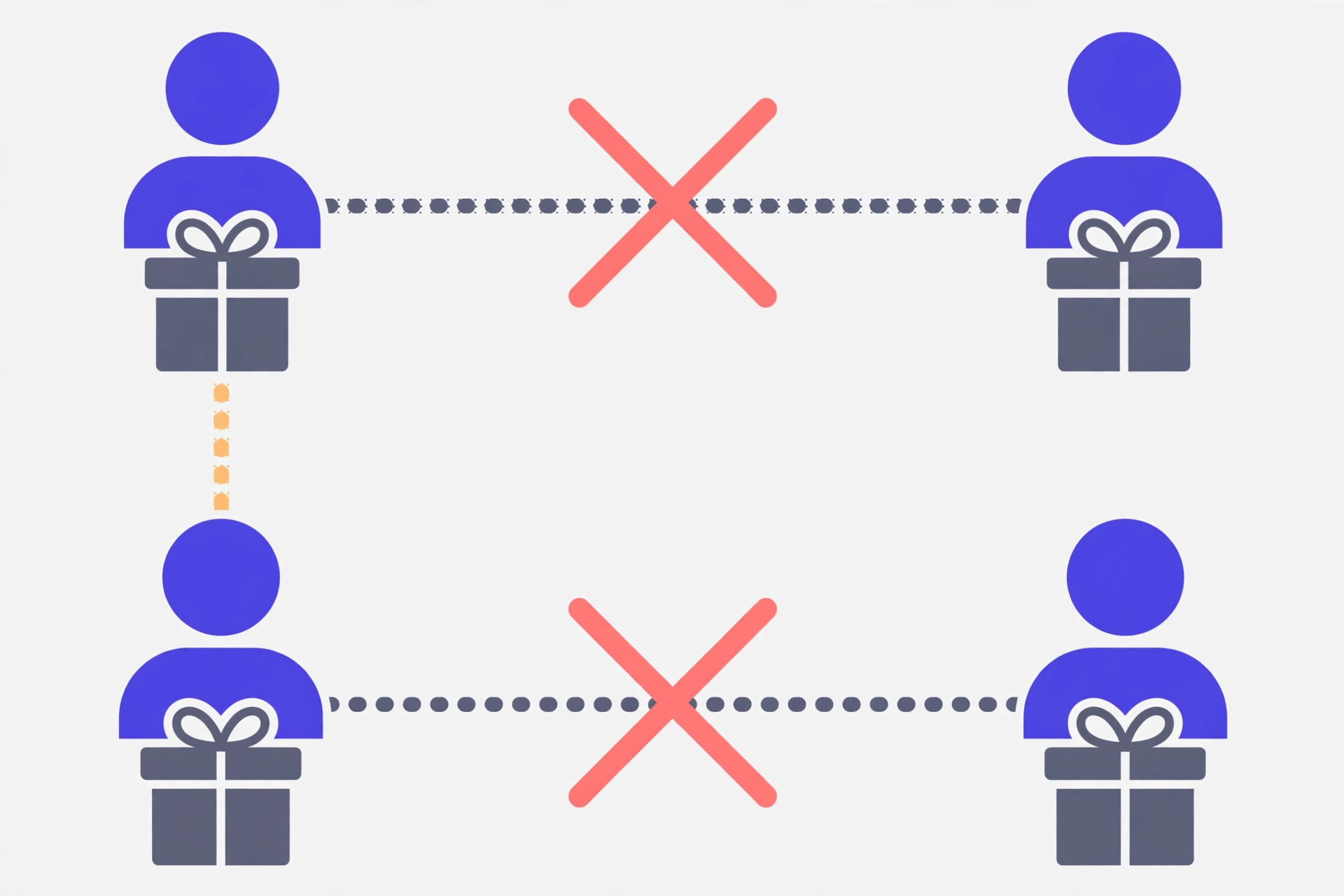
Exclusions narrow things further. Each one removes an allowed match: Ana cannot give to Ben. On the live tool exclusions are one-way, so “Ana - Ben” says nothing about Ben giving to Ana. A couple needs both lines. Last year’s pairing, a manager who should not draw their own report — same mechanism, one line each. Every line deletes some derangements from the pile of valid ones. Add too many, in too small a group, and the pile is empty: no arrangement obeys all your rules at once.
That empty case is not a bug, and you want a tool that admits it. Say three people play and one is excluded from both others. That person has nobody left: three names, minus themselves, minus two exclusions, equals zero options. No shuffle fixes arithmetic like that. The honest outcomes are to drop an exclusion, widen the group, or soften a rule. What you do not want is a draw that silently ignores an exclusion — you would only find out at the gift exchange, in front of everyone.
Run the draw on Verystep, step by step
Before you start: settle the group list, the gift budget and the exchange date in your group chat. The tool handles names, an event label and exclusions — it does not send invitations or email anyone. Have the final spelling of every name ready, because the tool takes your text literally.
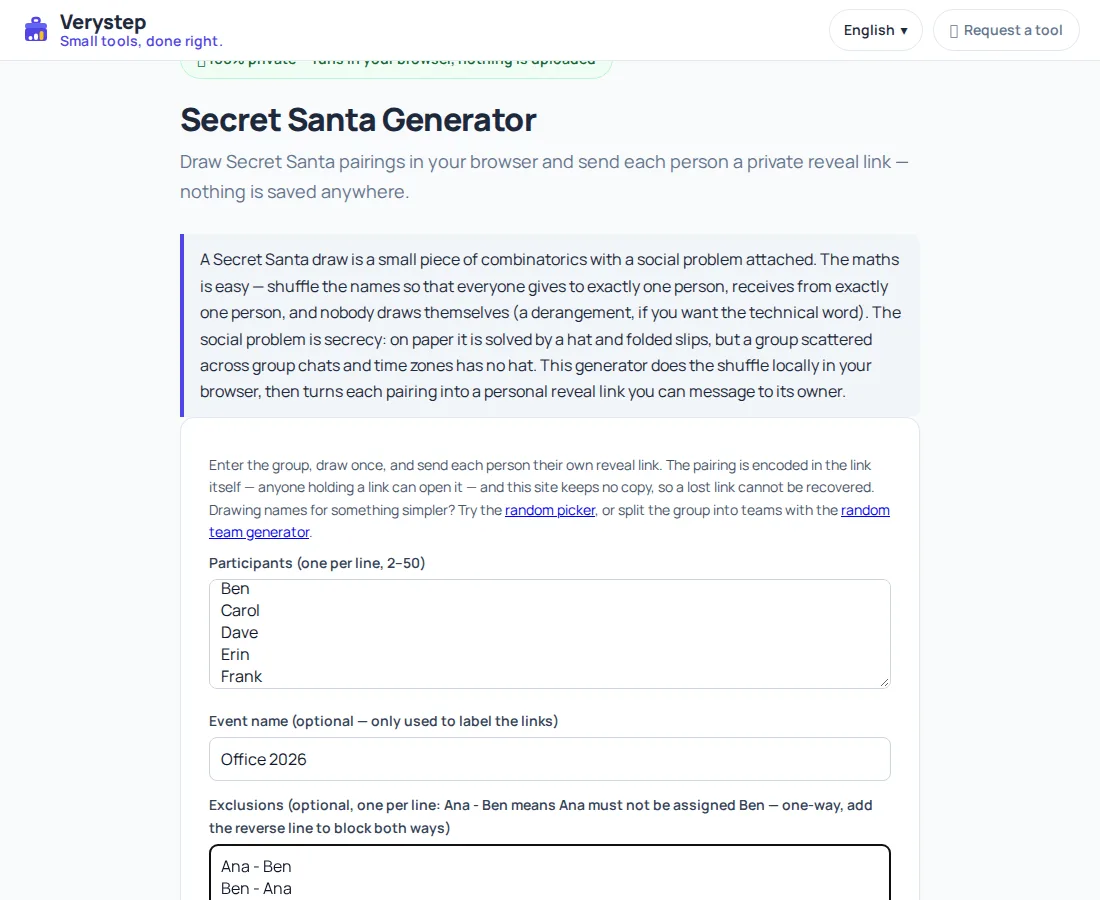
- Open the Secret Santa Generator and find the field labelled “Participants (one per line, 2–50)”. Type or paste one name per line, nothing else on each line. Read the list back slowly: a typo creates a phantom person, and two people who share a first name will be flagged as duplicates. If two people really do share a name, add a surname initial to each — “Sam J.” and “Sam K.” — so their links stay distinguishable.
- In “Event name (optional — only used to label the links)”, type a short label such as “Office Christmas 2026”. It changes nothing about the draw itself; it only labels the reveal links, which helps when you run more than one draw in a season.
- In “Exclusions (optional, one per line: Ana - Ben means Ana must not be assigned Ben — one-way, add the reverse line to block both ways)”, enter one pair per line, in exactly that format: giver, space, hyphen, space, receiver. Use the names exactly as they appear in the participants list. For a couple, enter both directions as two separate lines. Leave the box empty if you have no exclusions.
- Press “🎅 Draw pairings”. Expect one of two outcomes: an organiser overview table listing every pairing, plus one reveal link per person — or a message that no valid draw was found. The tool shuffles up to 800 times against your rules before giving up, and it will not break a rule to force a result.
- If the draw fails, do not just press again and hope. Count the pressure points: who has the most exclusions, and is the group very small? Remove or soften the least important exclusion and draw again. Adding people also helps, because every extra person gives everyone one more possible receiver.
- Share the assignments privately, one link per person. Copy each person’s own reveal link and send it to that person only, in a private message. Never screenshot the overview table or paste it into the group chat: it contains every pairing at once.
- Tell each recipient what happens at their end. Opening the link shows a notice that an assignment is waiting, not the name itself. They check nobody is looking over their shoulder, tap to reveal, and see only their own pairing. Ask everyone to keep their link — the site stored nothing, so a lost link cannot be resent; the only fix is a fresh draw for the whole group.
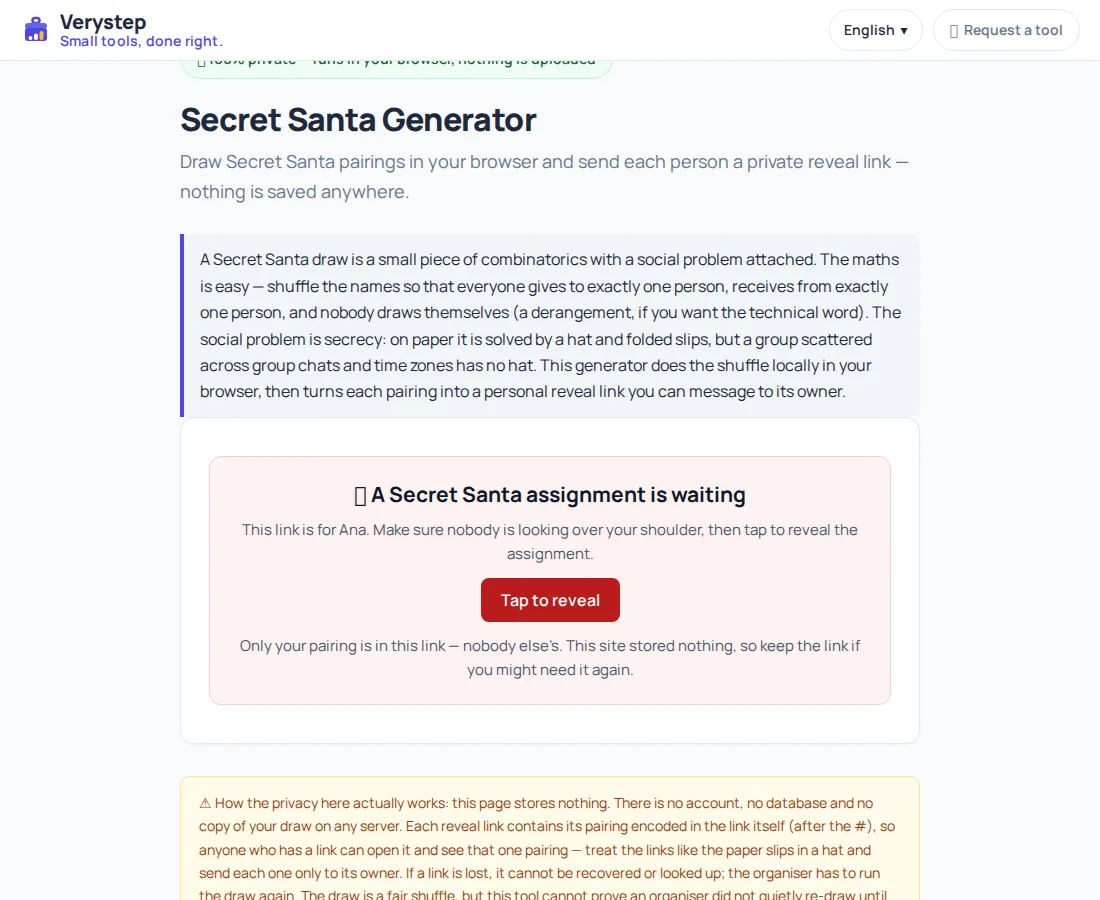
One honesty note: this flow stops participants spoiling each other, but it cannot prove an organiser did not quietly re-draw until they liked the result. If your group cares, draw live on a video call with the screen shared, or cross-check afterwards that every name appears exactly once as a giver and once as a receiver.
Worked example: six colleagues, one couple, a $25 budget
Take an office group of six: Ana, Ben, Carla, Dan, Priya and Tom. The group agrees a $25 budget and an exchange on the last working day before the break. Ana and Ben are a couple, so the group adds two exclusion lines — “Ana - Ben” and “Ben - Ana” — blocking that pair both ways. Now the arithmetic. Each giver starts with 6 possible receivers, minus 1 because nobody draws themselves: 5 left. Ana loses one more, Ben, so she has 4: Carla, Dan, Priya or Tom. Ben also has 4. The other four keep all 5. Nobody is near zero, so valid derangements exist in large numbers.
Say the draw comes out as: Ana gives to Priya, Ben gives to Carla, Carla gives to Tom, Dan gives to Ana, Priya gives to Ben, and Tom gives to Dan. Check it like a sceptic. Every name appears exactly once as giver and once as receiver. Nobody gives to themselves. Ana does not give to Ben, Ben does not give to Ana. That is a valid draw, and the check took twenty seconds.
Now the reveal. The organiser sends Ana her link privately; she taps and learns only “Priya”. Ben’s link tells him only “Carla”. And so on — six private messages, six separate reveals, and no screen outside the organiser’s overview ever shows more than one pairing. Ana knows she is buying for Priya, within the $25 budget, by the exchange date. Who is buying for her stays unknown. That is the whole game, preserved.
Limits: group size, duplicate names, and the organiser problem
Start with size. The tool accepts 2 to 50 participants, but with two people the only derangement is that they give to each other — not much of a secret. Three is the smallest group where any uncertainty survives, and even there one exclusion can empty the set. Four to six works well if exclusions stay light. Past about eight, you have room for several exclusions without the draw getting fragile. A 50-person draw is fine for the tool and a lot of private messages for you.
Duplicate names are the dullest way a draw goes wrong. The tool flags duplicates, but it cannot know whether “Alex” twice is a paste error or two real people. Disambiguate with a surname initial, because two identical names produce links nobody can tell apart — and a mix-up here means two people buying for the wrong person, or the same person twice. Spelling variants are the cousin of this problem: if the list says “Katherine” and your exclusion says “Kate”, the exclusion matches nobody and does nothing. Copy names from the list into the exclusion lines instead of retyping them.
Then the organiser problem, in plain words. In this tool, as in most, one screen — the organiser overview — holds every pairing. That is a real risk: a screenshot, a forwarded table, a phone left open on a desk, and the whole draw is spoiled at once. The masked reveal flow mitigates the sharing end. Participants never see a list; each reveal link carries only its owner’s pairing, encoded in the link itself, hidden behind a tap, so a link glimpsed over a shoulder shows nothing. Treat links like the paper slips in a hat: whoever holds one can open it, so send each only to its owner. What the flow cannot do is erase the organiser’s own view. If the organiser also plays, the group trusts that person not to peek at who drew them — or you draw live together, as above.
Finally, know what the tool does not do. It does not send emails or messages for you; you copy and send each link yourself. It does not store the draw, so there is no recovery and no resend button — the privacy and the fragility are the same feature. Names are processed in your browser, nothing is uploaded, which is exactly why a lost link means a fresh draw. Ask everyone to confirm receipt, keep the overview open until all confirmations land, then close it and let the links be the only copies.
The Verystep Secret Santa Generator takes participants one per line (2 to 50), an optional event name that only labels the links, and optional exclusions one per line in the form “Ana - Ben”, meaning Ana must not be assigned Ben. Press “Draw pairings” and you get an organiser overview plus one private reveal link per person. The draw runs in your browser, nothing is stored, and each link shows only its owner’s pairing, after a tap to reveal.
Last verified November 25, 2026 — checked against the live Secret Santa pages in all five languages (English /secret-santa/, Spanish /es/amigo-invisible/, Portuguese /pt/amigo-secreto/, French /fr/pere-noel-secret/, German /de/wichteln/): the “Participants (one per line, 2–50)” field with duplicate names flagged; the optional “Event name”, used only to label the links; the optional “Exclusions” field, one pair per line in the form “Ana - Ben”, one-way, with the reverse line needed to block both directions; the “Draw pairings” button; the organiser overview table listing all pairings; the per-person reveal links with the pairing encoded in the link itself (after the #), shown only after a tap to reveal; the retry behaviour (up to 800 shuffles, then a plain no-valid-draw message rather than a broken rule); and the privacy wording on the page (the draw runs in your browser, nothing is stored or uploaded, and a lost link cannot be recovered). Worked example recomputed by hand: 6 people, 2 exclusion lines forming one two-way couple block — Ana and Ben each have 4 possible receivers (6 − 1 self − 1 exclusion), the other four have 5 each, and the sample draw was checked to list every name exactly once as giver and once as receiver, with no self-draw and no broken exclusion.
Frequently asked questions
Can someone draw themselves in this generator?
No. The draw is a derangement: the generator shuffles until nobody is assigned themselves and no exclusion is broken, retrying up to 800 times. If no arrangement satisfies all the rules, it tells you instead of handing out a pairing that breaks one.
Are exclusions one-way or two-way?
One-way. “Ana - Ben” stops Ana being assigned Ben, but Ben can still be assigned Ana. For a couple who must not draw each other, add both lines: “Ana - Ben” and “Ben - Ana”.
Who can see my pairing from my reveal link?
Anyone who holds your link can open it, because the pairing is encoded in the link itself and the site keeps no copy to check against. That is why each link goes only to its owner, in a private message — forwarding the link forwards the secret.
Someone lost their reveal link. Can it be recovered?
No. Nothing is stored anywhere, so there is nothing to look up. The organiser overview is the only other copy while it is still open; once that is gone, the honest fix is a fresh draw for the whole group and new links for everyone.
What is the smallest group that works well?
The tool accepts 2 to 50 people, but 2 is a swap, not a secret, and 3 breaks easily if you add exclusions. Four or more gives the draw room to breathe; the more exclusions you need, the larger the group should be.
More guides

The PPWR Empty Space Ratio: Why the 50% Cap Hits Your Shipping Box First
Ask a room of online sellers what the PPWR will change first and most will say labels. The duty with a number in it is quieter: from 2030 at the earliest, no more than half the volume of your shipping box may be empty — and the filler you stuff into it counts as empty.

Counting a Return Window: The EU 14-Day Cooling-Off Period Starts the Day After Delivery
A shop page says “14 days to return”. Fourteen days from when — the order, the dispatch, the delivery? And counted how — in calendar days or working days? EU law answers both questions, and the answers are not the ones most countdown banners use.

How to Check Gift Return Eligibility Without a Receipt
Black Friday is over, the gifts are changing hands, and some of them are the wrong size, the wrong color or the second one you own. There is no receipt — there never is with a gift — so the question is not “can I get my money back?” but “which route does this store actually offer someone in my position, and how long do I have?”