How to Label Leftovers With Eat-or-Freeze-By Dates
The cooking is the easy part. The hard part is Wednesday, when six tubs with identical lids are staring back at you and nobody remembers which one went in first.
Two clocks run on every leftover, and they measure different things. The fridge clock is a safety limit: the USDA and FoodSafety.gov put refrigerated leftovers at 3 to 4 days, and the label date is day 4, the far edge of that window. The freezer clock is about quality, not safety: food kept continuously at 0°F (-18°C) stays safe indefinitely, and the months on the FoodSafety.gov chart — cooked meat or poultry 2 to 6 months, soups and stews 2 to 3 months, pizza 1 to 2 months, chicken nuggets or patties 1 to 3 months — are best-quality windows. Add one line per dish in the generator below, print the labels, and let the dates do the remembering. Past the fridge date, throw the food out. There is no sniff test.
Two clocks, and only one of them is a safety deadline
Rule one covers the fridge. The USDA Food Safety and Inspection Service (FSIS) fact sheet, Leftovers and Food Safety, and the FoodSafety.gov storage chart say the same thing: leftovers can be kept in the refrigerator for 3 to 4 days. That is a safety window. Once it closes, the official advice is blunt — throw the food out.
Rule two covers the freezer, and it works the other way round. FoodSafety.gov frames its freezer guidance as quality only: frozen foods stored continuously at 0°F (-18°C) or below can be kept indefinitely. Safe does not mean tasty forever, though. Frozen leftovers slowly dry out and lose flavor, so the chart gives each kind of food a best-quality window instead of a deadline: cooked meat or poultry 2 to 6 months, soups and stews 2 to 3 months, pizza 1 to 2 months — the shortest window on the chart — and chicken nuggets or patties 1 to 3 months. The FSIS fact sheet also gives frozen leftovers 3 to 4 months as a general figure, which the generator uses for its Other cooked leftovers line.
Why does the label land on day 4 rather than day 3? The published window is a range, and the generator counts from the day you enter and takes the far edge. A dish that went in on Thursday is labeled for Monday. That is not a loophole. FoodSafety.gov says exactly this about the biggest leftover week of the year: you have until the Monday after Thanksgiving to eat the leftovers or place them in the freezer. Thursday plus four days is Monday. Same rule, same arithmetic.
One more distinction shapes the whole tool. The generator gives dates only — never a verdict that a dish is fine, never a verdict that it is spoiled. It cannot know how long your turkey sat out. And there is no sniff test built in, on purpose: harmful bacteria cannot be seen, smelled or tasted. Spoilage bacteria can make old food smell off, but that is a different thing from safety. The calendar is the test the official guidance trusts, so the calendar is what you get.
Label every tub in seven steps
Before you start, get the food into the conditions these dates assume. Leftovers should be refrigerated within 2 hours of cooking — within 1 hour if the food sat above 90°F — split into shallow covered containers so they cool quickly, in a fridge at 40°F or below. Then work through the generator from top to bottom.
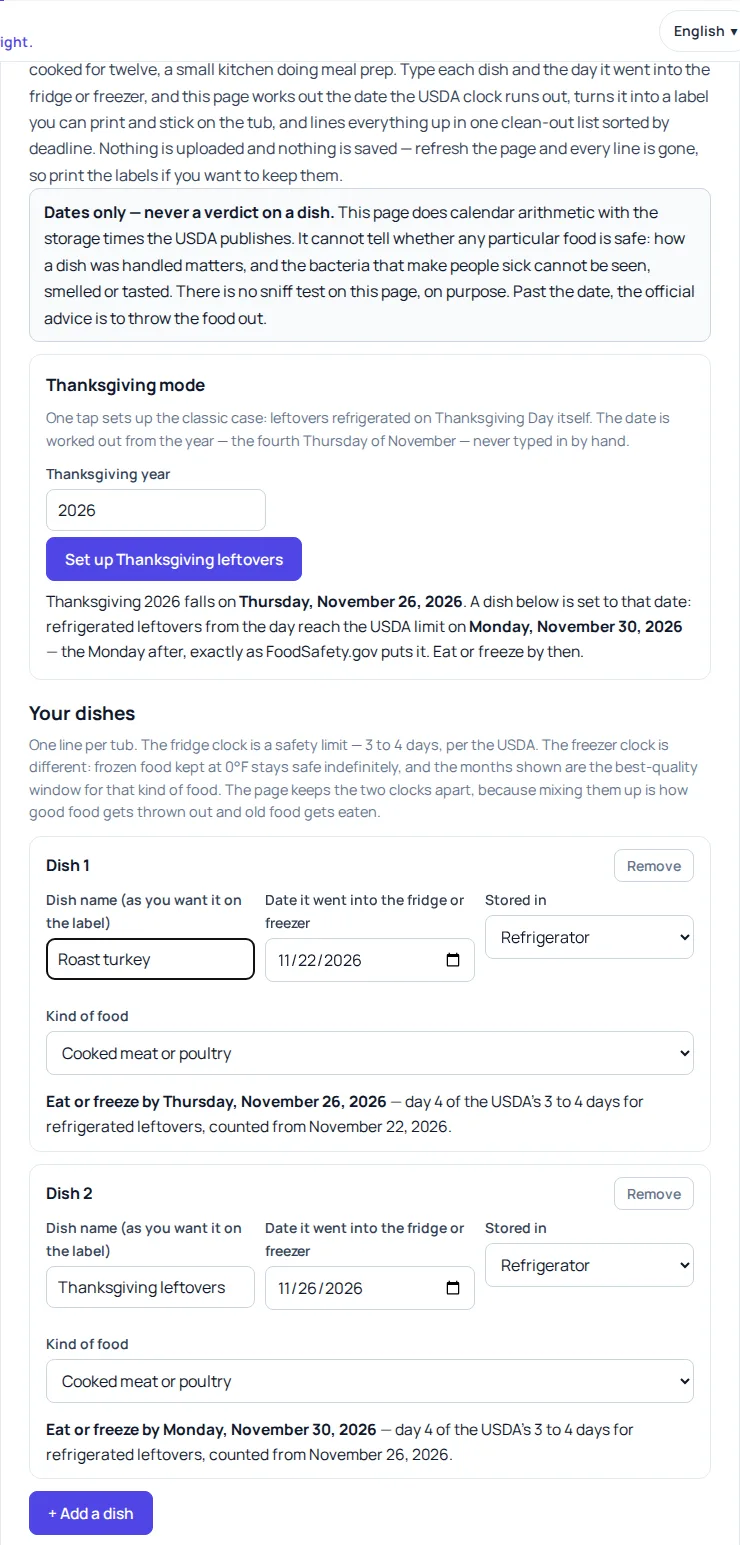
- For the holiday case, start with Thanksgiving mode at the top of the page. Pick the year in the Thanksgiving year field and tap Set up Thanksgiving leftovers. The page works out the fourth Thursday of November itself and sets the dishes up as refrigerated on that day.
- For any other meal, click + Add a dish and add one line per tub. One tub, one line. If the same soup fills three containers, that is three lines, because each lid needs its own label.
- In Dish name (as you want it on the label), type the name exactly as you want it printed. Short and specific beats clever: “Turkey — dark meat” will still make sense on Monday.
- Set Date it went into the fridge or freezer. Today is filled in for you, so change it only if the food went in on a different day. This date starts the clock — guessing a later day borrows time the food does not have.
- Choose Stored in: Refrigerator or Freezer. Expect a different kind of date back. Fridge lines get an eat-or-freeze-by date, day 4 of the 3 to 4 day window. Freezer lines get a best-quality-by date, taken from the top of the chart window for that kind of food.
- Pick the Kind of food: Cooked meat or poultry, Soups & stews, Pizza, Chicken nuggets or patties, or Other cooked leftovers. For fridge lines this changes nothing — every cooked leftover shares the same 3 to 4 days. For freezer lines it sets the quality window, so pick the closest match.
- Read the date under each line, then tap Print labels & clean-out list, cut the labels out and stick one on each tub. For calendar deadlines, use Download calendar reminders (.ics): one all-day event per fridge-stored dish, on its eat-or-freeze-by date. Freezer lines get no event, deliberately — a quality window is not a deadline.
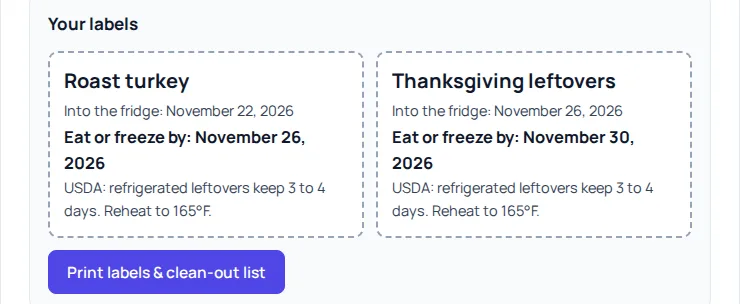
Print before you close the tab. Nothing is uploaded or saved, and refreshing wipes every line — a privacy feature with a sharp edge, since the paper labels are your only record. Print the clean-out list too: it lines everything up sorted by deadline, oldest first.
A worked example: Thanksgiving 2026, start to finish
Thanksgiving in 2026 falls on Thursday, November 26 — the fourth Thursday of November, which is how the date is defined. That evening the turkey and a pot of soup go into the fridge in shallow covered containers, well inside the 2-hour window.
Turkey first. Dish name: Turkey. Date in: Thursday, November 26, 2026. Stored in: Refrigerator. Kind of food: Cooked meat or poultry. The generator adds 4 days and lands on Monday, November 30, 2026, so the label reads eat or freeze by Monday, November 30, 2026. Count it on your fingers: Friday day 1, Saturday day 2, Sunday day 3, Monday day 4. It matches the FoodSafety.gov Thanksgiving guidance word for word. On Monday you still have a real choice — eat the turkey, or move it to the freezer and turn the problem into a quality question. On Tuesday that choice is gone. Out it goes.
The soup shows the other clock. Say you freeze a portion of it on Friday, November 27, 2026, entered as Soups & stews, Stored in: Freezer. Soups and stews carry a 2 to 3 month best-quality window, and the label takes the top of the window, so it reads best quality by February 27, 2027. Read that date the right way: late January through February 2027, the range the window describes, is when the soup is at its best. After February 27 it does not suddenly turn unsafe if it stayed at 0°F — it just starts losing the flavor you froze it for. The .ics file from this batch holds an event for the turkey on November 30 and nothing for the soup. That gap is the design working, not a missing feature.
Limits: what a date can and cannot do for you
Every figure in this guide comes from two United States federal sources: the USDA FSIS fact sheet Leftovers and Food Safety and the FoodSafety.gov Cold Food Storage Chart, the same sources cited on the tool page. Other countries publish their own storage times, and they differ. If you are outside the US system, treat these dates as one published reference point, not a local rule.
The dates also assume the handling above actually happened. Food left on the counter all afternoon is outside every number here, and no label rescues it — the USDA instruction for perishable food left out past the 2-hour window is to throw it away. The published times assume 40°F or below in the fridge and 0°F or below in the freezer; if your fridge runs warm, the real window is shorter than the printed one. And the tool cannot judge your dish: it does not know whether the gravy cooled fast or the power cut out on Saturday night. When the fridge date has passed, throw the food out and do not taste it to check. When in doubt, throw it out. A tub of soup costs a few dollars. A bad night costs more.
Two footnotes from the same fact sheet are worth pinning to the fridge door. Reheat leftovers to 165°F (74°C), measured with a food thermometer, and bring sauces, soups and gravies to a rolling boil. Once frozen leftovers thaw, the fridge clock starts again: use them within 3 to 4 days, or refreeze them. This guide explains published rules and a calendar method — not legal advice, and not personal medical advice.
The Verystep Leftover Label Generator takes one line per dish — Dish name (as you want it on the label), Date it went into the fridge or freezer, Stored in (Refrigerator or Freezer) and Kind of food — and returns printable labels, a clean-out list sorted by deadline, and .ics calendar reminders for the fridge dishes. Thanksgiving mode sets up the holiday case in one tap. It gives dates only, never a verdict on a dish, and nothing you type is uploaded or saved.
Last verified November 22, 2026 — figures checked against the USDA FSIS fact sheet Leftovers and Food Safety and the FoodSafety.gov Cold Food Storage Chart as cited on the live Verystep Leftover Label Generator (sources checked November 21, 2026): refrigerator 3 to 4 days with the label on day 4, freezer storage at 0°F (-18°C) safe indefinitely with best-quality windows of 2 to 6 months for cooked meat or poultry, 2 to 3 months for soups and stews, 1 to 2 months for pizza, 1 to 3 months for chicken nuggets or patties and the FSIS general figure of 3 to 4 months for other frozen leftovers; Thanksgiving arithmetic recomputed by hand — Thanksgiving 2026 is Thursday, November 26 (the fourth Thursday of November), November 26 + 4 days = Monday, November 30, 2026, and soup frozen November 27, 2026 at the top of its 2 to 3 month window gives February 27, 2027. Not legal advice.
Frequently asked questions
Why does my label say day 4 when the rule is 3 to 4 days?
Because the USDA window is a range and the label takes its far edge. The generator counts from the day the food went in and adds 4 days, so a dish refrigerated on Thursday is labeled for Monday — the same Monday FoodSafety.gov names for Thanksgiving leftovers. If you would rather work to the cautious edge, treat day 3 as your personal deadline. The printed date is the last day of the official window, not a suggestion to stretch past it.
Does the freezer date mean the food expires that day?
No, and the wording on the label tells you so: it says best quality by, not eat by. Food kept continuously at 0°F (-18°C) stays safe indefinitely, in the FoodSafety.gov chart’s own framing. What runs out is quality — flavor, moisture, texture. Cooked meat or poultry holds its best quality for 2 to 6 months, soups and stews for 2 to 3 months, pizza for 1 to 2 months, and chicken nuggets or patties for 1 to 3 months. Eat inside the window for the best result, but do not treat the date as a safety cliff.
Can I smell leftovers to check whether they are still okay?
No. That check does not exist in the official guidance, and the generator deliberately has no feature like it. Spoilage bacteria can give food a bad smell or taste after a few days, but the bacteria that cause foodborne illness cannot be seen, smelled or tasted. The official test is the calendar: past 3 to 4 days in the fridge, throw the food out without tasting it. When in doubt, throw it out.
Why does the calendar file only include the fridge dishes?
Because only fridge dates are deadlines. The .ics download holds one all-day event per fridge-stored dish, on its eat-or-freeze-by date. A freezer date marks the end of a best-quality window, and the food is still safe after it, so an alarm on that day would be a false alarm. Reminders that cry wolf get ignored, and then the real deadline gets ignored too.
I closed the tab and my list is gone. Can I get it back?
No. Nothing you type into the generator is uploaded, sent anywhere or saved, so there is nothing to recover — refreshing or closing the page clears every line. That is exactly why the workflow ends with printing. Print the labels and the clean-out list while they are on screen, stick a label on each tub, and the paper does the remembering from there.
More guides

The PPWR Empty Space Ratio: Why the 50% Cap Hits Your Shipping Box First
Ask a room of online sellers what the PPWR will change first and most will say labels. The duty with a number in it is quieter: from 2030 at the earliest, no more than half the volume of your shipping box may be empty — and the filler you stuff into it counts as empty.

Counting a Return Window: The EU 14-Day Cooling-Off Period Starts the Day After Delivery
A shop page says “14 days to return”. Fourteen days from when — the order, the dispatch, the delivery? And counted how — in calendar days or working days? EU law answers both questions, and the answers are not the ones most countdown banners use.

How to Check Gift Return Eligibility Without a Receipt
Black Friday is over, the gifts are changing hands, and some of them are the wrong size, the wrong color or the second one you own. There is no receipt — there never is with a gift — so the question is not “can I get my money back?” but “which route does this store actually offer someone in my position, and how long do I have?”