How to Find Your Last Order Day for Christmas
Customers cannot act on a ship-by date. They can act on the last day they are allowed to order — and that date is yours to work out, not the carrier’s.

Your last order day is the carrier’s ship-by date for the service you actually use, minus the days you need to pack. For Christmas 2026, USPS (delivery before Dec 25, contiguous U.S.) lists Ground Advantage and First-Class Mail on Dec 17, Priority Mail on Dec 18 and Priority Mail Express on Dec 19. UPS (by Dec 24) lists 3 Day Select on Dec 21, 2nd Day Air on Dec 22 and Next Day Air on Dec 23. FedEx (by Dec 24) lists Ground Economy on Dec 15, Express Saver on Dec 21, 2Day on Dec 22, Overnight services on Dec 23, SameDay on Dec 24, and Ground/Home Delivery on Dec 17–23 depending on transit time. Pick the service, subtract your packing days, and announce that earlier date. These are recommended ship-by dates, checked November 19, 2026 — not guarantees.
Ship-by is not order-by: the one subtraction that matters
A ship-by date is the last day you can hand a parcel to the carrier and still have it scheduled, or expected, to arrive in time. It says nothing about when a customer must buy. Between the click and the handover sits your own work: picking, wrapping, labelling, and for handmade goods, making the thing in the first place. If that work takes a day, a parcel ordered on the ship-by date itself has already missed the van.
So the rule is plain arithmetic: last order day = ship-by date minus packing days. Same-day packers can announce the ship-by date itself. Everyone else announces something earlier, and the busier or more handmade the shop, the earlier it gets. That gap is where the bad December reviews come from. A shop advertises the carrier date, a customer orders on it in good faith, and the parcel leaves a day late through nobody’s dishonesty — just a missing subtraction.
Why do the three carriers publish different dates? Their networks and their target days differ. USPS aims its table at delivery before Dec 25 in the contiguous U.S. UPS and FedEx aim theirs at arrival by Dec 24. Speed matters more than the logo, though. The fastest products — Priority Mail Express, Next Day Air, the FedEx Overnight services — run to Dec 19–23, while slow ground products close as early as Dec 15. Your deadline is set by the slowest part of your own setup: the service you buy plus the days the parcel sits with you.
Find your date in seven steps
Before you start, know three things: which carrier you really ship with, which service your parcels really travel on, and honestly how long an order sits with you before it leaves. Guessing any of the three gives you a confident, wrong date.
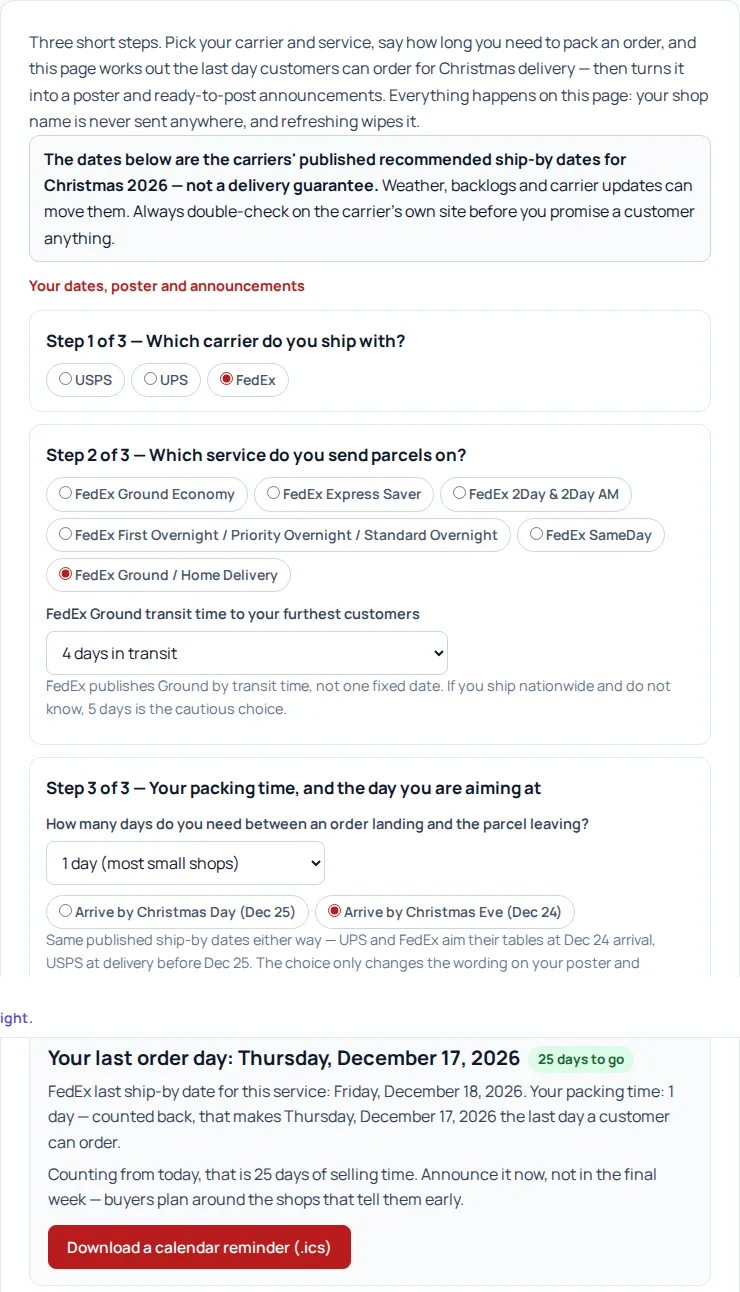
- Step 1: pick your carrier — USPS, UPS or FedEx. Choose the one your parcels actually go out with, not the one you might switch to in a busy week.
- Step 2: pick your service from that carrier’s list — for example USPS Priority Mail, UPS 2nd Day Air or FedEx 2Day. The page shows that service’s published ship-by date, so check it matches the table you expected.
- If you picked FedEx Ground or Home Delivery, also pick the transit time to your furthest customers: 1, 2, 3, 4 or 5 days. FedEx publishes this service by transit time, not one fixed date, and 5 days is the safe pick if you ship nationwide and are not sure.
- Step 3: set your packing time — 0 if you pack and ship the same day, or 1, 2 or 3 days. One day is what most small shops need; include making time if goods are made to order.
- Still in Step 3, choose your target arrival: Dec 25 (Christmas Day) or Dec 24 (Christmas Eve). The published ship-by dates are the same either way; the choice only changes the wording on your poster and announcements.
- Read the result: your last order day, counted back from the ship-by date. If it has already passed, the page says so plainly — use the after-cut-off wording rather than quietly hoping.
- Make the date visible: type your shop name, pick a poster colour, download the poster PNG and post it where customers look. Copy the announcements that fit, then download the .ics calendar reminder so the date nags you too.
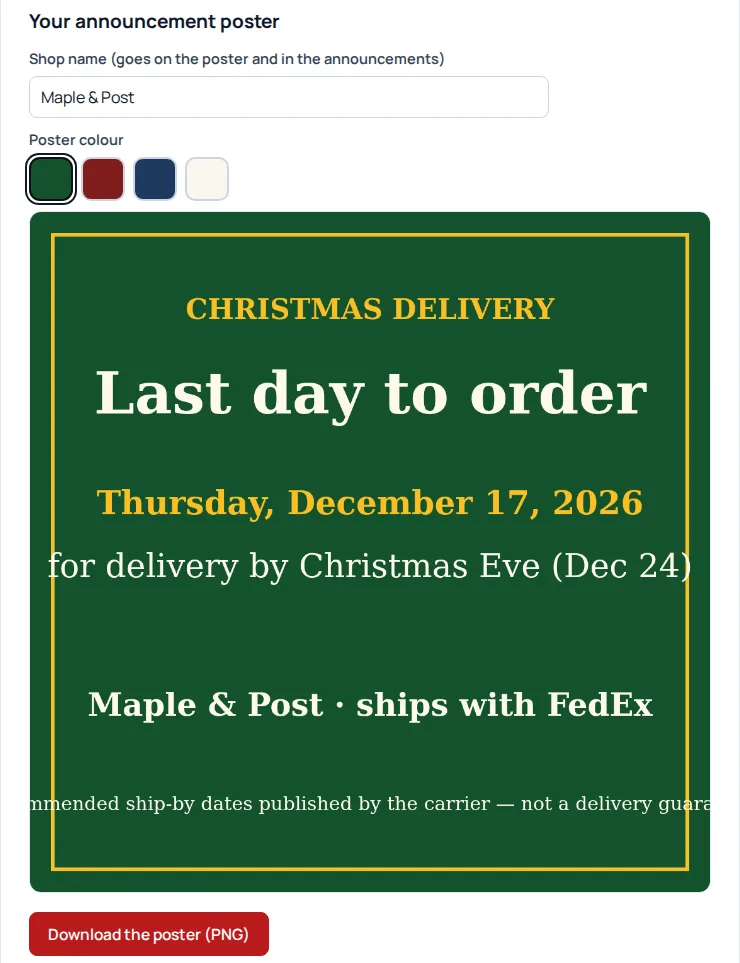
Announce the order day, never the ship day. “Order by Dec 17” is something a buyer can act on. “We ship until Dec 18” asks them to do your packing maths for you, and most will do it optimistically.
Three worked examples, counted by hand
First, a typical small shop on USPS Priority Mail. The ship-by date is Dec 18. Packing takes 1 day. Dec 18 minus 1 day = order by Dec 17. That is the date for the banner, the listing header and the email subject line — not Dec 18.

Second, a maker who needs real making time. She ships UPS 2nd Day Air, ship-by Dec 22, and each piece takes 3 days to make and pack. Dec 22 minus 3 days = order by Dec 19. Notice what did not help: UPS sells a faster product, Next Day Air on Dec 23, but she does not ship on it, so it buys her nothing. If she wants a later cut-off, the honest levers are a faster service she actually uses or a shorter making time — not a bolder promise.
Third, the FedEx Ground case, where there is no single date to memorise. A seller whose furthest customers are 5 transit days away gets a ship-by date of Dec 17. With 2 packing days, Dec 17 minus 2 = order by Dec 15. A seller across town from most buyers, at 1 transit day, starts from Dec 23 instead. Same carrier, same service name, six days apart — which is exactly why the calculator asks for transit time instead of printing one Ground date.
Limits: recommended dates, not promises
Every date here is a carrier’s published recommended ship-by date for Christmas 2026. Recommended is the carriers’ own word, and it matters. Hand a parcel over by that date, on that service, and it is scheduled or expected to arrive in time. Weather, volume surges and last-minute carrier changes can still move things, and no calculator can overrule a snowstorm. Check the carrier’s own site again before you promise a customer anything specific, especially in the final week.
Coverage has edges too. The USPS dates above are for the contiguous U.S.; Alaska, Hawaii and the territories sit in a separate table, and Ground Advantage has no single offshore date. International, military and territory dates are different tables entirely and are not covered here. UPS Ground is not listed as a fixed date at all, because UPS does not publish one — the right day depends on how far the parcel travels, so look your lanes up on the UPS site. And these are 2026 dates: carriers rewrite the table every year, so never reuse this page’s numbers next December.
Sources: USPS holiday shipping dates page (https://www.usps.com/holiday/holiday-shipping-dates.htm), UPS holiday shipping schedule (https://www.ups.com/us/en/support/shipping-support/shipping-services/holiday-shipping-schedule), FedEx holiday schedule — 2026 Peak last day to ship sheet (https://www.fedex.com/content/dam/fedex/us-united-states/services/2026_Peak_Last_Day_to_ship.pdf).
The Verystep Holiday Shipping Deadline Calculator asks for your carrier in Step 1, your service in Step 2 (plus FedEx Ground transit days if that is your service), and your packing time and target arrival day in Step 3. It returns your last order day, a downloadable poster PNG with your shop name and poster colour, ten ready-to-copy announcements, and a .ics calendar reminder download. Nothing you type is sent anywhere.
Last verified November 22, 2026 — Step 1 carrier choices (USPS, UPS, FedEx), Step 2 services, the FedEx Ground transit-time options (1–5 days), Step 3 packing options (0–3 days) and target arrival choices (Dec 24 or Dec 25), the poster shop name and poster colour fields, the ten announcements, and the .ics calendar reminder download checked against the live Verystep Holiday Shipping Deadline Calculator; ship-by dates checked against the carriers’ official 2026 holiday pages as listed on the tool (USPS holiday shipping dates, UPS holiday shipping schedule, FedEx 2026 Peak last day to ship), baseline checked November 19, 2026; examples recomputed by hand: Dec 18 minus 1 packing day = Dec 17, Dec 22 minus 3 days = Dec 19, and FedEx Ground 5-day transit Dec 17 minus 2 days = Dec 15. Dates are the carriers’ recommendations, not guarantees.
Frequently asked questions
What is the difference between a ship-by date and a last order day?
The ship-by date is the last day you can hand the parcel to the carrier. The last order day is that date minus your packing time — the last day a customer can buy and still have the parcel leave on time. If you pack in a day and ship USPS Priority Mail (Dec 18), your last order day is Dec 17. Only same-day packers can treat the two dates as the same.
Which date should I put on my shop banner?
The last order day, always. Customers act on the last day they can order; they cannot act on the day you hand parcels over, because your packing time is invisible to them. The calculator turns your result into a poster and ten ready-to-copy announcements — banner line, email subject, final-week nudge, the day itself, and honest wording for after the cut-off — with your shop name and dates already filled in.
Why does FedEx Ground ask for transit days?
Because FedEx publishes Ground and Home Delivery by transit time, not as one fixed date: 1 day in transit ships by Dec 23, 2 days by Dec 22, 3 days by Dec 21, 4 days by Dec 18 and 5 days by Dec 17, all for arrival by Dec 24. If you ship nationwide and do not know your longest lane, pick 5 days — it is the cautious choice.
Are these dates a guarantee my parcel arrives by Christmas?
No. They are the carriers’ published recommended ship-by dates for Christmas 2026, checked on November 19, 2026. Weather, backlogs and carrier updates can still interfere. Treat the date as the last sensible day, not a promise, and recheck on the carrier’s own site before you assure a specific customer.
What if my last order day has already passed?
Say so, and keep selling honestly. The calculator includes an after-cut-off announcement: orders are still welcome and will still be posted, they just may arrive after Christmas. That wording protects your reviews far better than quietly accepting orders you already know are late.
More guides

The PPWR Empty Space Ratio: Why the 50% Cap Hits Your Shipping Box First
Ask a room of online sellers what the PPWR will change first and most will say labels. The duty with a number in it is quieter: from 2030 at the earliest, no more than half the volume of your shipping box may be empty — and the filler you stuff into it counts as empty.

Counting a Return Window: The EU 14-Day Cooling-Off Period Starts the Day After Delivery
A shop page says “14 days to return”. Fourteen days from when — the order, the dispatch, the delivery? And counted how — in calendar days or working days? EU law answers both questions, and the answers are not the ones most countdown banners use.

How to Check Gift Return Eligibility Without a Receipt
Black Friday is over, the gifts are changing hands, and some of them are the wrong size, the wrong color or the second one you own. There is no receipt — there never is with a gift — so the question is not “can I get my money back?” but “which route does this store actually offer someone in my position, and how long do I have?”