How to Convert Recipe Quantities Between Cups, Grams and Servings
A cup of flour and a cup of honey don't weigh anywhere near the same. Convert per ingredient, in the right order, and a US recipe turns into grams you can actually weigh.
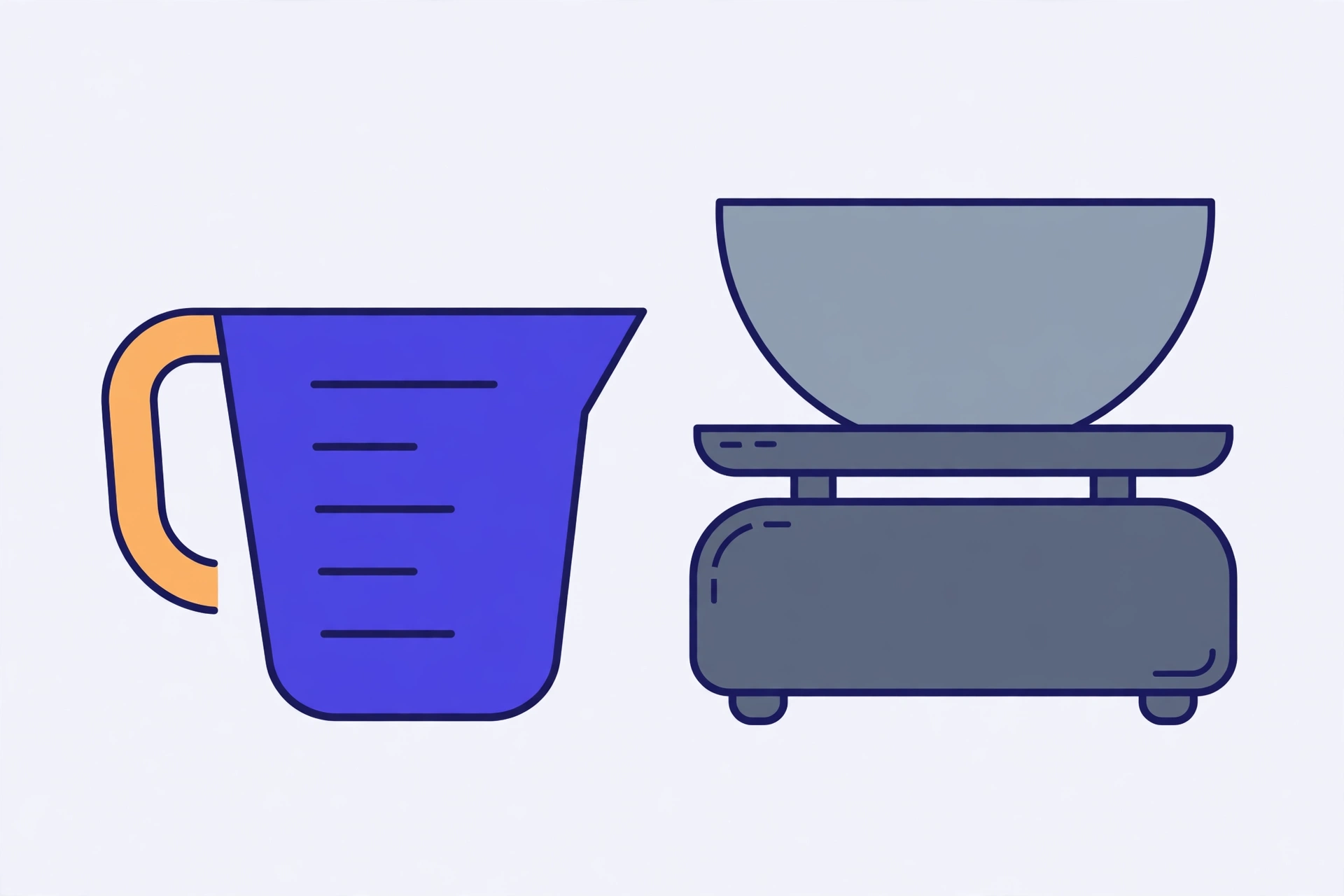
Converting a recipe between cups and grams fails when you treat a cup as a fixed weight. It isn't one. A cup is volume, and the weight inside it depends on the ingredient: one US cup of all-purpose flour weighs about 120 g, granulated sugar about 200 g, and honey about 340 g. The Cooking Converter handles that by asking for the Ingredient first, then applying that ingredient's density whenever you cross between volume and weight, and it shows the density it used. The result updates as you type, and the Swap button reverses the direction. Scaling for more servings is separate arithmetic: multiply every quantity by the new servings divided by the original servings, then convert each scaled quantity one ingredient at a time. This guide runs the conversions and the scaling in that order, with the numbers checked.
Set the ingredient first, every time
Open a US recipe with a metric kitchen scale in front of you and the problem shows up in the first line. The recipe says cups. Your scale says grams. A single cups-to-grams number can't bridge that gap, because a cup measures space, not weight. Fill that space with flour and you hold about 120 g. Fill it with granulated sugar and you hold about 200 g. Fill it with honey and you're at about 340 g, nearly three times the flour. Any converter that gives you one answer for all three is guessing, and your bake pays for the guess.
That's why the Cooking Converter puts the Ingredient field ahead of the amount in practice. The fields are Amount, Ingredient, From and To, and whenever a conversion crosses between volume and weight, the tool multiplies or divides by the density for the ingredient you picked. Weight equals cups times density. It also shows the density used in the result, so you can see which figure produced your answer instead of trusting a black box. Pick the wrong ingredient and the maths still runs, cleanly, to the wrong weight. The order in the steps below exists to stop that.
Convert and scale in seven steps
Conversion and scaling are two separate jobs. Convert one ingredient at a time, and if you're changing the serving count, scale first, then convert the scaled quantities.
- Set the Ingredient field first, before you type any amount, so the converter uses the right density.
- Enter the amount you have in the Amount field.
- Set the From and To units, for example cups to grams, and read the result, which updates as you type.
- Use the Swap button to reverse the direction without re-entering the amount.
- To scale a recipe, multiply every quantity by the new number of servings divided by the original number of servings.
- Convert each scaled quantity one ingredient at a time, resetting the Ingredient field for each one.
- Weigh flour spooned and levelled rather than scooped, so one cup stays close to 120 g.
Notice there's no Convert button to hunt for. The result updates as you type, so changing the Amount, the Ingredient or either unit re-runs the calculation on the spot. That makes checking a second ingredient fast: change the Ingredient field, keep your place in the recipe, and read the new figure. Just make sure you actually change it. Carrying flour's density into the sugar line is the single most common way this goes wrong.
Worked examples: flour, sugar, honey and a serving scale-up
Start with flour. Set the Ingredient to all-purpose flour, enter 2.5 in the Amount field, set From to cups and To to grams. The converter uses a density of about 120 g per US cup, so the result is 2.5 times 120, which is 300 g. Weigh out 300 g and you've matched the recipe's two and a half cups.
Now run the same one-cup amount through three ingredients to see why the Ingredient field matters. One cup of all-purpose flour converts to 120 g. One cup of granulated sugar, at about 200 g per cup, converts to 200 g. One cup of honey, at about 340 g per cup, converts to 340 g. Same volume, three very different weights, and a cake built on the wrong one either collapses or turns to brick. Cocoa sits at the light end, at about 100 g per cup, which is why cocoa-heavy recipes punish guessing hardest.
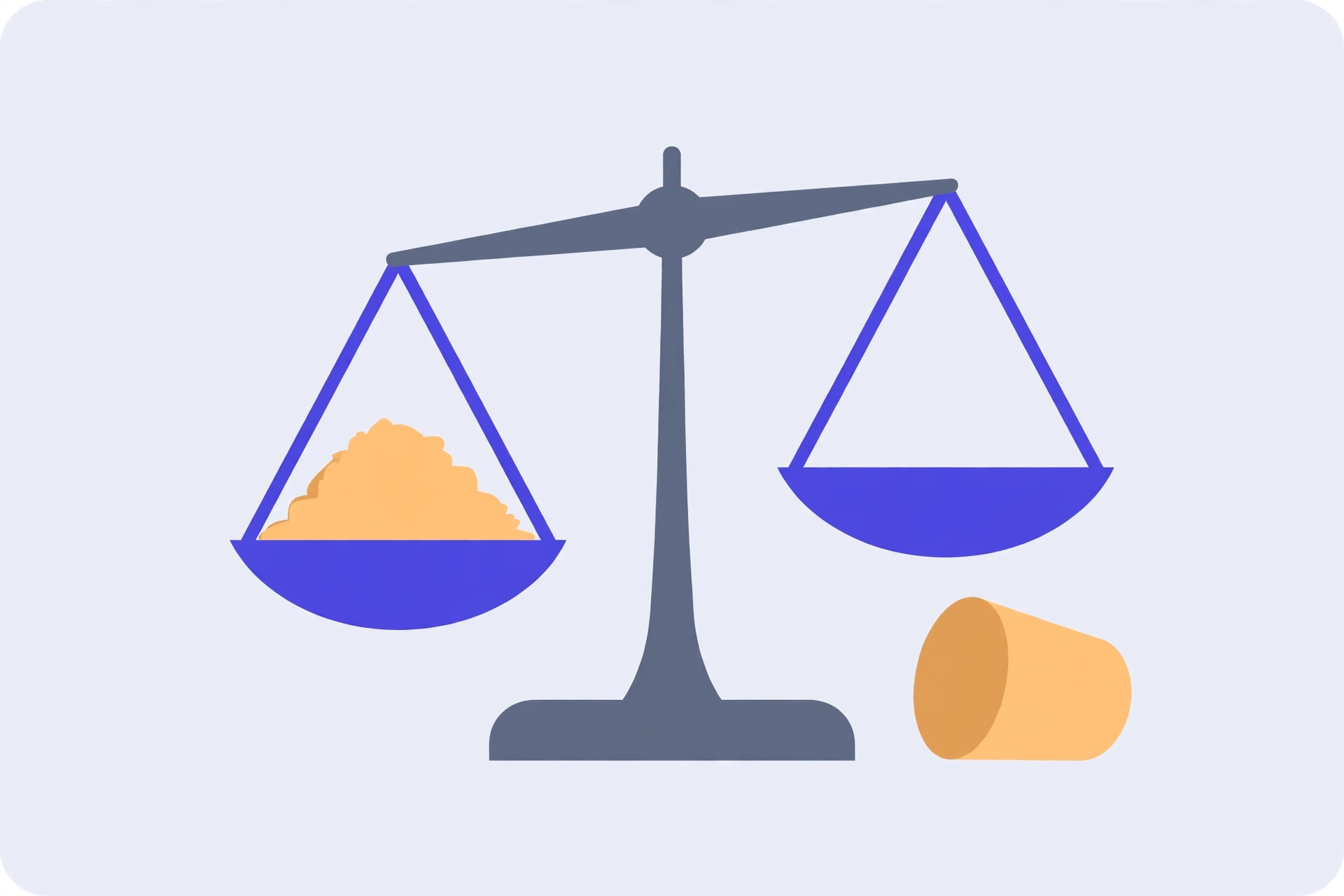
Scaling works on top of that. Say a recipe serves 4 and you need 6 servings. The multiplier is the new servings divided by the original servings: 6 divided by 4, which is 1.5. Multiply every quantity in the recipe by 1.5 first. Two cups of flour become 3 cups, one cup of sugar becomes 1.5 cups, half a cup of honey becomes 0.75 cups. Then convert each scaled quantity with its own ingredient selected: 3 cups of flour is 3 times 120, so 360 g; 1.5 cups of sugar is 1.5 times 200, so 300 g; 0.75 cups of honey is 0.75 times 340, so 255 g. Scale everything by the same factor, convert everything separately. Mixing those two steps up is how quantities drift.
The two traps: which cup, and how the flour got into it
Trap one is the cup itself. The converter's densities are built on the US cup, which is 236.588 ml. A metric cup is 250 ml. That gap is about 5.7%, small enough to ignore in a soup and big enough to matter in a sponge cake, where 2.5 metric cups of flour would weigh roughly 317 g instead of 300 g. If your measuring jug is metric and the recipe is American, convert by weight with the converter rather than filling your jug to the cup line and hoping. Tablespoons and teaspoons scale cleanly inside the US system, at 1/16 of a cup and 1/48 of a cup, and ounces convert at 28.3495 g, with a pound at 453.592 g, for recipes that mix systems.
Trap two is scooping. The 120 g flour figure assumes the flour was spooned into the cup and levelled off. Drag the cup through the bag and the flour packs down, and that same cup can weigh 140 g or more. Across three cups you've added the weight of half a cup without changing the recipe at all. If you weigh, the problem mostly disappears, since the scale reads what's actually there. If you measure by volume, spoon and level, and expect your cup to land near the density the converter used.
Limits: densities are references, not laws
The densities here are standard reference values, in line with the King Arthur Baking ingredient weight chart, and they're the right starting point for home baking. They still describe an average ingredient. Brown sugar packs or sits loose depending on how you fill the cup, chopped nuts vary with the chop, and grated cheese varies with the grater. For those, treat the converted weight as a close guide and weigh the ingredient in the form the recipe intends, packed or loose, rather than expecting one density to cover every state.
Scaling has limits too. The multiplier arithmetic is exact for quantities, but a recipe scaled far up or down doesn't always behave identically: leavening, pan size, cooking time and seasoning intensity don't all scale in straight lines. Doubling or halving is routine. Scaling a 4-serving recipe to 40 is a new cooking problem wearing the old recipe's numbers. Stay near the original size, convert each ingredient on its own density, and the cups-to-grams side of the job, at least, is solved.
The Verystep Cooking Converter has Amount, Ingredient, From and To fields and a Swap button, and the result updates as you type. Set the Ingredient first so cross conversions between volume and weight use that ingredient's density, convert each ingredient on its own, and use Swap to flip the direction without re-entering anything.
Last verified November 20, 2026 — Amount, Ingredient, From and To fields, Swap button and as-you-type result checked against the live Verystep Cooking Converter, and all worked examples recomputed: 2.5 cups of all-purpose flour at 120 g per cup gives 300 g, 1 cup of granulated sugar gives 200 g, 1 cup of honey gives 340 g, and scaling 4 servings to 6 multiplies every quantity by 1.5 (3 cups flour = 360 g, 1.5 cups sugar = 300 g, 0.75 cups honey = 255 g).
Frequently asked questions
Why can't I use one cups-to-grams number for every ingredient?
Because a cup is volume and grams are weight, and the bridge between them is density, which changes per ingredient. One US cup of all-purpose flour is about 120 g, granulated sugar about 200 g and honey about 340 g. The converter asks for the Ingredient first and shows the density it used, so each conversion uses the right bridge.
How do I scale a recipe from 4 servings to 6?
Multiply every quantity by the new servings divided by the original servings: 6 divided by 4 is 1.5, so every amount grows by half. Then convert each scaled quantity separately with its own ingredient selected. Two cups of flour becomes 3 cups, which converts at 120 g per cup to 360 g.
What is the difference between a US cup and a metric cup?
A US cup is 236.588 ml and a metric cup is 250 ml, a difference of about 5.7%. The converter's densities are based on the US cup. If your jug is metric and the recipe is American, converting to grams and weighing avoids the gap entirely.
Why did my flour weigh more than the converter said?
Almost certainly the scooping trap. The 120 g per cup figure assumes flour spooned into the cup and levelled. Scooping the cup through the bag packs the flour, and one cup can reach 140 g or more. Weighing the flour removes the guesswork, since the scale reads the packed weight directly.
What does the Swap button do?
It reverses the From and To units in one click, so a cups-to-grams conversion becomes grams-to-cups with the same amount still in place. It's the fast way to check a conversion in the other direction, for example when a metric recipe gives you grams and your measuring cups are what you have to hand.
More guides

The PPWR Empty Space Ratio: Why the 50% Cap Hits Your Shipping Box First
Ask a room of online sellers what the PPWR will change first and most will say labels. The duty with a number in it is quieter: from 2030 at the earliest, no more than half the volume of your shipping box may be empty — and the filler you stuff into it counts as empty.

Counting a Return Window: The EU 14-Day Cooling-Off Period Starts the Day After Delivery
A shop page says “14 days to return”. Fourteen days from when — the order, the dispatch, the delivery? And counted how — in calendar days or working days? EU law answers both questions, and the answers are not the ones most countdown banners use.

How to Check Gift Return Eligibility Without a Receipt
Black Friday is over, the gifts are changing hands, and some of them are the wrong size, the wrong color or the second one you own. There is no receipt — there never is with a gift — so the question is not “can I get my money back?” but “which route does this store actually offer someone in my position, and how long do I have?”