How to Check EU Pet Entry Requirements Before You Travel
A Christmas trip with your dog is booked in an afternoon. The paperwork behind it runs on clocks of 21 days, 90 days and ten days — and one of those clocks may already be too late to start.

Since 22 April 2026, pet dogs, cats and ferrets move into and around the EU under Regulation (EU) 2016/429 and Delegated Regulation (EU) 2026/131. The regulation most older guides still quote, Regulation (EU) No 576/2013, was repealed on that date, so check any checklist you find against the current texts. The shape of the trip decides the workload. Your animal needs compliant identification — a microchip, or a clearly readable tattoo applied before 3 July 2011 — and a rabies vaccination given after that identification, at 12 weeks of age or older, with 21 days past since the primary course was completed. From a third country you enter on an animal health certificate issued within ten days before arrival, through a designated travellers’ point of entry. From a country on neither official list, add a rabies antibody titration: sample at least 30 days after the primary vaccination, at least 0.5 IU/ml at a designated laboratory, and the certificate issued at least 90 days after the sample. Dogs bound for Finland, Ireland, Malta, Northern Ireland or Norway also need a tapeworm treatment 24 to 120 hours before entry. Non-commercial means at most five animals travelling with you or an authorised person. The worked examples below put dates on all of it: a listed-country dog can be ready in about seven weeks; a non-listed one needs 120 days from vaccination to the earliest lawful entry.
The mechanism: the route decides the rulebook, and the lists decide the blood test
EU pet rules are not one checklist. They are a small decision tree, and the first fork is the journey itself. A dog moving between two member states travels on an EU pet passport. A dog arriving from outside the EU travels on an animal health certificate, and how much work sits behind that certificate depends on where it is coming from. The European Commission and Your Europe pet-travel pages describe the same structure in plain language; the legal texts behind them are Regulation (EU) 2016/429, the Animal Health Law, and Delegated Regulation (EU) 2026/131, which has governed these movements since 22 April 2026. Anything you read that still cites Regulation (EU) No 576/2013 or Implementing Regulation (EU) No 577/2013 as the live law is quoting a repealed rulebook — the substance often looks similar, but details that strand travellers, such as the certificate model and the blood-test exemption, have moved.

Three layers stack up. The base layer never changes: identification first, then rabies vaccination, because a vaccination given before the chip was implanted does not count. The route layer changes with the origin: the official Annex I and Annex II lists to Implementing Regulation (EU) 2026/636 sort third countries into listed and non-listed, and a non-listed origin adds the antibody titration with its long fuse. The destination layer is the one people forget: a handful of tapeworm-free destinations add a treatment window measured in hours, and the entry state and the destination state are judged separately — your first EU airport is not always the place whose extra rules apply. The checker follows exactly this structure, which is why it asks about the shape of the movement before it asks about any document.
One more gate before the layers: is the movement non-commercial at all?
The whole rulebook above covers non-commercial movements — your own pet, travelling with you, not for sale or transfer. The checker tests that first, as four separate elements: the species (dog, cat or ferret; other animals sit under different rules), the purpose, the number — at most five animals in one movement — and who carries them, meaning you, or an authorised person travelling within five days of your own journey. Fail one of those tests and you are not looking at stricter paperwork; you are in a different legal regime altogether, the commercial one, and the checker says so and stops rather than walking you down the wrong path. Answer for one animal and one trip, and answer honestly: the preparation list at the end is only as good as the answers going in.
Check your trip in the order the checker asks, step by step
Have three things beside you before you start: the animal’s vaccination record with dates, the microchip number and implantation date, and your travel dates. Where a date decides the answer — the 21 days, the titration’s 90 days — the checker asks for the dates and does the counting, but only when every condition for counting holds.
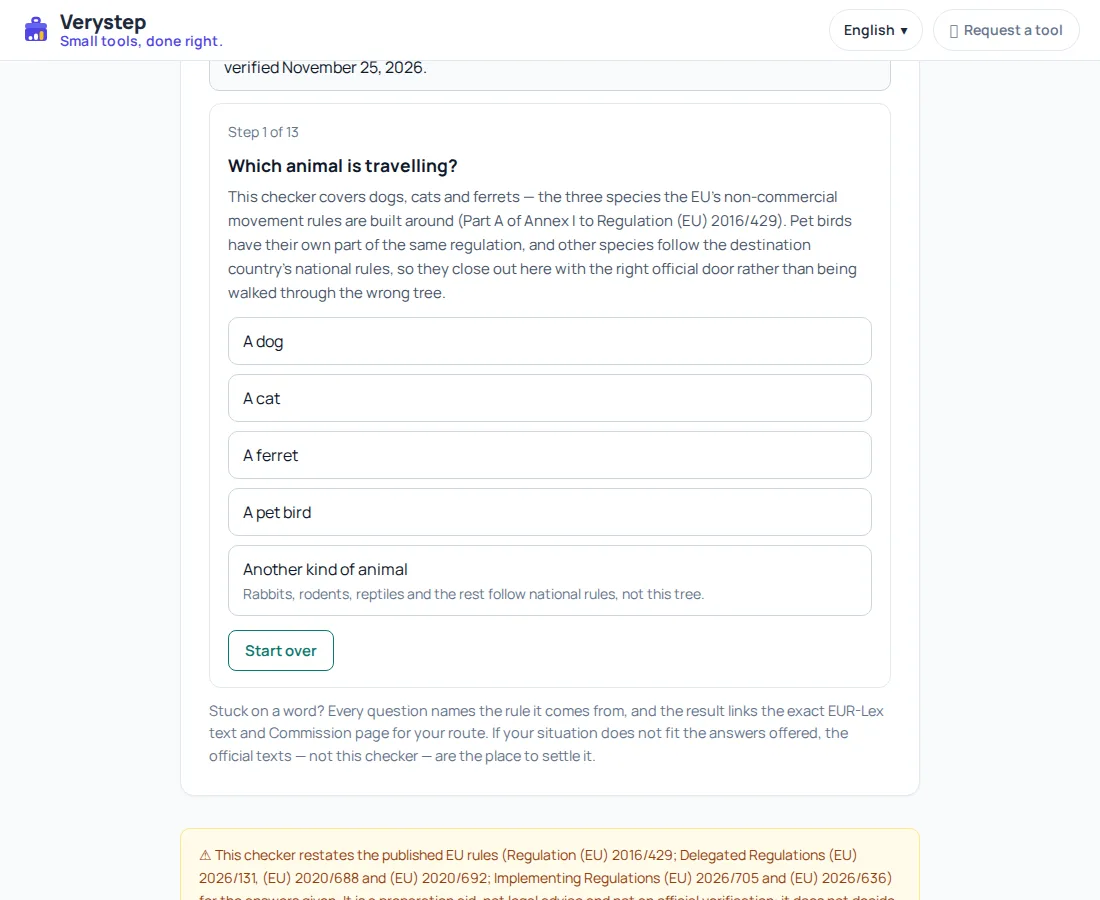
- Say which animal is travelling and clear the non-commercial tests: a dog, cat or ferret, your own pet, no more than five animals, carried by you or an authorised person within five days of your journey. Expect a sale, a transfer or a sixth animal to end the check here — that movement runs under the commercial regime instead.
- Pick the shape of the trip: between member states, in from a third country, an EU pet coming home, or a transit. For a third-country entry, classify the origin against the official Annex I and Annex II lists the question links to — the checker never prints the lists, because they change, so confirm your country’s current group yourself. Expect this one answer to decide whether the blood test appears later.
- Answer how the animal is identified: an ISO microchip, or a clearly readable tattoo applied before 3 July 2011. A non-standard chip raises a follow-up about reading equipment. Expect the identification date to matter in the next step — it is the anchor date of the whole file.
- State where the rabies vaccination stands: given after the identification, at 12 weeks of age or older, by an authorised vet, with the primary course completed and 21 days past. A booster inside the previous validity keeps the cover unbroken; a booster after a lapse is a new primary course and restarts the 21 days. Expect the checker to calculate the earliest lawful travel date from your completion date — or to refuse a date where a precondition, such as a vaccination given before the chip, has failed.
- Where your route needs the rabies blood test, give its status, the sampling date, the laboratory and the result: sample at least 30 days after the primary course, tested at a designated laboratory, at or above 0.5 IU/ml, with vaccination cover unbroken since. From a non-listed country this step is compulsory. From a listed country, do not assume either way — Article 17(2) of Delegated Regulation (EU) 2026/131 sets the test aside only for three shapes of movement, such as travelling directly with an owner habitually resident in that country, so the checker asks about the movement itself in three parts.
- Answer for the documents. Between member states: the EU pet passport, issued in the member state where you habitually live — a passport issued in Great Britain is not valid for EU entry, while a Northern Ireland one is a different document and remains valid. From a third country: the animal health certificate on the current Annex III model to Implementing Regulation (EU) 2026/705, issued by an official vet within ten days before arrival, and entry through a designated travellers’ point of entry. Expect the old certificate model to trigger a question about its issue date, because it is recognised only inside a transition — issued before 1 October 2026, for entries before 31 March 2027.
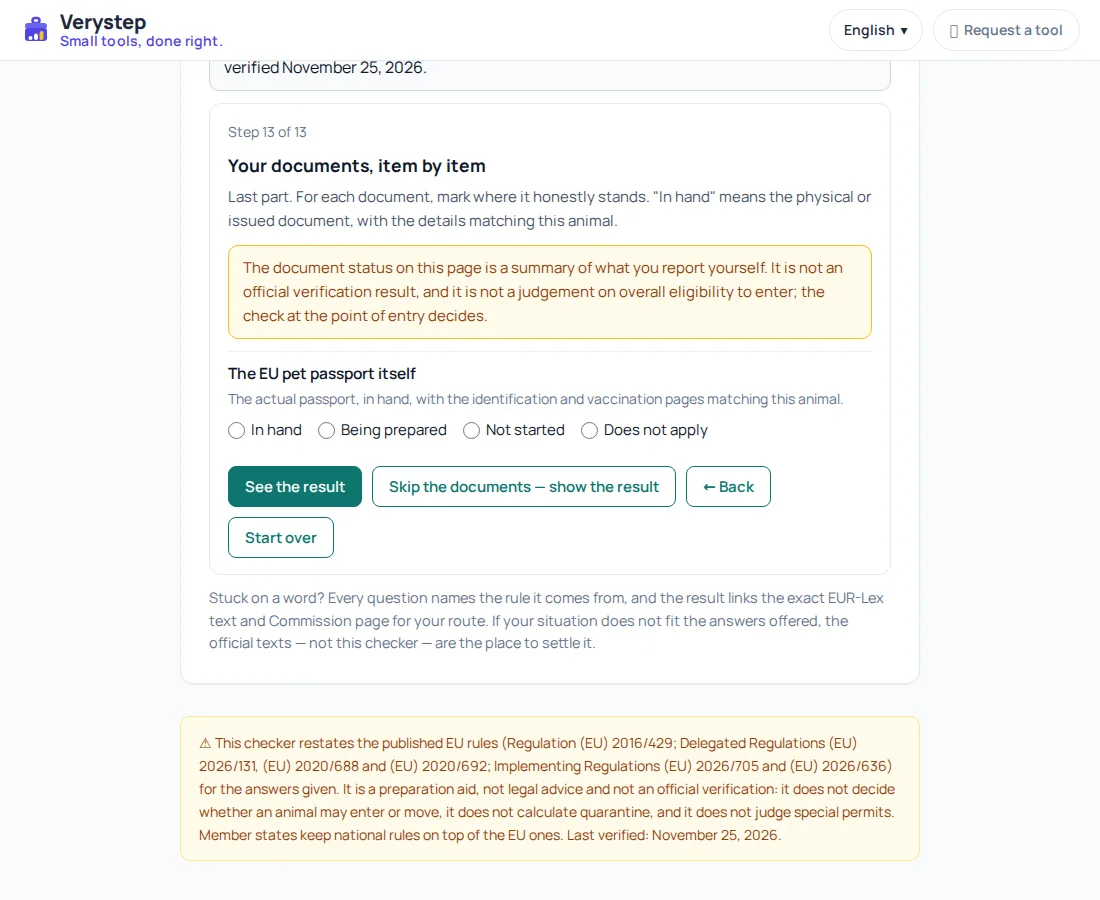
- Finish with the destination layer and your document status. For a dog bound for Finland, Ireland, Malta, Northern Ireland or Norway, the tapeworm (Echinococcus) treatment must fall 24 to 120 hours before entry, recorded by the treating vet — 20 hours is too early, however tidy the rest of the file looks. Young animals have their own branch, and from a third country there is no young-animal shortcut: full vaccination standard first. Then mark each document honestly — in hand, being prepared, not started, does not apply — and read the result in its three columns: sorted, still to do, to verify, with the entry state and the destination state kept apart.
Worked examples: a listed-country dog makes Christmas, a non-listed one does not
First, the straightforward case. A family dog flies from the United States — an Annex II listed country — to Germany for Christmas, travelling directly with its owner, who lives in the US. The chip goes in first; the primary rabies course is completed on 2 November 2026, the dog being well over 12 weeks old. Count 21 days: the vaccination takes effect on 23 November 2026. Because the movement fits the first Article 17(2) shape — direct, with the owner habitually resident in the listed country — no titration is needed; the listing alone would not have exempted the dog, the shape of the movement does. The official vet issues the certificate on 14 December; entry on 20 December is six days later, inside the ten-day window. Germany adds no tapeworm layer. Total runway: 48 days from vaccination to wheels-down, and most of it is the 21-day wait.
Now change one answer — the origin — and watch the calendar collapse. Same dog, same Christmas plan, but coming from a country on neither list. The primary course is completed earlier this time, on 1 September 2026. The blood sample cannot be drawn before 1 October, 30 days later. It comes back at or above 0.5 IU/ml from a designated laboratory — good news that changes nothing about the next clock: the certificate may only be issued at least 90 days after the sample, which lands on 30 December 2026. Add it up and the full sequence runs 120 days from vaccination to the earliest lawful entry. Christmas is missed by five days, not because anything went wrong, but because the owner started in September. For a non-listed origin, the honest advice this arithmetic gives is to count backwards from the travel date before booking anything — and for a dog also bound for, say, Ireland, to slot the tapeworm treatment into the final 24 to 120 hours before entry, neither with the certificate appointment nor at the airport café.
Limits and boundaries: what a preparation list cannot settle
The checker restates the published rules for the answers you give. It does not decide whether an animal may enter — the document and identity check at the travellers’ point of entry makes that call, and a member state may refuse entry where the conditions are not met. It does not calculate quarantine, because there is no standard EU quarantine to calculate; non-compliance is handled case by case, at the owner’s expense. It does not judge special permits, such as those for animals from shelters or for scientific purposes.
Three practical boundaries follow. The lists move: the Annex I and II country lists, the designated laboratories and the points of entry all change — two countries joined Annex II in June 2026 alone — so a classification you made in summer deserves a fresh look before a December trip, and the official list wins over anything printed here. Member states keep national rules on top of the EU floor — breed rules, registration, rules for other species — which the checker flags but does not reproduce. And the animal’s own fitness to fly, carrier rules and your vet’s judgement about this particular dog or cat sit outside the legal file entirely; ask your vet, and for the paperwork an official or authorised vet, well before the ten-day certificate window opens.
Sources: Regulation (EU) 2016/429 (Animal Health Law), Articles 245–246; Delegated Regulation (EU) 2026/131, including Article 14 (certificate validity: ten days for the entry checks, then six months in total for onward movement or until the vaccination expires) and Article 17(2) (the titration exemption shapes for listed countries); Implementing Regulation (EU) 2026/705, Annex III certificate model and Article 6(3) transition; Implementing Regulation (EU) 2026/636, Annex I and II country lists; Delegated Regulation (EU) 2020/688, Annex VII (the 21 days; the 24–120 hour tapeworm window); Delegated Regulation (EU) 2020/692, Annex XXI (the 30/90 days and 0.5 IU/ml); European Commission and Your Europe pet-travel pages. General information only — not legal advice, and not a substitute for your vet or the official texts.
The Verystep EU Pet Import Checker walks one animal and one trip through the 2026 rules in the order this guide follows — species and the non-commercial tests, the route and the origin-country lists, identification, the rabies vaccination and its 21 days, the blood test where your route needs one, the documents, and the destination’s own layer — then sorts everything into sorted, still to do, and to verify, with a printable preparation list. It runs entirely in your browser; your answers are never uploaded or stored. It restates the published rules for the answers you give — the officers at the point of entry make the final call.
Last verified November 28, 2026 — the live EU Pet Import Checker re-read in full (its own baseline: last verified November 25, 2026) and this guide aligned to its actual question flow: species; the non-commercial tests (purpose, five-animal cap, authorised carriage within five days); route shape (internal, third-country entry, return, transit); origin classified against the Annex I/II lists to Implementing Regulation (EU) 2026/636; identification (microchip, or tattoo from before 3 July 2011); rabies vaccination after identification at 12 weeks or older with the 21 days counted only when all preconditions hold; titration (sample at least 30 days after the primary course, designated laboratory, at or above 0.5 IU/ml, certificate at least 90 days after the sample, Article 17(2) of Delegated Regulation (EU) 2026/131 exemption shapes for listed countries); documents (passport tied to the member state of habitual residence; GB-issued passport invalid, Northern Ireland passport valid; certificate on the Annex III model to Implementing Regulation (EU) 2026/705 issued within ten days of entry, old model recognised only if issued before 1 October 2026 for entries before 31 March 2027; six months’ onward validity after the entry check under Article 14); designated travellers’ point of entry; tapeworm treatment 24–120 hours before entry to Finland, Ireland, Malta, Northern Ireland or Norway; young-animal branch with no third-country derogation. Legal frame checked against the checker’s cited texts: Regulation (EU) 2016/429, Delegated Regulation (EU) 2026/131 (in force for these movements since 22 April 2026, when Regulation (EU) No 576/2013 was repealed), Implementing Regulations (EU) 2026/705 and (EU) 2026/636, Delegated Regulations (EU) 2020/688 Annex VII and (EU) 2020/692 Annex XXI, and the European Commission / Your Europe pet-travel pages. Example arithmetic recomputed: primary course completed 2 November 2026 + 21 days = in effect 23 November 2026; certificate issued 14 December, entry 20 December = 6 days, inside the ten-day window; 2 November to 20 December = 48 days. Non-listed example: course completed 1 September 2026, earliest sample 1 October 2026 (+30 days), earliest certificate 30 December 2026 (+90 days), total 120 days. General information only — not legal advice.
Frequently asked questions
My guidebook still cites Regulation 576/2013. Can I rely on it?
Not for the details. Regulation (EU) No 576/2013 was repealed with effect from 22 April 2026, and these movements now run under Regulation (EU) 2016/429 with Delegated Regulation (EU) 2026/131. Much of the substance feels familiar — chip, rabies vaccination, certificate — but the certificate model, the passport’s link to where the owner habitually lives, and the blood-test exemption for listed countries all changed. Check any older checklist against the current texts or the Commission’s pet-travel pages.
We are flying in from a listed country. Do we still need the rabies blood test?
Maybe — the listing alone does not settle it. Under Article 17(2) of Delegated Regulation (EU) 2026/131 the test is set aside only where the movement itself fits one of three shapes: direct from the listed country with the owner habitually resident there; an animal whose previous stays were only in listed countries; or a transit through a non-listed country with no contact with susceptible animals and the signed transit declaration. If none of the three fits, the titration is required even though the country is listed.
How early do we honestly need to start for a Christmas trip?
Count backwards from the entry date. From a listed country, the binding wait is usually the 21 days after the primary vaccination, plus a certificate appointment inside the last ten days — the worked example needed 48 days from vaccination to entry. From a non-listed country, the sequence is fixed and long: vaccination, at least 30 days to the blood sample, at least 90 more days before the certificate can be issued — 120 days in total, which puts a September start on 30 December. If your dates do not fit, they do not fit; no vet can shorten a statutory wait.
Our dog’s tapeworm treatment was given 20 hours before we land in Ireland. Is that close enough?
No. For Finland, Ireland, Malta, Northern Ireland and Norway the treatment must fall between 24 and 120 hours before entry, recorded by the treating vet. Twenty hours is outside the window on the early side, just as six days would be outside it on the late side. The fix the checker shows is to re-time the entry or re-treat inside the window — and the window is judged against the destination, not your first EU airport.
Is a British pet passport still valid for entering the EU?
A passport issued in Great Britain is not valid for entry into the EU or for movements between member states since Brexit; the trip needs the animal health certificate instead. A passport issued in Northern Ireland is a different document and remains valid. Inside the EU, the current rules also tie the passport to the member state where the owner habitually lives.
More guides

The PPWR Empty Space Ratio: Why the 50% Cap Hits Your Shipping Box First
Ask a room of online sellers what the PPWR will change first and most will say labels. The duty with a number in it is quieter: from 2030 at the earliest, no more than half the volume of your shipping box may be empty — and the filler you stuff into it counts as empty.

Counting a Return Window: The EU 14-Day Cooling-Off Period Starts the Day After Delivery
A shop page says “14 days to return”. Fourteen days from when — the order, the dispatch, the delivery? And counted how — in calendar days or working days? EU law answers both questions, and the answers are not the ones most countdown banners use.

How to Check Gift Return Eligibility Without a Receipt
Black Friday is over, the gifts are changing hands, and some of them are the wrong size, the wrong color or the second one you own. There is no receipt — there never is with a gift — so the question is not “can I get my money back?” but “which route does this store actually offer someone in my position, and how long do I have?”