How to Calculate Ti-Hi and Cartons Per Pallet
Ti is how many cartons fit in one layer. Hi is how many layers you may stack. Multiply them and you have the pallet — but two separate limits decide the Hi, and only one of them gets the final say.
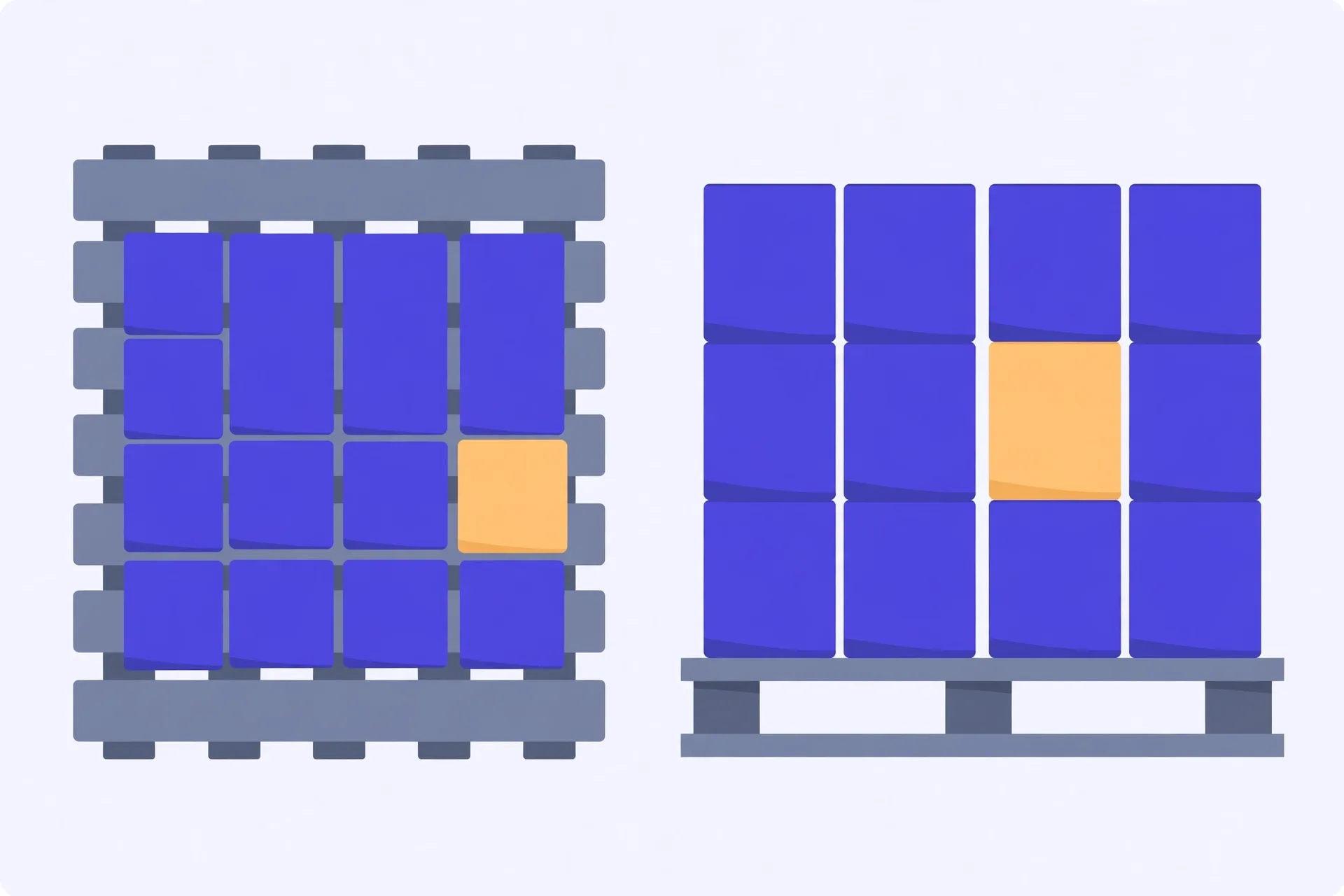
The Ti-Hi Pallet Calculator counts a uniform pallet load in three moves. Ti comes from fitting the carton footprint onto the pallet both ways round: Ti = max(floor(pallet length ÷ a) × floor(pallet width ÷ b), floor(pallet length ÷ b) × floor(pallet width ÷ a)), a uniform grid with no overhang. Hi is then capped twice — by height, floor((maximum overall height − deck height) ÷ carton height), with a deck of 144 mm (140 mm on the 48×40 pallet, 144 mm assumed for custom sizes), and by weight, floor(floor(load limit ÷ carton weight) ÷ Ti) — and the smaller Hi wins. Only full layers count. The result is a count, not a stability or safety certification, and the optional cost and value figures stay in page memory only, never in the URL.
Ti counts a layer, Hi counts the stack
Ti-Hi is warehouse shorthand, and once you hear it spelled out it sticks. Ti is the number of cartons in one layer — the count you'd get if you covered the pallet deck exactly once. Hi is the number of layers stacked on top of each other. Cartons per pallet is simply Ti multiplied by Hi, which is why getting either number wrong throws the whole pallet count off by a full layer's worth of cartons.
Ti sounds like a single division, but it isn't. A carton footprint can sit on the pallet two ways: length along the pallet's length, or turned ninety degrees so the length runs along the pallet's width. Those two orientations rarely fit the same count, because the remainders fall differently. The calculator tries both and keeps the better one: Ti = max(floor(pallet length ÷ a) × floor(pallet width ÷ b), floor(pallet length ÷ b) × floor(pallet width ÷ a)), where a and b are the carton's length and width. Every carton in the layer points the same way. That's a uniform grid — no mixed orientations, no interlocking patterns, and nothing hanging over the pallet edge.
Hi has two masters, and this is the part people skip. Height gives one cap: how many carton heights fit between the deck and your maximum overall stack height. Weight gives another: how many full layers your load limit can carry. A tall, light load runs into the ceiling first. A short, dense one runs out of weight allowance while there's still air above it. The reported Hi is whichever cap is smaller, and the guide's two worked examples below are chosen so each limit wins once.
Calculate Ti-Hi in seven steps
Measure once, carefully — every result on the page descends from the carton dimensions you type first.
- Measure the outside of one packed carton and enter its length, width and height, with height as the vertical side, in the unit you measured in.
- Pick your pallet from the Pallet list, or choose Custom size… and enter the custom pallet length and width.
- Enter the Maximum overall stack height (pallet included) and set its Height unit — the limit is the full height, pallet and all.
- If you know them, add the Gross weight per carton and the Maximum pallet load weight, and set the Weight unit to kg or lb.
- Read the Ti from both orientations, the Hi allowed by height, and the Hi allowed by weight, and note which limit gives the smaller Hi.
- Check the reported cartons per pallet, overall height and total load against your own limits before you build the pallet.
- Add Units per carton and the Unit purchase cost in USD if you want the unit count and total value for the full pallet.
Step three trips people up. The maximum height on this page includes the pallet itself, because that's how racking clearances and door heights are measured in real buildings. The calculator subtracts the deck height — 144 mm on most listed pallets, 140 mm on the North American 48×40, and 144 mm assumed for a custom size — before it divides by your carton height. If you enter a height that was meant to be cartons only, you'll get a layer more than your space allows.
Worked example one: height sets the limit
Start with cartons of 60 × 40 × 40 cm on a EUR/EPAL pallet, 1200 × 800 mm, with a maximum overall stack height of 180 cm. Try the footprint both ways. Length along length: floor(120 ÷ 60) is 2 across, floor(80 ÷ 40) is 2 deep, so 2 × 2 = 4 cartons. Turned around: floor(120 ÷ 40) is 3, floor(80 ÷ 60) is 1, so 3 × 1 = 3. The better orientation wins, and Ti is 4.
Now the height cap. The deck takes 14.4 cm of the 180 cm limit, leaving 165.6 cm for cartons. Divide by the 40 cm carton height: floor(165.6 ÷ 40) is 4 layers. What about weight? Say each carton weighs 12 kg and the load limit is 1000 kg. The limit allows floor(1000 ÷ 12) = 83 cartons, and 83 cartons at a Ti of 4 is 20 full layers — far above the height cap. Height binds. Hi is 4.
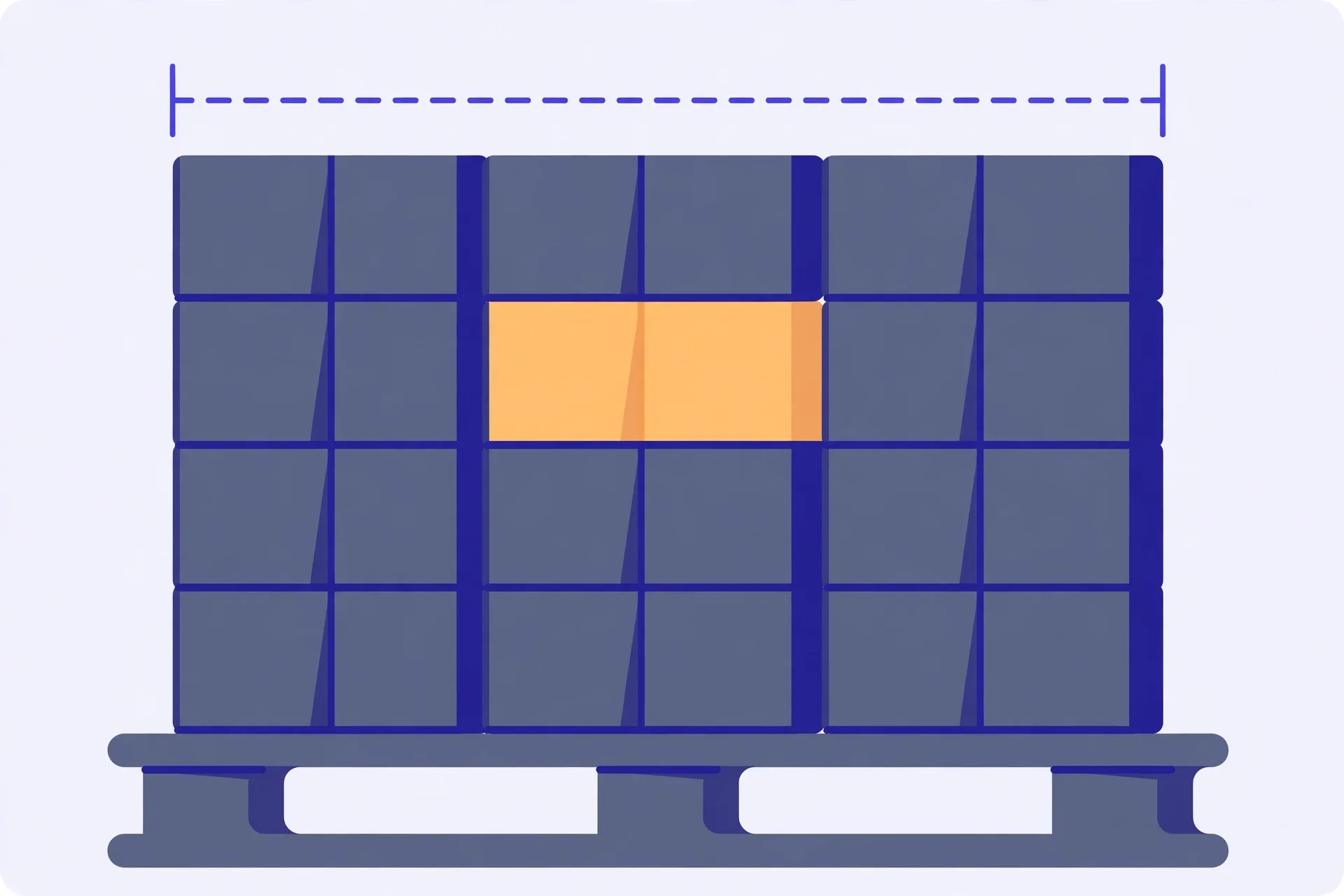
So the pallet holds 4 × 4 = 16 cartons, and its overall height is the 14.4 cm deck plus four 40 cm layers: 174.4 cm, inside the 180 cm limit with a little air to spare. Fill in the optional value fields — 24 units per carton at a unit purchase cost of $2.50 — and the same pallet carries 384 units worth $960.00. Those two figures are arithmetic on your own entries, shown for the load in front of you; they don't travel anywhere.
Worked example two: weight sets the limit
Now a denser load. Cartons of 40 × 30 × 30 cm go onto a North American 48×40 pallet — 1219 × 1016 mm — with a maximum overall stack height of 200 cm, a load limit of 400 kg, and cartons weighing 8 kg each. Footprint first. One way: floor(121.9 ÷ 40) is 3, floor(101.6 ÷ 30) is 3, giving 9 cartons. Turned: floor(121.9 ÷ 30) is 4, floor(101.6 ÷ 40) is 2, giving 8. Ti is 9.
Height allows plenty. This pallet's deck is 14.0 cm, so floor((200 − 14.0) ÷ 30) gives 6 layers. But weight won't carry six. The 400 kg limit divided by 8 kg per carton allows 50 cartons, and 50 cartons at a Ti of 9 is 5 full layers — the sixth layer would need 54 cartons, over the carton count the weight permits. Only full layers count, so the leftover allowance for five cartons doesn't buy you a partial layer. Weight binds. Hi is 5.
The finished pallet holds 9 × 5 = 45 cartons. Its overall height is 14.0 cm of deck plus five 30 cm layers: 164.0 cm, well under the 200 cm cap — which is exactly what a weight-bound stack looks like, short and heavy. The total load is 45 × 8 kg = 360 kg, under the 400 kg limit. With 12 units per carton at $4.00 a unit, that's 540 units worth $2,160.00 on the pallet. Same calculator, opposite binding limit: that's why the page reports Hi by height and Hi by weight side by side instead of hiding the loser.
What the count doesn't promise
Be clear about what you've got at the end of this: a count. The calculator tells you how many cartons of one size fit a uniform grid on a given pallet, under the height and weight limits you entered. It doesn't judge whether that stack is stable, whether the cartons at the bottom can bear the load above them, or whether the load suits your racking, your wrap or your carrier's rules. A count is not a stability or safety certification, and a tall stack that fits on paper still needs a warehouse judgement before it moves.
The grid assumption cuts both ways. A skilled loader using mixed orientations or an interlocked pattern might fit cartons this page says won't fit — the tool won't chase that, because a uniform grid is the pattern you can repeat, wrap and hand to someone else. Likewise there's no overhang in these results, ever: a carton that only fits by hanging past the deck edge is counted as not fitting.
Two practical habits close the job. First, measure the packed carton, not the product — tape, bulge and cushioning all count, and a centimetre of wishful thinking per carton becomes a layer that doesn't fit. Second, if you used the optional cost fields, remember where those numbers live: in the page's memory, on your device, for this session. They aren't written into the URL or sent anywhere, so if you need the value figure later, note it down before you close the tab.
The Verystep Ti-Hi Pallet Calculator takes your carton length, width and height, your pallet — EUR/EPAL, North American 48×40, ISO sizes or a custom footprint — a maximum overall stack height, and optional carton weight, load limit, units per carton and unit cost. It returns Ti for both orientations, Hi by height and by weight, cartons per pallet, overall height, load, units and value. Counts run in your browser; cost and value figures stay in page memory only and never go into a URL.
Last verified November 19, 2026 — field names, pallet sizes, deck heights and the Ti and Hi formulas checked against the live Verystep Ti-Hi Pallet Calculator, and both worked examples recomputed by hand (EUR example: Ti 4, Hi 4, 16 cartons, 174.4 cm, 384 units, $960.00; 48×40 example: Ti 9, Hi 5, 45 cartons, 164.0 cm, 360 kg, 540 units, $2,160.00).
Frequently asked questions
What do Ti and Hi actually mean?
Ti is the number of cartons in one layer on the pallet; Hi is the number of layers. Cartons per pallet is Ti × Hi. In the first worked example, a Ti of 4 and a Hi of 4 give 16 cartons per pallet; in the second, Ti 9 and Hi 5 give 45.
Why does the calculator try the carton both ways round?
Because the two orientations fit different counts. A 60 × 40 cm footprint on a 1200 × 800 mm pallet fits 2 × 2 = 4 cartons one way and 3 × 1 = 3 the other. The formula takes the maximum of the two — but every carton in the layer points the same way, in a uniform grid with no overhang.
Which decides Hi, the height limit or the weight limit?
Whichever allows fewer full layers. Hi by height is floor((maximum overall height − deck height) ÷ carton height); Hi by weight is floor(floor(load limit ÷ carton weight) ÷ Ti). The reported Hi is the smaller of the two — height bound the EUR example at 4 layers, while weight bound the 48×40 example at 5 of the 6 layers height alone would have allowed.
Why won't it count a partial top layer?
Because Ti-Hi describes complete, repeatable layers. In the second worked example the weight limit allowed 50 cartons, which is 5 full layers of 9 plus 5 spare cartons — but 5 loose cartons aren't a layer, so Hi stayed at 5 and the pallet count stayed at 45. If you do top a pallet off with a partial layer, count those cartons separately from the Ti-Hi figure.
Does a good result mean my pallet is safe to ship?
No. The calculator returns counts only — cartons per layer, layers, totals, height and load. It is not a stability or safety certification, and it can't assess carton strength, wrap, racking or carrier rules. Use the count for planning quantities and space, then apply your own warehouse judgement before the pallet moves.
More guides

The PPWR Empty Space Ratio: Why the 50% Cap Hits Your Shipping Box First
Ask a room of online sellers what the PPWR will change first and most will say labels. The duty with a number in it is quieter: from 2030 at the earliest, no more than half the volume of your shipping box may be empty — and the filler you stuff into it counts as empty.

Counting a Return Window: The EU 14-Day Cooling-Off Period Starts the Day After Delivery
A shop page says “14 days to return”. Fourteen days from when — the order, the dispatch, the delivery? And counted how — in calendar days or working days? EU law answers both questions, and the answers are not the ones most countdown banners use.

How to Check Gift Return Eligibility Without a Receipt
Black Friday is over, the gifts are changing hands, and some of them are the wrong size, the wrong color or the second one you own. There is no receipt — there never is with a gift — so the question is not “can I get my money back?” but “which route does this store actually offer someone in my position, and how long do I have?”