How to Work Out Your Daily Water Intake
Two fields, one click, and a number that is easy to misread. The calculator gives you total water from all sources, not a jug you have to empty, and this guide shows you how to run it and split that total honestly.
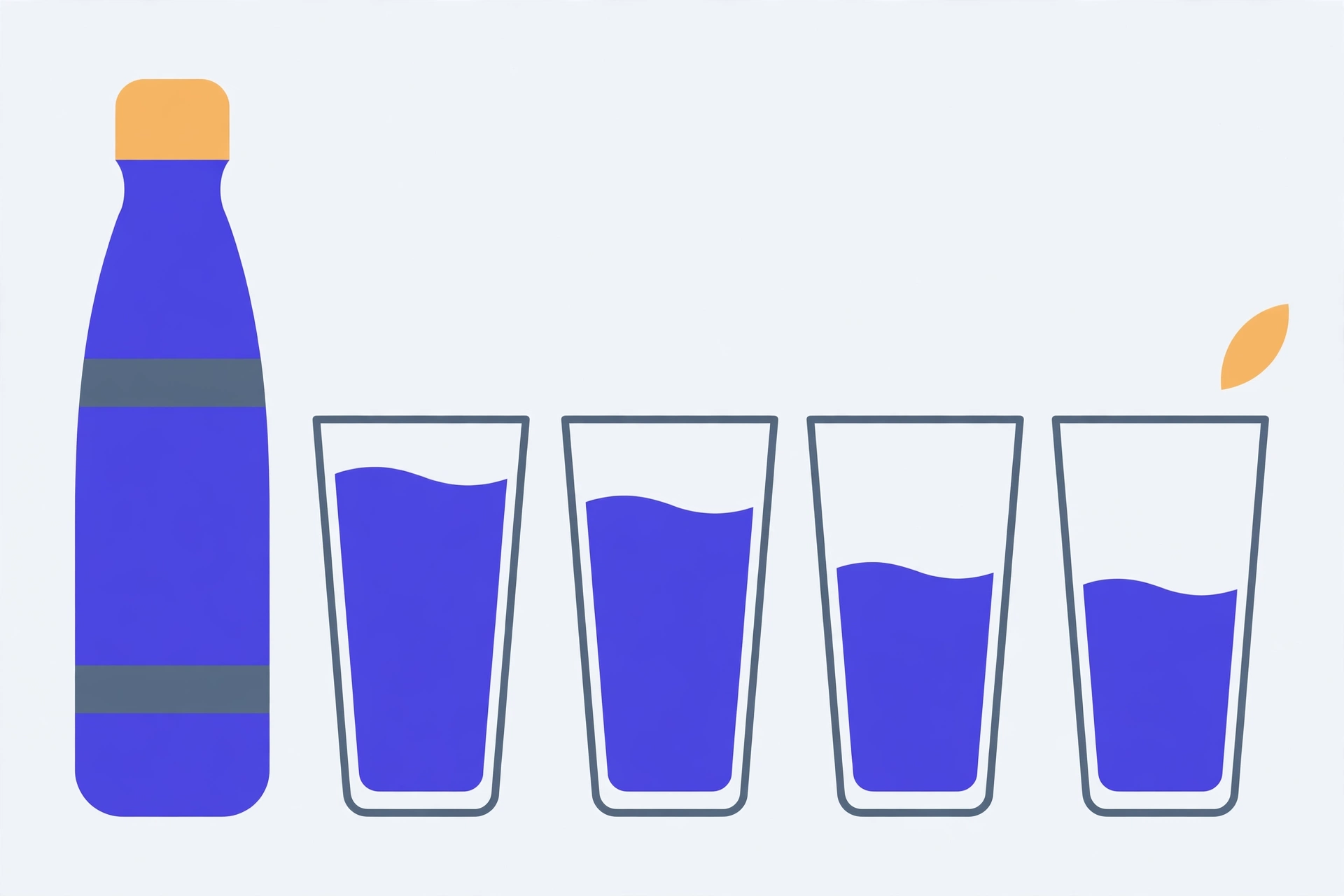
The Water Intake Calculator builds its estimate from two inputs: Weight (kg) and Exercise (min/day). The baseline is roughly 33 ml per kg of body weight, so a 70 kg person starts at about 2.3 litres. Exercise adds roughly 0.4 litres for every 30 minutes, taking that same person to about 2.7 litres. That total counts water from all sources, and about 20 percent of a typical day's water arrives in food, which leaves roughly 2.2 litres as drinks for the 70 kg example and about 1.3 litres for a sedentary 50 kg person. The result is a general starting estimate, not medical advice. Heat, health conditions and medication can shift real needs a long way, and thirst and urine colour are better real-time signals than any fixed number.
What the number is, and what it is not
Start with the limit, because it shapes everything else on this page. The figure this calculator returns is a general estimate built from a simple rule of thumb, roughly 33 ml of water per kilogram of body weight per day, plus an allowance for exercise. It is not medical advice, it is not a diagnosis, and it is not a personal target anyone has set for you. It is a starting point for understanding the scale of a day's water, nothing stronger than that.
The second thing to get straight is what the total counts. It counts water from all sources: the drinks on your desk, yes, but also the water inside soup, fruit, rice, yoghurt and everything else you eat. On a typical day roughly 20 percent of total water arrives in food. So when the calculator says 2.7 litres, it has not asked you to drink 2.7 litres. Part of that total is already on your plate. Reading the headline figure as a drinking quota is the single most common way people misread this tool, and it makes a sensible estimate look like a chore nobody could finish.
The inputs are deliberately plain. There is a Weight (kg) field and an Exercise (min/day) field, and a Calculate button. No age bands, no diet questionnaires, no activity multipliers with names you have to decode. That simplicity is the point and also the limit, and the last section of this guide covers what a two-input model leaves out.
Run the estimate in seven steps
The whole run takes under a minute. The care goes into the last two steps, where you split the total and decide how much weight to give it.
- Enter your body weight in the Weight (kg) field.
- Enter your usual daily exercise time in the Exercise (min/day) field, or leave it at zero on a rest day.
- Click Calculate and read the base figure, which is your weight multiplied by about 33 ml per kg.
- Add the exercise allowance the calculator applies, roughly 0.4 litres for every 30 minutes of exercise.
- Read the total as water from all sources, meaning drinks plus the water that arrives in food.
- Take roughly 20 percent off the total for food water to get the amount that would come as drinks.
- Treat the result as a starting estimate and adjust by thirst, urine colour, heat and how the day actually feels.
If your weight is in pounds, convert it before you type. Divide pounds by 2.2046 to get kilograms, or near enough, halve the pounds and subtract a tenth of that half. A 154 lb person lands at about 70 kg, which is the worked example below, so you can sanity-check your conversion against it.
Worked examples, checked by hand
Take a 70 kg person who exercises for 30 minutes a day. The base comes first: 70 multiplied by 33 ml gives 2,310 ml, which rounds to about 2.3 litres. That matches the calculator's table, which lists 70 kg at 2.3 litres before exercise. Next, the exercise allowance: roughly 0.4 litres for those 30 minutes. Add it and the total is about 2.7 litres, again matching the table's 2.7 in the plus-30-minutes column.
Now split it. Food supplies roughly 20 percent of 2.7 litres, which is about 0.54 litres, a bit over half a litre arriving in meals and snacks without you pouring anything. Subtract that and you get about 2.16 litres, call it roughly 2.2 litres, as drinks. That is the number most people actually wanted when they opened the tool, and it only appears once you do the split. In glasses of about 250 ml, 2.2 litres is roughly nine glasses spread across a whole day, which reads very differently from the raw 2.7.
Run the quieter case too. A 50 kg person with no exercise enters 50 and zero. The base is 50 multiplied by 33 ml, which is 1,650 ml, or 1.65 litres total. Take off roughly 20 percent for food, about 0.33 litres, and the drinks share is about 1.32 litres, roughly 1.3 litres. The calculator's table tells the same story at other weights: 60 kg gives 2.0 litres, or 2.4 with 30 minutes of exercise; 80 kg gives 2.6, or 3.0; 90 kg gives 3.0, or 3.4; 100 kg gives 3.3, or 3.7. Each step up is just the 33 ml rule doing its arithmetic.
Mistakes that distort the result
The first mistake is the one from the top of this page: treating the total as a drinking target. That inflates the job by about a fifth and puts people off a number that was never unreasonable. Always do the food split before you judge the figure.
Second, entering pounds into a kilogram field. A 154 lb person who types 154 gets a base over 5 litres, which should look wrong on sight, and it does, but only if you pause to look. Third, double-counting exercise: adding a long workout in the Exercise field and then mentally adding extra on top again because the day felt active. The allowance is already in the total. Fourth, treating one run as a permanent figure. A rest day, a travel day and a training day are three different days, and the honest move is to rerun the two fields rather than stretch one result across all of them. Fifth, chasing the number litre by litre. The inputs are round rules of thumb, so the output carries that roughness with it. Quoting it to two decimal places pretends to a precision the method never had.
Where the estimate stops
A two-input model cannot see your day. Hot, humid weather pulls water out through sweat at rates a mild day never approaches, and the same goes for physical work, fever and long hours in dry, air-conditioned air. Health conditions and medication can shift fluid needs in either direction, sometimes by a lot, and pregnancy and breastfeeding change the picture again. None of that is in the Weight or Exercise fields, and no tweak to the 33 ml rule can put it there. If any of those apply to you, the calculator's figure is background context at best, and a clinician who knows your situation outranks it completely.
Your body also sends live signals that beat any estimate. Thirst is one. Urine colour is another: pale straw generally tracks with a day that is going fine, while consistently dark urine tracks with a day that is not. Those signals respond to the day you are actually having, in the climate you are actually in, which is exactly what a formula cannot do. Use the number to understand the rough scale, then let the signals steer.
One last limit cuts the other way. More is not automatically better. Overhydration is real: drinking far beyond need, especially in a short window, can dilute blood sodium to dangerous levels. So do not turn an estimate into a contest, do not force water down past thirst to hit a figure, and do not treat a higher total as a healthier one. The calculator gives you a starting estimate. What you do across a normal day, guided by thirst and how you feel, matters more than landing on its decimal.
The Verystep Water Intake Calculator takes two inputs, Weight (kg) and Exercise (min/day), and one click on Calculate. It applies roughly 33 ml per kg as a baseline, adds about 0.4 litres per 30 minutes of exercise, and returns a total-from-all-sources figure you can split into food water and drinks, all in your browser with nothing uploaded.
Last verified November 20, 2026 — Weight (kg) and Exercise (min/day) fields and the Calculate button checked against the live Verystep Water Intake Calculator, and both worked examples recomputed offline: 70 kg gives a 2.31 L base (70 x 33 ml), about 2.7 L total with 30 minutes of exercise at roughly 0.4 L per 30 minutes, and about 2.2 L as drinks after roughly 20 percent food water; 50 kg sedentary gives 1.65 L total and about 1.3 L as drinks, matching the tool's weight table.
Frequently asked questions
Does the total mean I have to drink that much water?
No. The total counts water from all sources, and roughly 20 percent of a typical day's water arrives in food. In the 70 kg worked example, the 2.7 litre total becomes about 2.2 litres as drinks once you take the food share off. Read the headline figure as all-sources first, then split it.
How does the calculator work out the base figure?
It multiplies your weight in kilograms by roughly 33 ml. So 50 kg gives 1.65 litres, 70 kg gives about 2.3 litres and 100 kg gives 3.3 litres. Exercise then adds roughly 0.4 litres for every 30 minutes you enter in the Exercise (min/day) field.
My weight is in pounds. What do I enter?
Convert first: divide pounds by 2.2046 to get kilograms. A 154 lb person is about 70 kg, so they would enter 70 and land on the worked example in this guide, about 2.3 litres base and roughly 2.7 litres total with 30 minutes of exercise. Entering 154 directly would more than double the estimate.
Is this figure medical advice for me personally?
No. It is a general estimate from a rule of thumb, and the tool says so itself. Climate, health conditions, medication, pregnancy and breastfeeding can all shift real needs, and thirst and urine colour are better real-time guides. Anyone with a condition that affects fluids should follow their own clinician's guidance, not a calculator.
Can drinking too much water be a problem?
Yes. Overhydration exists, and drinking far beyond need, especially quickly, can dilute blood sodium to dangerous levels. That is one more reason to treat the result as a rough starting estimate rather than a quota to force down. Let thirst steer the day and use the number only for scale.
More guides

The PPWR Empty Space Ratio: Why the 50% Cap Hits Your Shipping Box First
Ask a room of online sellers what the PPWR will change first and most will say labels. The duty with a number in it is quieter: from 2030 at the earliest, no more than half the volume of your shipping box may be empty — and the filler you stuff into it counts as empty.

Counting a Return Window: The EU 14-Day Cooling-Off Period Starts the Day After Delivery
A shop page says “14 days to return”. Fourteen days from when — the order, the dispatch, the delivery? And counted how — in calendar days or working days? EU law answers both questions, and the answers are not the ones most countdown banners use.

How to Check Gift Return Eligibility Without a Receipt
Black Friday is over, the gifts are changing hands, and some of them are the wrong size, the wrong color or the second one you own. There is no receipt — there never is with a gift — so the question is not “can I get my money back?” but “which route does this store actually offer someone in my position, and how long do I have?”