Hours and Daylight Saving: Two Days a Year Are Not 24 Hours
Your timesheet assumes every day has 24 hours. Two days a year break that assumption — and a night shift that crosses one of them is where the missing, or extra, hour lands.

Daylight saving time does not change how long you work; it changes what the clock says while you work it. In spring, clocks jump forward 60 minutes and the day has 23 hours; in autumn they fall back and the day has 25. Directive 2000/84/EC fixes the European changeovers at 1.00 a.m. GMT on the last Sunday in March and the last Sunday in October — in 2026, 29 March and 25 October. The United States changes on the second Sunday in March and the first Sunday in November — in 2026, 8 March and 1 November. A shift calculator adds wall-clock minutes: end minus start minus break. That arithmetic is exact on 363 days a year and off by exactly one hour on a changeover night, because the calculator has no calendar and cannot know that one hour never happened, or happened twice. Ordinary week: five shifts of 09:00–17:00 with a 30-minute break total 37.5 hours either way. Changeover night shift, 22:00–06:00 with a 30-minute break: the wall clock says 7.5 hours, but you actually worked 6.5 hours in spring and 8.5 in autumn.
Wall-clock time is not elapsed time: the mechanism behind the 23- and 25-hour days
Two different things share the word “hour”. Elapsed time is physics: how much time actually passes between the moment you clock in and the moment you clock out. Wall-clock time is labelling: the numbers a clock on the wall shows. On almost every day of the year the two march together, one labelled hour per elapsed hour. Daylight saving breaks the lockstep twice a year, on purpose, by relabelling.

The European rule is written down in one short directive. Article 1 of Directive 2000/84/EC defines the summer-time period as the “period of the year during which clocks are put forward by 60 minutes compared with the rest of the year”. Article 2 then fixes the start: “the summer-time period shall begin, in every Member State, at 1.00 a.m., Greenwich Mean Time, on the last Sunday in March”. Article 3 fixes the end in the same pattern: it “shall end, in every Member State, at 1.00 a.m., Greenwich Mean Time, on the last Sunday in October”. Because the switch happens at 1.00 a.m. GMT, the local jump lands at 02:00 in Central Europe: clocks leap from 02:00 to 03:00 in spring, so the hour between 02:00 and 03:00 simply never occurs, and in autumn they fall from 03:00 back to 02:00, so that hour occurs twice. Count the labelled hours and the spring day has 23, the autumn day 25.
The United States runs the same idea on different Sundays. As NIST states the rule on time.gov, daylight saving begins on the second Sunday in March and ends on the first Sunday in November, with clocks moving at 2:00 a.m. local time. For 2026 that gives concrete dates worth circling: Europe changes on 29 March and 25 October 2026; the United States changes on 8 March and 1 November 2026. Note the gaps between those pairs — three weeks in spring, one week in autumn — because they matter for anyone working across the Atlantic, as the last worked example shows.
How the calculator adds, and the one boundary that matters on changeover nights
The Hours Calculator does honest, simple arithmetic. Each shift is one row: end minus start, minus the break minutes you enter. Enter 09:00 and 17:00 with a 30-minute break and the row returns 7 hours 30 minutes. If the end is earlier than the start — 22:00 to 06:00, say — the calculator assumes the shift runs past midnight and adds a full day automatically, so overnight rows need no special handling. Add rows and it totals the week, showing the sum both as hours and minutes and as decimal hours.
Here is the boundary, stated plainly because it is the whole lesson of this guide: every one of those numbers is wall-clock arithmetic. The calculator knows no dates and no time zones. It cannot know that the night of 28–29 March 2026 contains no 02:00–03:00 hour in Europe, or that the night of 24–25 October contains that hour twice. So on a changeover night its answer differs from the elapsed time actually worked by exactly one hour — one hour too many in spring, one hour too few in autumn. That is not a bug and not a rounding issue. It is what any date-blind tool must do, and the fix is equally simple: use the calculator for the week, then adjust the changeover row by hand, in the direction the season dictates.
Add a week of shifts, step by step
Before you start, have the week in front of you as a list of shifts — start, end and unpaid break minutes for each day — and check whether any shift crosses a changeover: the last Sunday in March or October in Europe, the second Sunday in March or first Sunday in November in the US. One row per shift, in order, keeps the total auditable.
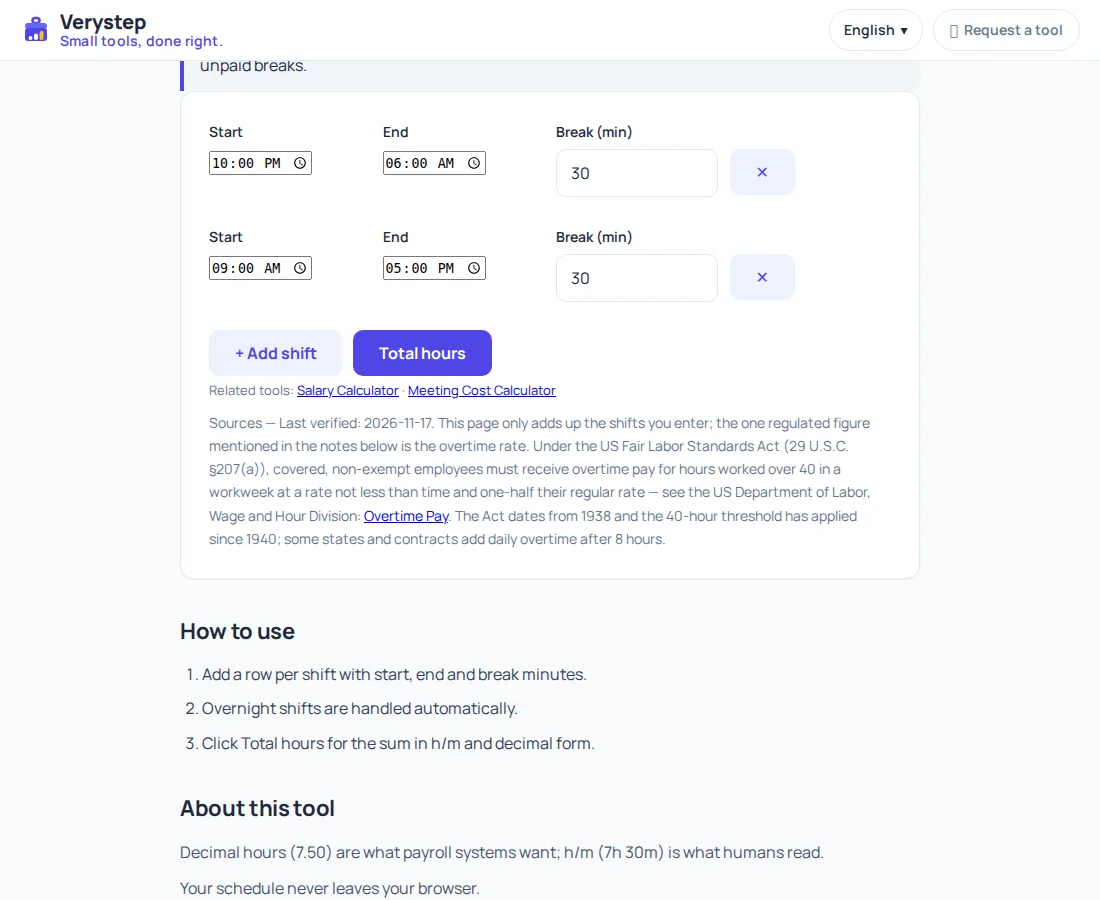
- Enter the first shift: type its start in the start field and its end in the end field, exactly as the rota shows them. Expect the row to accept overnight times too — an end earlier than the start is read as next-day, with a full day added automatically.
- Type that shift’s unpaid break in minutes in the break field — 30 for a half-hour lunch. Expect the break to be subtracted from this row only, so a day with no break honestly takes 0.
- Read the row result before moving on: it should equal end minus start minus break, in hours and minutes. If a row looks wrong, fix it now; a wrong row buried in a week total is much harder to spot later.
- Add one row for each remaining shift of the week and repeat the same three entries. Expect the running total to grow row by row, so a five-day week of identical shifts shows five identical rows — the pattern itself is a check.
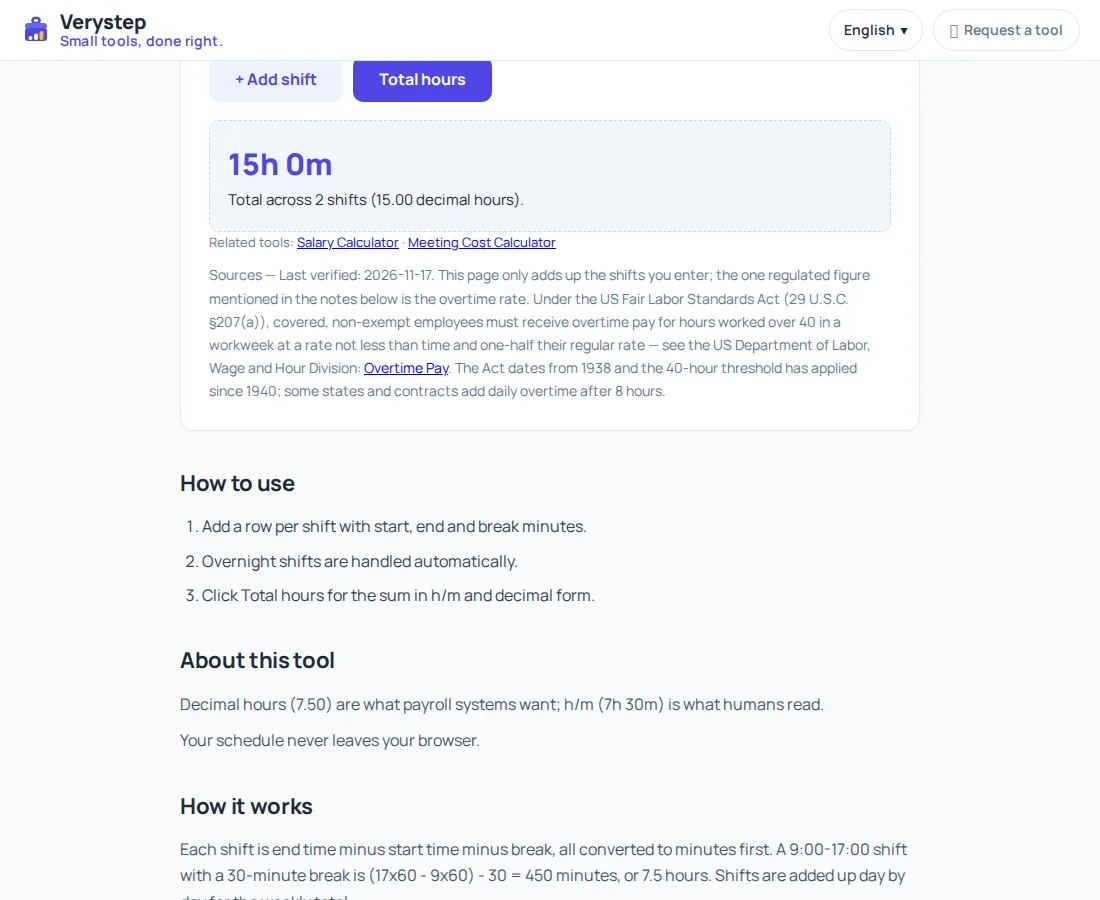
- Read the week’s total in both forms the tool shows: hours and minutes for the timesheet, and decimal hours for payroll, where decimal means minutes divided by 60 — 15 minutes is 0.25, 30 minutes is 0.5, 45 minutes is 0.75.
- If any row crossed a changeover night, correct that row’s contribution by hand before you use the total: subtract one hour for a spring-forward night, add one hour for a fall-back night. Expect the corrected figure, not the raw total, to match the elapsed time actually worked.
Worked examples: an ordinary week, two changeover nights, and one Atlantic wrinkle
Start ordinary. Monday to Friday, 09:00–17:00, 30-minute break. Each row: 8 hours minus 0.5 is 7.5 hours. Five rows total 37.5 hours for the week — 37 hours 30 minutes, and 37.5 in decimal. No changeover, no correction; the wall clock and the elapsed time agree.
Now the spring-forward night. A night shift on the European changeover night of 28–29 March 2026 is scheduled 22:00–06:00 with a 30-minute break. The wall-clock arithmetic the calculator performs: 22:00 to 06:00 is 8 hours, minus the break, 7.5 hours. But the 02:00–03:00 hour never happens that night — at 02:00 the clocks jump to 03:00. The elapsed time between clocking in and clocking out is therefore 7 hours, and minus the break the shift actually worked is 6.5 hours. Anyone paid from the raw total would be paid for an hour that did not exist.
The autumn night runs the other way. The same scheduled shift, 22:00–06:00 with a 30-minute break, on the fall-back night of 24–25 October 2026: the wall clock still says 7.5 hours. This time the 02:00–03:00 hour happens twice — the clock reaches 03:00, returns to 02:00, and climbs through the hour again. Elapsed time is 9 hours; minus the break, 8.5 hours actually worked. The raw total now short-changes the worker by an hour.
Finally, the cross-zone wrinkle, for support and on-call teams. A daily overlap booked as 09:00 in Berlin and 03:00 in New York rests on the normal six-hour gap between the two cities. Between the US spring change on 8 March 2026 and the European one on 29 March, New York is already on daylight time while Berlin is not, so the gap shrinks to five hours: 09:00 in Berlin is 04:00 in New York, not 03:00. A stand-up pinned to the New York clock drifts an hour earlier for Berlin for three weeks — and drifts again, briefly, in the autumn gap week. No calculator that ignores dates will warn you; the calendar has to.
Limits and boundaries: what the total is, and what it is not
The calculator totals the shifts you enter. It does not apply overtime law, rounding rules, night premiums or daylight saving by itself, and it does not know your contract. On a changeover night, record the actual elapsed hours — 6.5 or 8.5 in the examples above — and let your contract and local rules decide how those hours are paid; employers and payroll providers handle the spring hour and the doubled autumn hour under their own applicable rules.
One piece of context, not advice: in the United States, the Fair Labor Standards Act’s overtime rule is stated at 29 U.S.C. §207(a) — overtime at not less than one and one-half times the regular rate for hours worked over 40 in a workweek. Whether a given changeover shift crosses that line depends on the whole week’s actual hours, which is one more reason the elapsed-time figure, not the wall-clock figure, is the one to record. This guide is general information about how the arithmetic works — for a pay dispute, your contract, your payroll department or an adviser is the right address.
Sources: Directive 2000/84/EC on summer-time arrangements, Articles 1, 2 and 3, official text on EUR-Lex; National Institute of Standards and Technology (NIST), time.gov — US daylight saving begins the second Sunday in March and ends the first Sunday in November; 29 U.S.C. §207(a) (FLSA overtime). All shift arithmetic in the examples was recomputed by hand for this guide.
The Verystep Hours Calculator takes one row per shift — start, end and break minutes — adds a full day automatically when the end is earlier than the start, and shows your total in hours and minutes plus decimal hours. It works in wall-clock time and knows no dates or time zones, so on a daylight-saving changeover night you correct its total by one hour yourself, as this guide shows. It runs entirely in your browser; nothing you type is uploaded or stored.
Last verified November 27, 2026 — Directive 2000/84/EC quoted verbatim from the official text on EUR-Lex: Article 1 (summer-time period as the “period of the year during which clocks are put forward by 60 minutes compared with the rest of the year”), Article 2 (“the summer-time period shall begin, in every Member State, at 1.00 a.m., Greenwich Mean Time, on the last Sunday in March”) and Article 3 (“shall end, in every Member State, at 1.00 a.m., Greenwich Mean Time, on the last Sunday in October”); 2026 changeover dates derived from those rules and checked against the calendar — EU 29 March and 25 October 2026, both Sundays; US rules (second Sunday in March, first Sunday in November, 2:00 a.m. local) checked against NIST time.gov, giving 8 March and 1 November 2026; the Berlin–New York gap (normally 6 hours, 5 hours from 8 to 29 March 2026) checked against the two zones’ 2026 offsets; FLSA overtime context checked at 29 U.S.C. §207(a). The live Hours Calculator checked in all five languages (EN /hours/, ES /es/calculadora-de-horas-trabajadas/, PT /pt/calculadora-de-horas-trabalhadas/, FR /fr/calculateur-heures-de-travail/, DE /de/arbeitsstunden-rechner/): one row per shift with start, end and break minutes, end earlier than start treated as next-day, totals shown in hours/minutes and decimal hours, no date or time-zone input. All example arithmetic recomputed: 09:00–17:00 minus 30 minutes = 7.5 h, ×5 = 37.5 h; 22:00–06:00 wall clock 8 h − 0.5 = 7.5 h, spring elapsed 7 h − 0.5 = 6.5 h, autumn elapsed 9 h − 0.5 = 8.5 h. Sources: Directive 2000/84/EC — EUR-Lex, https://eur-lex.europa.eu/legal-content/EN/TXT/?uri=CELEX:32000L0084 ; NIST — time.gov, https://www.time.gov ; 29 U.S.C. §207(a). General information only — not legal or payroll advice.
Frequently asked questions
Did I really work one hour less on the spring changeover night?
Yes, if your shift crossed the jump. A 22:00–06:00 shift with a 30-minute break on the European night of 28–29 March 2026 spans 7 elapsed hours, not 8, because the 02:00–03:00 hour never occurs — so 6.5 hours were actually worked. The rota labels stayed the same; the night itself was shorter.
Why does the calculator show 7.5 hours for that shift?
Because it does wall-clock arithmetic: end minus start minus break, with a day added when the end is earlier than the start. It knows no dates or time zones, so it cannot know a changeover fell inside your shift. On a changeover night, adjust its total by one hour — down in spring, up in autumn.
How do I convert minutes to decimal hours for payroll?
Divide the minutes by 60. Fifteen minutes is 0.25, 30 minutes is 0.5, 45 minutes is 0.75. The calculator shows the decimal form next to the hours-and-minutes total, so 37 hours 30 minutes appears as 37.5 — the figure most payroll systems want.
When exactly do the clocks change in 2026?
In Europe, forward on Sunday 29 March 2026 and back on Sunday 25 October 2026, at 1.00 a.m. GMT under Directive 2000/84/EC — 02:00 local in Central Europe. In the United States, forward on Sunday 8 March 2026 and back on Sunday 1 November 2026, at 2:00 a.m. local time.
My shift ends before the 02:00 jump. Am I affected?
No. The correction applies only to shifts that actually cross the changeover moment. A shift ending at 01:00, or starting at 04:00, sits entirely on one side of the jump, and wall-clock and elapsed time agree for it as usual.
More guides

The PPWR Empty Space Ratio: Why the 50% Cap Hits Your Shipping Box First
Ask a room of online sellers what the PPWR will change first and most will say labels. The duty with a number in it is quieter: from 2030 at the earliest, no more than half the volume of your shipping box may be empty — and the filler you stuff into it counts as empty.

Counting a Return Window: The EU 14-Day Cooling-Off Period Starts the Day After Delivery
A shop page says “14 days to return”. Fourteen days from when — the order, the dispatch, the delivery? And counted how — in calendar days or working days? EU law answers both questions, and the answers are not the ones most countdown banners use.

How to Check Gift Return Eligibility Without a Receipt
Black Friday is over, the gifts are changing hands, and some of them are the wrong size, the wrong color or the second one you own. There is no receipt — there never is with a gift — so the question is not “can I get my money back?” but “which route does this store actually offer someone in my position, and how long do I have?”