GPSR Listing Information Checklist: What Every Online Offer Must Show
Most sellers fix the product, the label and the box — then forget the web page. Under the GPSR, the offer itself is a compliance surface, and it is the easiest one for a marketplace or an authority to check.

Article 19 of Regulation (EU) 2023/988 regulates the online offer, not just the product. Where you sell at a distance, every offer must clearly and visibly show four things: (a) the manufacturer’s name, registered trade name or trade mark, plus postal and electronic address; (b) if the manufacturer is outside the EU, the same details for the responsible person; (c) information identifying the product, including a picture, its type and any other identifier; and (d) any warning or safety information, in a language consumers can easily understand as the Member State of sale determines. One missing item is enough to get a listing pulled. Work through the four in order, on the offer itself — not on a page two clicks away.
The offer is the compliance site, not just the product
The General Product Safety Regulation (Regulation (EU) 2023/988, applicable since 13 December 2024) does not stop at the factory gate. For distance sales it moves onto the screen. Article 19 opens with this sentence, quoted word for word: “Where economic operators make products available on the market online or through other means of distance sales, the offer of those products shall clearly and visibly indicate at least the following information:”
Read that again: the offer shall indicate. Not the packaging, not a PDF in your files — the offer a buyer sees before ordering. That is why detail pages have become enforcement targets: an authority opens your listing, like a customer, and ticks four boxes. If an item is missing, the page itself is the evidence.
Item (a), in the Regulation’s words: “name, registered trade name or registered trade mark of the manufacturer, as well as the postal and electronic address at which they can be contacted”. Postal and electronic — both, not one or the other. Item (b) adds the responsible person: where the manufacturer is not established in the Union, the offer must also show that person’s name and postal and electronic address. That person exists because of Article 16(1): a covered product shall not be placed on the market unless an EU-established operator is responsible for the Article 4(1) tasks under Regulation (EU) 2019/1020 — an importer, authorised representative, fulfilment service provider, or the EU manufacturer itself. Item (c) is identification: a picture, the type, any other identifier. Item (d) is the warnings, verbatim: “any warning or safety information to be affixed to the product or to the packaging or included in an accompanying document in accordance with this Regulation or the applicable Union harmonisation legislation in a language which can be easily understood by consumers, as determined by the Member State in which the product is made available on the market.”

Any one missing item can trigger a platform removal or an authority’s action, and the check takes about a minute. Sellers who treat the listing as advertising copy discover, usually via a takedown notice, that it was a legal document all along.
Check one offer against Article 19, step by step
Before you start: you need the manufacturer’s full identity and both addresses, the responsible person’s details if the manufacturer sits outside the EU, the product’s type and identifier, and the exact warning text from the product, its packaging or an accompanying document. Have the live offer open in a second tab — you audit the page a buyer sees, not your dashboard draft.
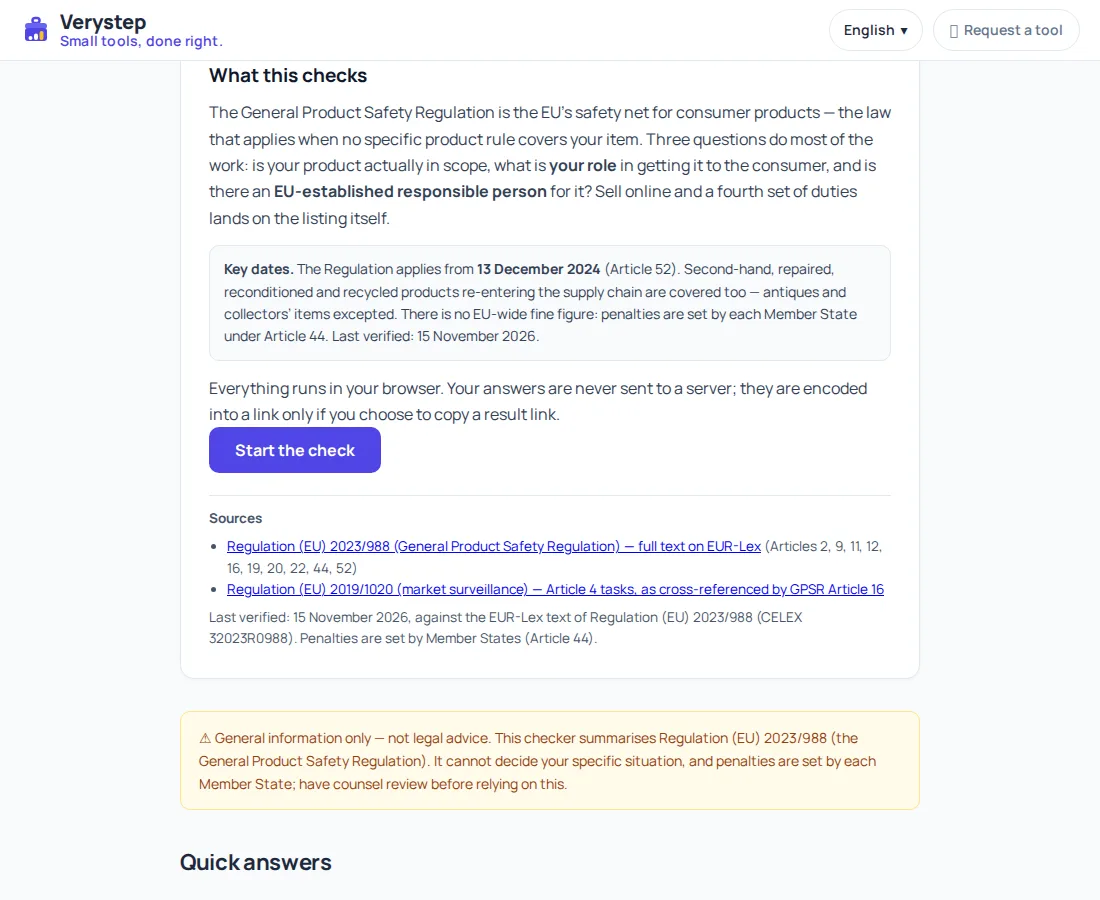
- Confirm the offer is a distance sale of a consumer product. Ask the checker’s first and third questions of your own listing: is this a consumer product made available in the EU (Question 1 of 5 — “The product”), and do you sell at a distance (Question 3 of 5 — “Distance and online sales”)? Both yes means Article 19 applies here; never selling at a distance takes this set off you, though the rest of the Regulation might still apply.
- Put the manufacturer block on the offer (item (a)): the name, registered trade name or registered trade mark, then the postal and the electronic address. Expect both visibly on the offer itself; a logo alone, or a contact form with no electronic address, does not match item (a).
- Add the responsible person block if the manufacturer is outside the EU (item (b)). First confirm the person exists: Question 4 of 5 — “The responsible person (Article 16)” — asks whether an EU-established operator is responsible for this product, and Article 16(3) wants that operator’s name and contacts on the product, its packaging, the parcel or an accompanying document. Then put the same name and both addresses on the offer, side by side with the manufacturer’s.
- Add the identification block (item (c)): a picture of the actual product, its type, and any other identifier you use — a model name or number is the usual one. Expect a buyer, or an inspector, to match this offer to one physical product only; a photo borrowed from a different model fails that test.
- Add the warnings, in the right language (item (d)). Take the warning text exactly as it appears on the product, the packaging or an accompanying document, and place it on the offer in a language easily understood by consumers, as determined by the Member State where you sell. Three Member States can mean three versions.
- Score the finished offer before it stays live. Question 5 of 5 — “Listing information (Article 19)” — asks whether each offer shows all four items; answer honestly (“All four”, “Most”, “None or almost none”, “Not sure”) and read the result page, headed “General information only — not legal advice”. Then check the listing itself: an address behind three accordions is not “clearly and visibly” indicated. Re-run the whole check whenever the listing moves marketplace or country.
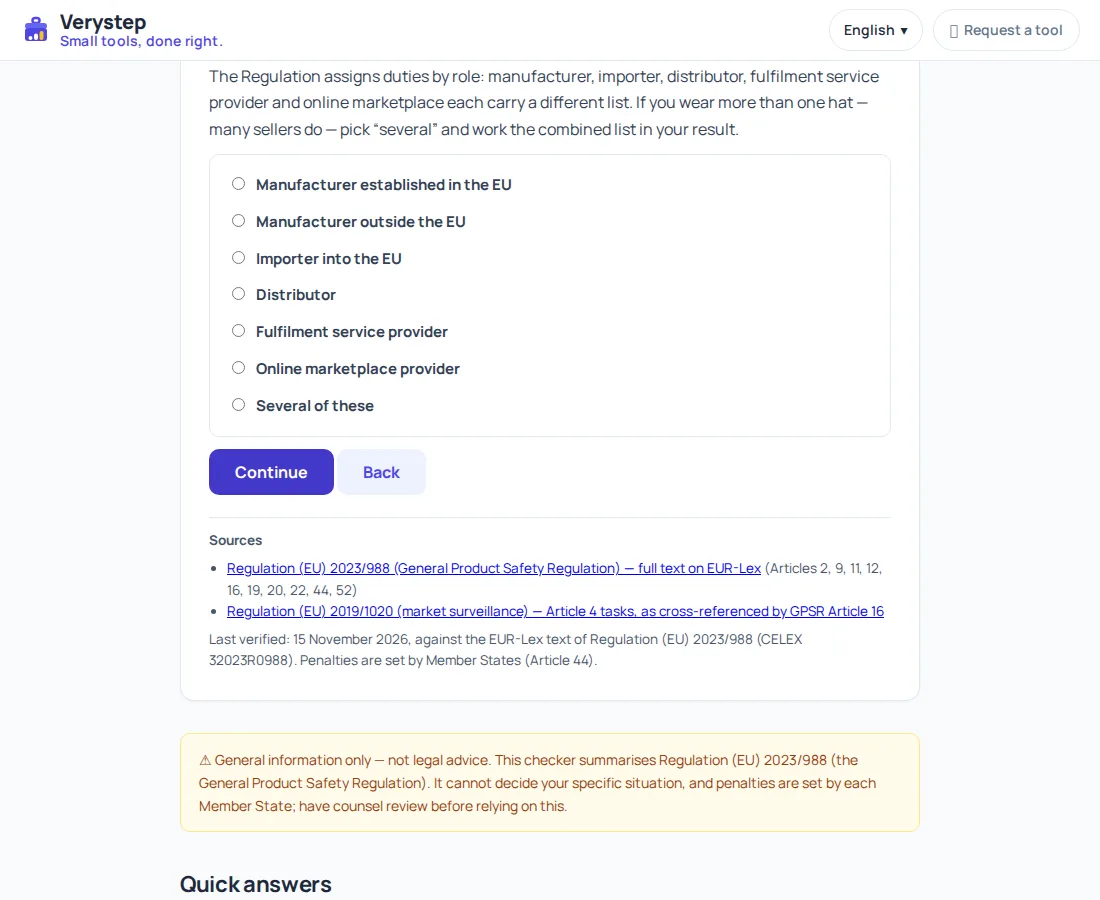
Re-run this check whenever a listing moves to a new marketplace or country: templates drop fields in transit, and the country change alone can break item (d).
Worked example: a non-EU maker lists a steel bottle on a marketplace
Say a manufacturer outside the EU sells a 750 ml stainless steel bottle, type “TrailFlask 750”, via a big marketplace to buyers in Germany and France. The bottle itself is sorted: it carries the maker’s name, and the responsible person — an authorised representative in the Union — is named on the packaging, as Article 16(3) expects. The listing, though, was written by the marketing intern: glossy photos, a price, “premium steel bottle”. Run the four items.
Item (a): the offer names the brand but gives no postal or electronic address. Fail — the Regulation wants the name or trade mark plus both addresses, on the offer. In go the manufacturer’s full postal address and contact email. Item (b): the manufacturer is not in the Union, so the offer must also carry the responsible person’s name and both addresses. It carries none. Fail. The representative’s block goes in next to the manufacturer’s.
Item (c): the photos show the bottle — but nothing states the type or any identifier, and two sizes share the same photo set. Partial fail. In go “TrailFlask 750”, the size, and photos of that exact model. Item (d): the bottle ships with a warning against hot liquids above a stated temperature, on an insert in English only, and the offer shows no warning at all — while the destinations are Germany and France. Fail twice over: the warning belongs on the offer, in a language easily understood as each Member State determines — German for the German offer, French for the French one.
End state: four blocks, all visible. Nothing about the product changed; the page did — and the page was the problem. Answer Question 5 again and the honest answer has moved from “None or almost none” to “All four”.
Limits and boundaries: what this checklist cannot do
Article 19 is a floor, not a ceiling — “at least the following information”. Sector laws sit on top: toys, machinery and other harmonised products carry their own listing duties, and the GPSR assigns separate duties by role — Article 9 (manufacturers), 11 (importers), 12 (distributors), 22 (marketplaces). Passing this checklist does not clear those.
“Clearly and visibly” and “easily understood” are judgements, not measurements. No checklist can certify your layout or your translation; an authority decides on the actual page, in the actual Member State. Penalties are national: Article 44 leaves them to each Member State, so the same gap can cost differently in two countries — and a delisted offer costs sales everywhere at once.
Scope, finally: this guide covers Article 19 offer information for distance sales — not whether your product is safe, whether a sector law governs it, or whether your responsible person arrangement holds up. General information only — not legal advice. For a product line you depend on, have counsel review the listing before an authority does.
Sources: Regulation (EU) 2023/988 — full text on EUR-Lex (CELEX 32023R0988), Articles 2, 9, 11, 12, 16, 19, 20, 22, 44, 52; Regulation (EU) 2019/1020, Article 4; European Commission product safety pages and the Safety Gate system.
The Verystep GPSR Product Safety Checker walks through five questions — the product, your role, distance and online sales, the responsible person (Article 16) and, as Question 5 of 5, “Listing information (Article 19)”: does each distance-sale offer show all four Article 19 items? Answer “All four”, “Most”, “None or almost none” or “Not sure”, and the result page tells you which duty to fix first. It runs in your browser; your answers are never sent to a server. General information only — not legal advice.
Last verified November 24, 2026 — Article 19 chapeau, point (a) and point (d) quoted verbatim from the EUR-Lex text of Regulation (EU) 2023/988 (CELEX 32023R0988); Article 16(1) and 16(3) and Regulation (EU) 2019/1020 Article 4(1) checked in the same text; the live GPSR Product Safety Checker checked in all five languages (EN /gpsr-checker/, ES /es/comprobador-gpsr-seguridad-de-productos/, PT /pt/verificador-gpsr-seguranca-de-produtos/, FR /fr/verificateur-rsgp-securite-produits/, DE /de/gpsr-produktsicherheit-checker/): five questions, with Question 5 of 5 “Listing information (Article 19)” listing the four items (a)–(d) and the answer options “All four”, “Most”, “None or almost none” and “Not sure”; the result page headed “General information only — not legal advice”; penalties left to Member States under Article 44; Regulation applies from 13 December 2024 (Article 52). Worked example checked item by item against Article 19(a)–(d). This guide is general information only — not legal advice.
Frequently asked questions
Does Article 19 apply to my own web shop, or only to marketplaces?
To the offer, whoever publishes it. The chapeau covers operators who make products available “online or through other means of distance sales” — your own shop, a marketplace listing, a catalogue offer. Marketplaces have extra duties under Article 22, but the four items sit on the offer itself.
Can I put the manufacturer and responsible person details on a linked page instead?
The safest guide is the checker’s own wording: the four items belong in the offer itself, not on a page two clicks away. A link labelled “GPSR details” that hides both addresses behind a click is a gamble most sellers lose at the first platform review.
My manufacturer is in the EU. Do I still need item (b)?
No — item (b) is conditional. It applies “where the manufacturer is not established in the Union”. An EU manufacturer is itself the EU-established operator for Article 16 purposes. You still need (a), (c) and (d) on every distance-sale offer.
Which language do my warnings need to be in?
The language which can be easily understood by consumers, “as determined by the Member State in which the product is made available on the market” — Article 19(d), verbatim. In practice: the language (or languages) of each country you sell into. One English warning pasted onto offers aimed at five countries is the classic failure.
What actually happens if one item is missing?
Two things, neither theoretical. The marketplace can remove or suspend the offer — platforms run these checks because Article 22 gives them duties of their own. And an authority can act on the offer as evidence of a wider problem, with penalties set by that Member State under Article 44. There is no single EU fine figure; anyone quoting you one for the GPSR is guessing.
More guides

The PPWR Empty Space Ratio: Why the 50% Cap Hits Your Shipping Box First
Ask a room of online sellers what the PPWR will change first and most will say labels. The duty with a number in it is quieter: from 2030 at the earliest, no more than half the volume of your shipping box may be empty — and the filler you stuff into it counts as empty.

Counting a Return Window: The EU 14-Day Cooling-Off Period Starts the Day After Delivery
A shop page says “14 days to return”. Fourteen days from when — the order, the dispatch, the delivery? And counted how — in calendar days or working days? EU law answers both questions, and the answers are not the ones most countdown banners use.

How to Check Gift Return Eligibility Without a Receipt
Black Friday is over, the gifts are changing hands, and some of them are the wrong size, the wrong color or the second one you own. There is no receipt — there never is with a gift — so the question is not “can I get my money back?” but “which route does this store actually offer someone in my position, and how long do I have?”