Bringing a Dog to the USA: Three CDC Routes, Two Hidden Layers, One Checklist
The CDC form itself is free and takes minutes. Trips fall apart in the layers around it — an endorsement that had to happen before you left, a blood test running on two clocks at once, and a disease check that ignores your dog’s history entirely.

Every dog entering the United States must arrive healthy, be at least six months old, carry a microchip a universal scanner can read, and travel with a CDC Dog Import Form receipt. Past that baseline, the dog import requirements USA travellers face split into three routes. If your dog spent the last six months only in rabies-free or low-risk countries, the form receipt is the whole CDC story, and one receipt covers repeat entries from the same country for six months. If it was in a high-risk country, everything turns on where the rabies vaccine was given: vaccinated in the US means the form plus a USDA-endorsed certification of that vaccination, arranged before the dog left the US; vaccinated abroad means a foreign certification form endorsed by an official vet inside a 30-day window, a rabies titer from a CDC-approved lab or a 28-day facility quarantine, a booked CDC-registered facility, and a flight into that facility’s airport. Two more layers sit outside the CDC routes: APHIS judges this trip’s departure region for screwworm and foot-and-mouth disease, and Hawaii and Guam run destination systems of their own. The free checker below walks all of it and sorts your paperwork into ready, missing and needs-checking.
Three rulebooks, not one: why dog import trips go wrong
Most failed arrivals are not missing paperwork in general. They are missing the one document whose deadline has already passed. That happens because “dog import requirements” is not one rulebook but three, written by different authorities who ask different questions. The CDC judges the dog: where it has been for the last six months, and where its rabies vaccination was given. USDA APHIS judges the shipment: which region this particular trip departs from, because two animal diseases travel with dogs regardless of the dog’s own history. And the destination can add a third system — Hawaii and Guam run their own animal entry programmes that sit on top of the federal rules, or, for a purely domestic trip, replace the CDC layer entirely. Airlines then stack a fourth, private layer of pet rules on top of all three.
The practical signal is to ask, of every requirement you meet, which rulebook it belongs to — because the clocks differ wildly. One certificate has to exist before your dog leaves the United States. Another is only valid if signed within 30 days of travel. A third must be dated within five days of departure. Treat them as one checklist with one deadline and at least one of them will quietly expire.

The CDC fork: six months of history, then one question about a needle
Start with the baseline that applies to every dog on every route: at least six months old on arrival, apparently healthy, microchipped with a chip a universal scanner can read, and a submitted CDC Dog Import Form with its receipt. From there, the dog import checker asks the same first question the CDC does: in the last six months, has this dog been only in dog-rabies-free or low-risk countries, or in any high-risk country? The CDC keeps the high-risk country list; check your dog’s actual whereabouts against it, not your memory of the map.
Route one — low-risk only. If the six months were spent entirely in rabies-free or low-risk countries, the form receipt is the whole CDC requirement. The dog may enter at any port — air, sea or land — and the receipt stays valid for six months, covering repeat entries from the same country while the dog’s history stays low-risk. This is the route most pet dogs actually travel, and it is genuinely simple. The mistakes here are clerical: a chip that cannot be scanned, a receipt whose details do not match the trip.
Route two — high-risk history, vaccinated in the US. Now the dog needs the form receipt plus a Certification of U.S.-issued Rabies Vaccination, completed by a USDA-accredited vet and endorsed by USDA before the dog leaves the United States. That “before” is the single most expensive word in the whole system. If the endorsement never happened, the CDC’s FAQ answer is blunt: you will need to follow the entry requirements for foreign-vaccinated dogs instead — there is no retroactive fix at the airport. One legacy exception survives: a USDA-endorsed export health certificate issued on or before July 31, 2025 can stand in for the certification; one issued after that date is not accepted.
Route three — high-risk history, vaccinated abroad. This is the heavy route, and every item in it has a clock. A Certification of Foreign Rabies Vaccination and Microchip, endorsed by the exporting country’s official government vet and signed within 30 days before travel — sign it earlier and it lapses; it is good for one entry only. A rabies titer result from a CDC-approved laboratory, with the blood drawn at least 30 days after the dog’s first rabies vaccination and the sample taken at least 28 days before entry. A reservation at a CDC-registered animal care facility. And a flight that lands at that facility’s airport — this route cannot enter by land at all, service dogs included. Skip the titer, or hold one that misses its timing marks, and the facility stay turns into a 28-day quarantine after landing — CDC does run a monitored-testing protocol that can shorten that stay in approved cases, but 28 days is the number to plan around.
There is also a dead end, and it is better to meet it here than at check-in: a dog that has been in a high-risk country in the last six months and is not vaccinated against rabies is not allowed to enter the United States. Two signals cut across all three routes. First, the microchip must go in before the rabies vaccine — a vaccination given before the chip was implanted does not count, however tidy the certificate looks. Second, on the high-risk routes the arrival port printed on your form receipt has to be the port you actually arrive at; the receipt is written for one listed date and port.
The layer most checklists skip: APHIS asks where this trip starts
USDA APHIS runs a separate animal-disease layer, and its question is narrower than the CDC’s: is this shipment leaving from a region where screwworm or foot-and-mouth disease is known to exist? Note what it does not ask. There is no six-month lookback — the CDC’s history window does not carry over, and treating the two systems as one is how this layer gets missed.
Depart from a screwworm region and the dog needs a certificate signed by an official vet in the region of origin, based on an examination within five days before travel, stating the dog is free of screwworm — or was treated and held until free before leaving (the rule sits in 9 CFR §93.600). Depart from a foot-and-mouth region and there is no certificate at all: the dog’s coat and bedding must be free of excessive dirt, hay and straw, you bathe the dog soon after arrival, and you keep it away from livestock for five days. The signal worth remembering runs in both directions — a dog that visited a screwworm region months ago but ships from a clean region is not caught by this layer on the text of the rule, and a dog that has never travelled in its life but ships from an affected region is. Origin, not history.
Hawaii and Guam are not just another state
Hawaii and Guam each run their own animal entry system — the Hawaii Department of Agriculture’s animal quarantine programme and the Guam Department of Agriculture — and those systems apply to dogs arriving from the US mainland too. A New York to Honolulu flight never touches the CDC import rules at all, yet Hawaii’s system applies in full; fly in from abroad and the two stack, CDC route first, destination system on top. This guide deliberately does not quote their timelines or quarantine terms: those are set by the territory programmes, they change on their own schedule, and a copied number is exactly how travellers get caught. The checker flags the layer and links the official entry points. The one piece of universal advice is timing — start the destination paperwork as early as the federal paperwork, not after it.
Check your dog’s route, step by step
The checker follows the same order as the rules themselves — trip first, history second, paperwork last — because each answer decides which questions even apply. Two minutes of honest answers beats a folder of almost-right documents.
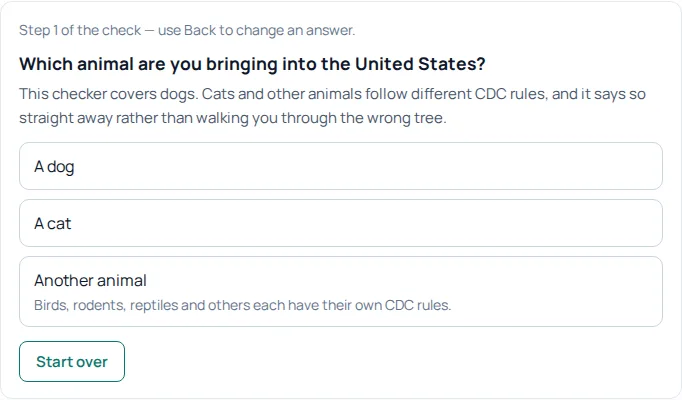
- Start with the trip, not the dog: where this journey begins, the final destination, and whether it involves entering the US from abroad. A purely domestic trip skips the CDC tree entirely — the checker says so and points at the destination layer instead of inventing a route.
- List every country your dog has been in during the last six months and compare it with the CDC high-risk list. One high-risk stay moves you out of the simple route; if you genuinely cannot reconstruct the six months, the checker stops at “needs checking” rather than guessing a route for you.
- Say where the current rabies vaccination was given — in the US or abroad — and whether the certification paperwork is already endorsed. This answer picks the branch, and on the US branch the endorsement status is the whole ballgame.
- Answer the APHIS questions about this trip’s departure region: the screwworm and foot-and-mouth status of the place the shipment leaves from, not anywhere the dog travelled before.
- Add how you are arriving — air, sea or land — and at which port or airport, and whether the destination is Hawaii or Guam, so the port rules and the destination layer can be applied to your route.
- Work through the materials checklist and mark each item honestly: done and in hand, not yet, not sure, or does not apply to you. The result comes back in three layers — your route, the state of your paperwork item by item, and the official pages to confirm anything marked unsure.
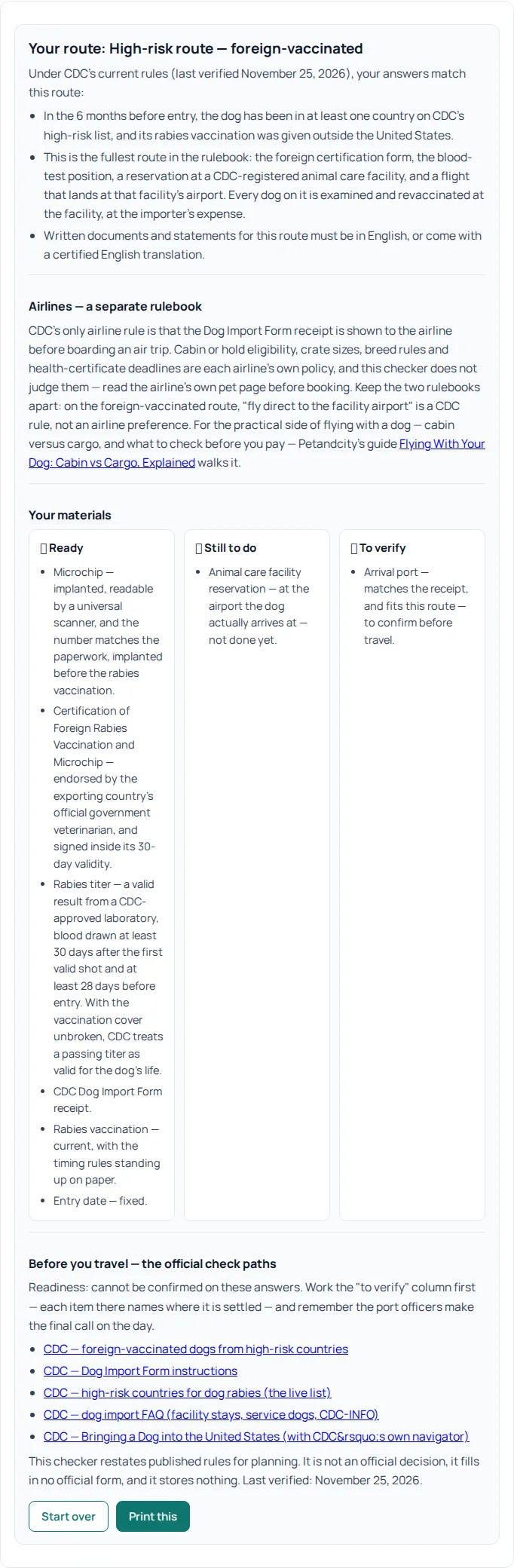
Nothing is uploaded along the way: your answers stay in the browser, and the finished checklist is yours to print and carry.
Worked example: two dogs on the same flight home
Two dogs, the same six months in a high-risk country, the same flight into New York. Dog A was vaccinated in the US before the trip, and her owner had the certification endorsed by USDA before they ever left. Her arrival kit is the form receipt plus that one certification — no facility booking, no titer, no quarantine. Dog B was vaccinated abroad and has no titer result. His kit is the foreign certification form, endorsed inside its 30-day window, a reservation at the CDC-registered facility at the arrival airport — and, because there is no valid titer, a 28-day quarantine at that facility after landing. Same plane, same origin country, opposite arrivals. The only difference is where a needle went in, months earlier.
Run the arithmetic behind Dog B and the calendar becomes the requirement. A qualifying titer needs blood drawn at least 30 days after the first rabies vaccination, with the sample taken at least 28 days before entry — so the draw cannot happen in the final month before the flight at all, and the result still has to come back from the approved lab. “We’ll sort the paperwork next month” quietly becomes “we cannot fly next month”. The transferable signal: on the foreign-vaccinated route, count backwards from the flight date, not forwards from today, and treat any plan that starts inside the last 60 days as a plan to move the flight.
What this checker cannot tell you
It does not decide entry — CDC officers at the port do. The checker maps your answers onto the published rules, flags what is missing, and marks “needs an official check” wherever the text of a rule leaves your situation open, instead of papering over it. Airlines add their own layer on top of everything here — cabin versus cargo, breed rules, how fresh a health certificate must be — and no government checklist covers that; confirm it with the carrier before you book. States other than Hawaii and Guam can add arrival rules of their own, which the checker flags rather than cataloguing. Out of scope by design: dogs imported for resale or paid adoption and research or institutional moves follow different official paths, and other species follow other rules entirely — cats, for the record, live under a far lighter CDC regime, with no rabies proof and no import form, just a healthy appearance on arrival, though Hawaii and Guam have cat rules of their own. Finally, these rules change, which is why the checker carries a Last verified date and sits on a weekly and monthly regulation watch. If your trip is months away, run the check again closer to departure — it costs two minutes and the route may have moved.
The Verystep Dog Import Checker walks the same fork this guide explains: trip type first, then six months of travel history, where the rabies vaccination was given, the APHIS departure-region questions, and your destination and arrival method. It then asks what paperwork you already hold and splits the result into three layers — your route, your materials item by item (ready, still to do, needs checking), and the official CDC, APHIS, Hawaii and Guam pages to confirm against. It never decides entry and it never guesses: where your answers leave a rule unclear, it says so and points at the official source. Everything runs in your browser — nothing you answer is stored or uploaded — and the finished checklist is yours to print.
Last verified November 25, 2026 — checked against the live Dog Import Checker at /dog-import-checker/ (question flow: trip type and destination first, then six-month travel history, vaccination place and endorsement status, APHIS departure-region questions, arrival method and port, materials checklist; result in three layers — route, materials state, official review paths) and against the official sources below, opened the same day. CDC: Bringing a Dog into the United States, https://www.cdc.gov/importation/dogs/index.html (baseline requirements: six months of age, microchip, healthy appearance, Dog Import Form receipt; high-risk country list); CDC Dog Import FAQs, https://www.cdc.gov/importation/dogs/faqs.html (endorsement before departure and the foreign-vaccinated fallback; service dogs meeting the same requirements; port and microchip consequences on arrival); CDC route pages for entry from dog-rabies-free or low-risk countries, for US-vaccinated dogs from high-risk countries, and for foreign-vaccinated dogs from high-risk countries (foreign certification form signed within 30 days and endorsed by an official government vet; titer drawn at least 30 days after the first vaccination and at least 28 days before entry, CDC-approved laboratory; CDC-registered facility reservation; air arrival only; 28-day quarantine without a valid titer; export health certificates issued on or before July 31, 2025 accepted in place of the US certification, later ones not accepted). USDA APHIS: Bring a Pet Dog into the United States, https://www.aphis.usda.gov/pet-travel/another-country-to-us/import-dogs (screwworm and foot-and-mouth disease sections — judged on this shipment’s region of origin, with no lookback window); 9 CFR §93.600, https://www.law.cornell.edu/cfr/text/9/93.600 (screwworm certificate signed by an official vet of the region of origin after an examination within five days of travel). Hawaii Department of Agriculture, Animal Quarantine information, https://hdoa.hawaii.gov/ai/aqs/ and Guam Department of Agriculture, https://doag.guam.gov/ — destination systems flagged and linked only; their timelines and terms are deliberately not reproduced. General information about published rules — not legal or veterinary advice, and not an entry decision for any individual dog.
Frequently asked questions
Does every dog need the CDC Dog Import Form?
Yes. Every dog entering the United States, on every route, needs the form submitted and the receipt carried — it is the one document the three routes share. What changes by route is everything around it. A low-risk receipt stays valid for six months and covers repeat entries from the same country while the dog’s history stays low-risk; on the high-risk routes the receipt is written for a single entry, on the listed arrival date and at the listed port.
My dog was vaccinated in the US, but nobody endorsed the certificate before we left. Can we still fly?
Not on the US-vaccinated paperwork route — the USDA endorsement has to happen before the dog leaves the United States, and there is no way to backdate it from abroad. The CDC’s FAQ answer for exactly this situation is that you will need to follow the entry requirements for foreign-vaccinated dogs instead, with the foreign certification form, the facility booking and the rest of that route. The narrow exception is a USDA-endorsed export health certificate issued on or before July 31, 2025, which can still stand in for the certification.
Does my dog need a rabies titer test?
Only on one route: high-risk history with the vaccination given abroad. The blood sample must be drawn at least 30 days after the dog’s first rabies vaccination and at least 28 days before entry, and the result must come from a CDC-approved laboratory. Dogs on the low-risk and US-vaccinated routes need no titer at all. On the foreign-vaccinated route, arriving without a valid titer does not stop the trip — it converts the facility stay into a 28-day quarantine.
Can we drive across the border from Canada or Mexico instead of flying?
It depends on the route, and the answer is in the route, not the border. Low-risk dogs may enter at any port, land crossings included, and US-vaccinated dogs from high-risk countries may use land crossings too — as long as the crossing is the port listed on their form receipt. Foreign-vaccinated dogs from high-risk countries may not enter by land at all — they must fly in to the airport of the CDC-registered facility they have booked. There is no land exception for service dogs on that route either.
What happens if the microchip cannot be read when we land?
Treat it as a trip-ending risk, because the CDC does: on the high-risk routes, a dog whose chip cannot be scanned on arrival may be denied entry and returned to the country of departure at the owner’s expense. Get any vet to scan the chip before you fly, confirm the number matches every document you carry, and remember the ordering rule — the chip must have been implanted before the rabies vaccination it is meant to support, or that vaccination does not count.
More guides

The PPWR Empty Space Ratio: Why the 50% Cap Hits Your Shipping Box First
Ask a room of online sellers what the PPWR will change first and most will say labels. The duty with a number in it is quieter: from 2030 at the earliest, no more than half the volume of your shipping box may be empty — and the filler you stuff into it counts as empty.

Counting a Return Window: The EU 14-Day Cooling-Off Period Starts the Day After Delivery
A shop page says “14 days to return”. Fourteen days from when — the order, the dispatch, the delivery? And counted how — in calendar days or working days? EU law answers both questions, and the answers are not the ones most countdown banners use.

How to Check Gift Return Eligibility Without a Receipt
Black Friday is over, the gifts are changing hands, and some of them are the wrong size, the wrong color or the second one you own. There is no receipt — there never is with a gift — so the question is not “can I get my money back?” but “which route does this store actually offer someone in my position, and how long do I have?”