Compliance Calendar: Entry Into Force, Application and Grace Expiry Are Three Different Dates
A regulation does not have a deadline. It has at least three — and the one most teams pin to the wall, entry into force, is the one that obliges them to do almost nothing.
Every EU regulation runs on three distinct dates. Entry into force is when the act exists as law: the AI Act, Regulation (EU) 2024/1689, entered into force on 1 August 2024, and the PPWR, Regulation (EU) 2025/40, on 11 February 2025. Application is when its duties start to bite: 2 August 2026 for the AI Act in general, 12 August 2026 for the PPWR. Grace or transition expiry is when a carve-out for existing systems runs out — for older general-purpose AI models, 2 August 2027 under Article 111(3) of the AI Act. A calendar that watches only the first date will sleep through the other two. Build one countdown per binding date, name it after the duty, and let the days-remaining figure — 249 days to 2 August 2027, counted from 26 November 2026 — do the nagging.
Why one regulation needs three dates: the mechanism
Start with the AI Act’s own closing article. Article 113 of Regulation (EU) 2024/1689, headed “Entry into force and application”, says: “This Regulation shall enter into force on the twentieth day following that of its publication in the Official Journal of the European Union. It shall apply from 2 August 2026.” The Regulation was published on 12 July 2024, so the twentieth day after publication landed on 1 August 2024. From that day the Act existed: institutions could be set up, standards requested, guidance drafted. But almost no duty bound a company yet, because the same article staggers application — Chapters I and II from 2 February 2025, a second block including the general-purpose AI chapters from 2 August 2025, and Article 6(1) with its corresponding obligations only from 2 August 2027.
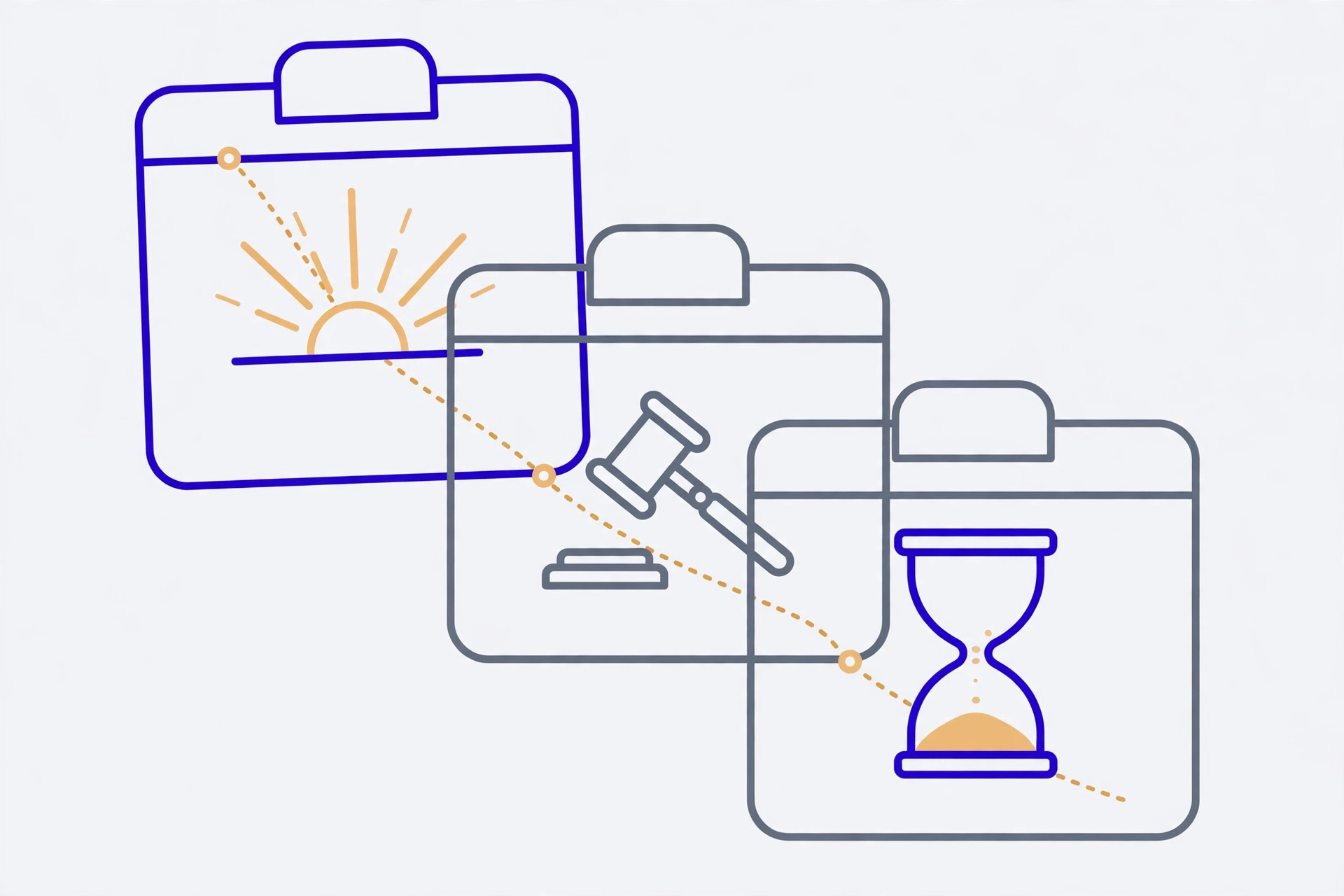
The PPWR tells the same story in one article. Article 71 of Regulation (EU) 2025/40 provides for entry into force on the twentieth day following publication — publication was 22 January 2025, so in force on 11 February 2025 — then states: “It shall apply from 12 August 2026. However, Article 67(5) shall apply from 12 February 2029.” Same pattern, different numbers: an eighteen-month preparation window, then a general application date, then individual provisions with far later start dates of their own.
The third date is the one calendars forget. Transition and grace rules shelter what already exists: Article 111(3) of the AI Act gives providers of general-purpose AI models placed on the market before 2 August 2025 until 2 August 2027 to comply. Legally, a grace period is not an exemption and not a delay of the whole act — the act applies on schedule to everything new, while a named class of existing systems gets a dated runway. When the runway ends, the full duty lands on systems that may have been running untouched for years. That expiry deserves its own countdown, because nobody’s “launch checklist” will ever surface it again.
Turn each binding date into a countdown, step by step
Before you start, list your nodes on paper first: for each regulation that touches you, write the application date of the duties that bind you and every grace or transition expiry that covers your existing systems — each with its article number, checked in the official text. One countdown per node; never one vague countdown per regulation. You need the target date and, for precision, a time — use 00:00 in your own time zone unless the act or your counsel specifies an hour, because the timer counts in your device’s local time.
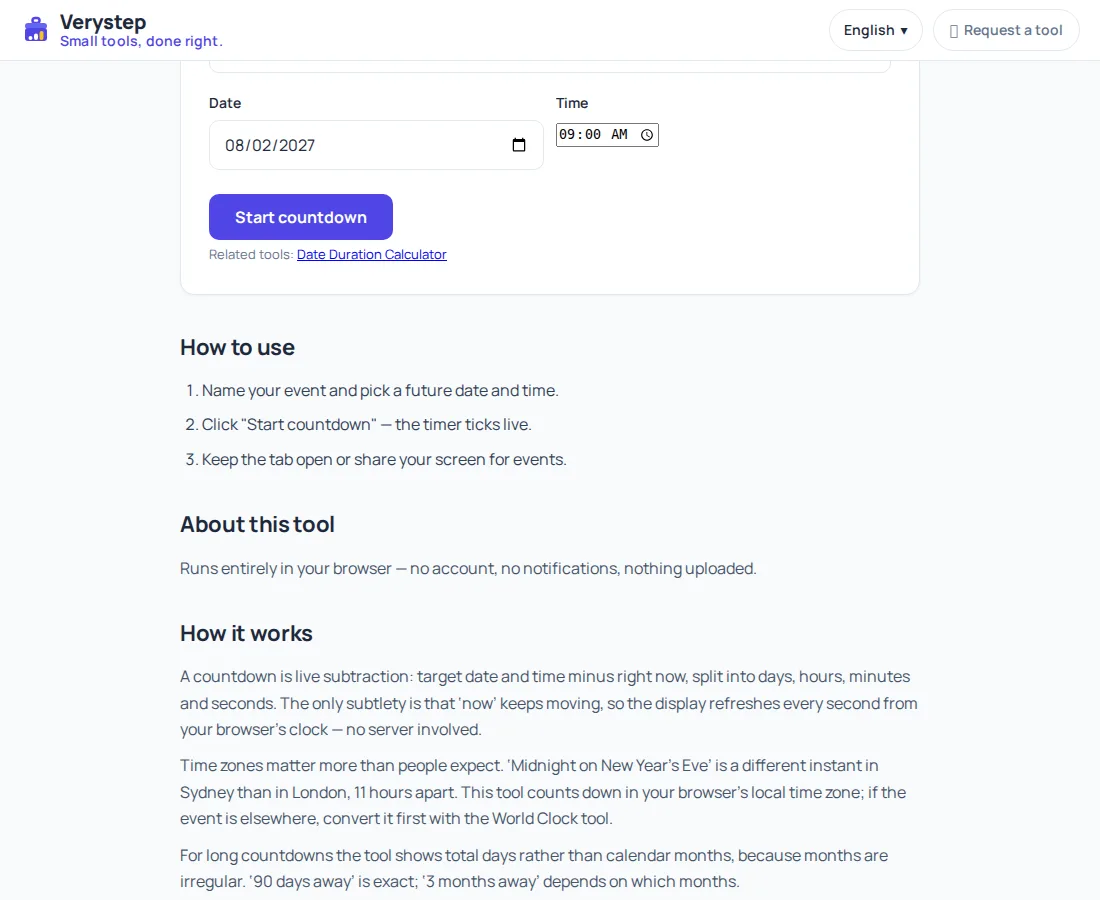
- Open the Countdown Timer and type the duty into the Event name field — for example “AI Act Article 6(1) applies” rather than “AI Act”. Expect the name to stay on screen above the counter, so a precise name is what future-you will actually read.
- Set the Date field to the application or grace-expiry date you verified — 2 August 2027 for the Article 6(1) stage and the Article 111(3) model deadline. The date picker takes a calendar date; double-check day and month order before moving on, because the tool counts to exactly what you enter.
- Set the Time field to 00:00 for a date-only legal deadline, so the countdown reaches zero at the start of the binding day in your time zone. If your team works across zones, agree whose midnight governs and convert first — the tool always counts in the local time of the device showing it.
- Click “Start countdown”. The display splits what remains into days, hours, minutes and seconds and refreshes every second. Read the days figure first: from 26 November 2026 it shows 249 days to 2 August 2027 — that single number is your planning horizon.
- Repeat for the next node in a second tab — for example the PPWR’s Article 67(5) date, 12 February 2029, which shows 809 days from 26 November 2026. Each tab holds one live countdown; keep the tabs open during a working session or share your screen in a team meeting, because closing a tab stops its countdown.
- Record the days-remaining figures in your team calendar or tracker on a fixed rhythm — weekly is enough — since the timer itself sends no notifications and stores nothing. The countdown is the display; your calendar entry, set well before zero, is the alarm.
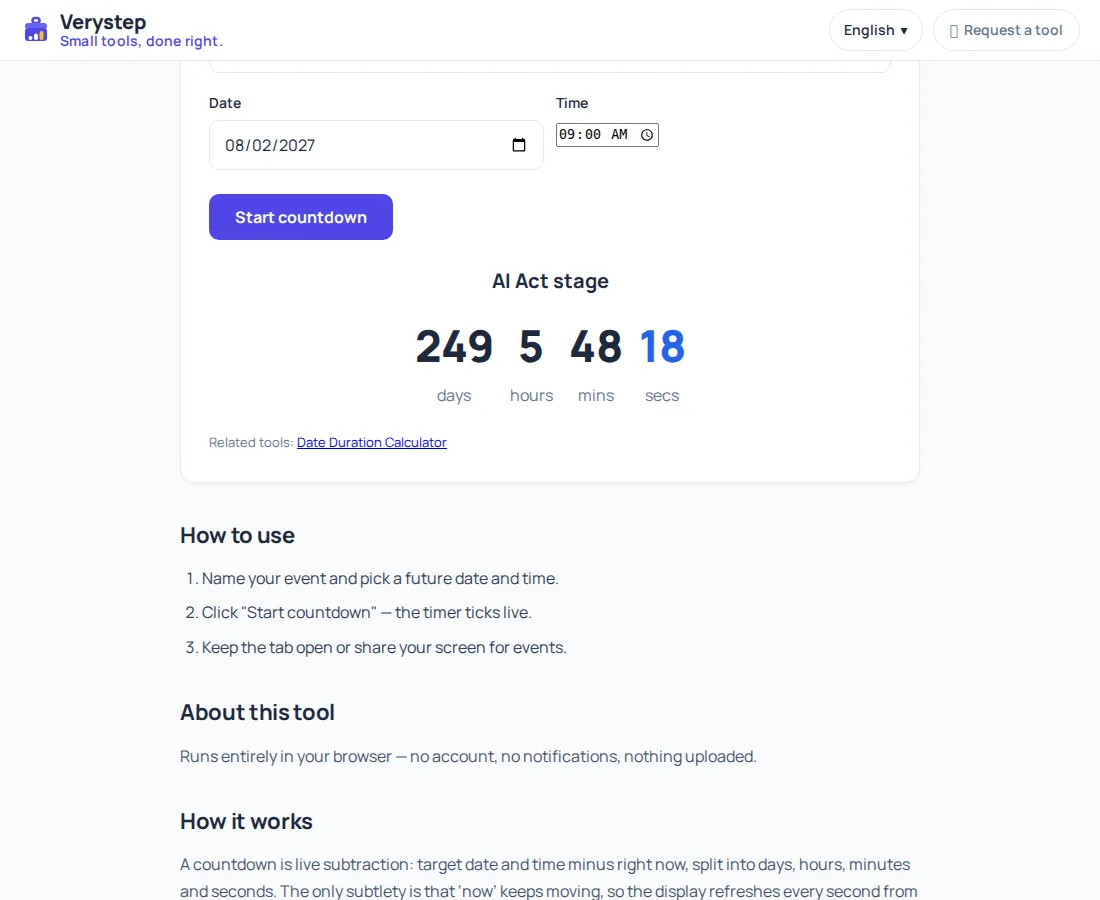
Nothing leaves your device in any of this: the timer runs in your browser, with no account and no server copy of your dates, which is exactly why it cannot remind you after the tab closes.
Worked example: a small team, two regulations, four countdowns
Picture a six-person software team on 26 November 2026. It sells an AI feature built on a general-purpose model it first shipped in June 2025, and it ships physical products in cardboard packaging into two EU countries. Its compliance wall, built properly, holds four countdowns — not two.
Countdown one already reads zero, and that is the lesson: the AI Act’s general application date, 2 August 2026, and the PPWR’s, 12 August 2026, are both in the past. Duties attached to new systems and new packaging are live today; a calendar that “watched” entry into force in 2024 and 2025 and then relaxed missed the moment the obligations actually switched on.
Countdown two targets 2 August 2027 — 249 days away. Two different provisions land that day: Article 6(1) and its corresponding obligations begin to apply under Article 113, and the Article 111(3) runway ends for general-purpose AI models placed on the market before 2 August 2025 — which includes the team’s June 2025 model. One date, two duties, one countdown, named “2 Aug 2027 — AI Act Art 6(1) + GPAI transition ends”.
Countdown three targets 12 February 2029 — 809 days away — the day Article 67(5) of the PPWR starts to apply. It looks comfortably distant, and that is precisely why it gets a countdown now: 809 days shrinks quietly, and the team that pinned it in 2026 will still be watching it at 90 days. Four dates checked in two official texts, three live countdowns, zero reliance on anyone’s memory of a headline.
Limits and boundaries: what a countdown cannot do for you
First, a countdown is only as right as the date typed into it. The timer does flawless arithmetic on whatever you enter; it cannot tell you whether 2 August 2027 is the date that binds your system. That judgement comes from the article text and, for anything you depend on, from counsel — not from a tool.
Second, dates move. Regulations get amended, application dates get postponed by later acts, and consolidated texts change. Re-check each node against the current EUR-Lex text on a schedule — quarterly is a sane rhythm — and rebuild any countdown whose underlying article has changed.
Third, mind the mechanics: the timer counts in your device’s local time, shows total days rather than calendar months, sends no notifications, and stops when its tab closes. Treat it as a wall clock for a deadline you have already verified, never as the verification itself, and never as a reminder service.
Sources: Regulation (EU) 2024/1689 (Artificial Intelligence Act) — EUR-Lex, CELEX 32024R1689, Article 113 (entry into force on the twentieth day following publication; application from 2 August 2026; Chapters I and II from 2 February 2025; Article 6(1) from 2 August 2027) and Article 111(3) (pre-2 August 2025 general-purpose AI models to comply by 2 August 2027), publication in the Official Journal on 12 July 2024; Regulation (EU) 2025/40 (PPWR) — EUR-Lex, CELEX 32025R0040, Article 71 (entry into force on the twentieth day following publication; application from 12 August 2026; Article 67(5) from 12 February 2029). Day counts computed from 26 November 2026: 249 days to 2 August 2027, 809 days to 12 February 2029. This guide is general information only — not legal advice.
The Verystep Countdown Timer takes an event name, a date and a time, and ticks down live in days, hours, minutes and seconds. Name each countdown after the duty it tracks — “AI Act Article 6(1) applies” beats “AI Act deadline” — and set the target to the application date or the grace expiry, in your own time zone. It runs entirely in your browser: no account, no notifications, nothing uploaded or stored, and the tab must stay open for the live ticking. General information only — not legal advice.
Last verified November 26, 2026 — Article 113 of Regulation (EU) 2024/1689 quoted from the EUR-Lex official text (CELEX 32024R1689): entry into force “on the twentieth day following that of its publication”, application from 2 August 2026, Chapters I and II from 2 February 2025, the Chapter III Section 4 / Chapter V / Chapter VII / Chapter XII block from 2 August 2025, and Article 6(1) from 2 August 2027; publication in the Official Journal on 12 July 2024 (entry into force 1 August 2024) as shown in the same text; Article 111(3) — providers of general-purpose AI models placed on the market before 2 August 2025 to comply by 2 August 2027 — checked in the same text (Article 111 carries paragraphs 1–3 only; no 2026-12-02 node exists there, so none is used). PPWR dates reused from the verbatim-verified 2026-11-25 check: Regulation (EU) 2025/40, Article 71, entry into force on the twentieth day following publication (published 22 January 2025, in force 11 February 2025), application from 12 August 2026, Article 67(5) from 12 February 2029 (CELEX 32025R0040). Day counts computed with Python datetime from 26 November 2026: 249 days to 2 August 2027; 809 days to 12 February 2029. The live Countdown Timer checked in all five languages (EN /countdown/, ES /es/cuenta-atras/, PT /pt/contagem-regressiva/, FR /fr/compte-a-rebours/, DE /de/countdown-timer/): Event name, Date and Time fields, Start countdown button, live days/hours/minutes/seconds display refreshed every second, local device time zone, total days rather than months, no account, no notifications, nothing uploaded, countdown stops when the tab closes. Sources: Regulation (EU) 2024/1689 — EUR-Lex, https://eur-lex.europa.eu/legal-content/EN/TXT/?uri=CELEX:32024R1689 ; Regulation (EU) 2025/40 — EUR-Lex, https://eur-lex.europa.eu/legal-content/EN/TXT/?uri=CELEX:32025R0040 . Not legal advice.
Frequently asked questions
A regulation has entered into force. Am I bound by it from that day?
Not by most of it. Entry into force makes the act law and starts the institutional machinery, but duties bind from the application date the act itself sets — 2 August 2026 in general for the AI Act, 12 August 2026 for the PPWR. Some chapters apply earlier and some provisions later, which is why the closing article, not the headline, is what your calendar should copy.
What is the difference between a grace period and an exemption?
An exemption removes a duty for a class of cases, permanently or while conditions hold. A grace or transition period only postpones it for a named class — typically systems already on the market — until a fixed date. Article 111(3) of the AI Act is the postponement kind: older general-purpose AI models must comply by 2 August 2027, after which the full duty applies to them.
Which date should my countdown target: entry into force, application, or grace expiry?
Application and grace expiry — the dates on which a duty starts to bind you or a shelter ends. Entry into force is worth a calendar note for context, but counting down to it measures the wrong thing: when it reaches zero, almost nothing is yet required of you, and the real deadlines are still months or years away.
The countdown shows total days instead of months. Why?
Because months are irregular — 28 to 31 days — so “three months away” is ambiguous while “249 days away” is exact. The timer subtracts the target date and time from the current moment and splits the remainder into days, hours, minutes and seconds, refreshing every second. Legal deadlines are counted in calendar days too, so the days figure maps directly onto your planning.
Will the timer remind me before the deadline?
No. It runs entirely in the open tab, sends no notifications and stores nothing on a server — closing the tab stops it. Use it as the visible display during work sessions, and put the actual reminders in your team calendar, set weeks before the date the countdown is tracking.
More guides

The PPWR Empty Space Ratio: Why the 50% Cap Hits Your Shipping Box First
Ask a room of online sellers what the PPWR will change first and most will say labels. The duty with a number in it is quieter: from 2030 at the earliest, no more than half the volume of your shipping box may be empty — and the filler you stuff into it counts as empty.

Counting a Return Window: The EU 14-Day Cooling-Off Period Starts the Day After Delivery
A shop page says “14 days to return”. Fourteen days from when — the order, the dispatch, the delivery? And counted how — in calendar days or working days? EU law answers both questions, and the answers are not the ones most countdown banners use.

How to Check Gift Return Eligibility Without a Receipt
Black Friday is over, the gifts are changing hands, and some of them are the wrong size, the wrong color or the second one you own. There is no receipt — there never is with a gift — so the question is not “can I get my money back?” but “which route does this store actually offer someone in my position, and how long do I have?”