The Business Days Trap: One Delivery Window, Three Different Holiday Calendars
Nobody lied and nobody miscounted. You and your supplier both counted “business days” — you just used different countries’ holiday tables, and the answers were never going to match.
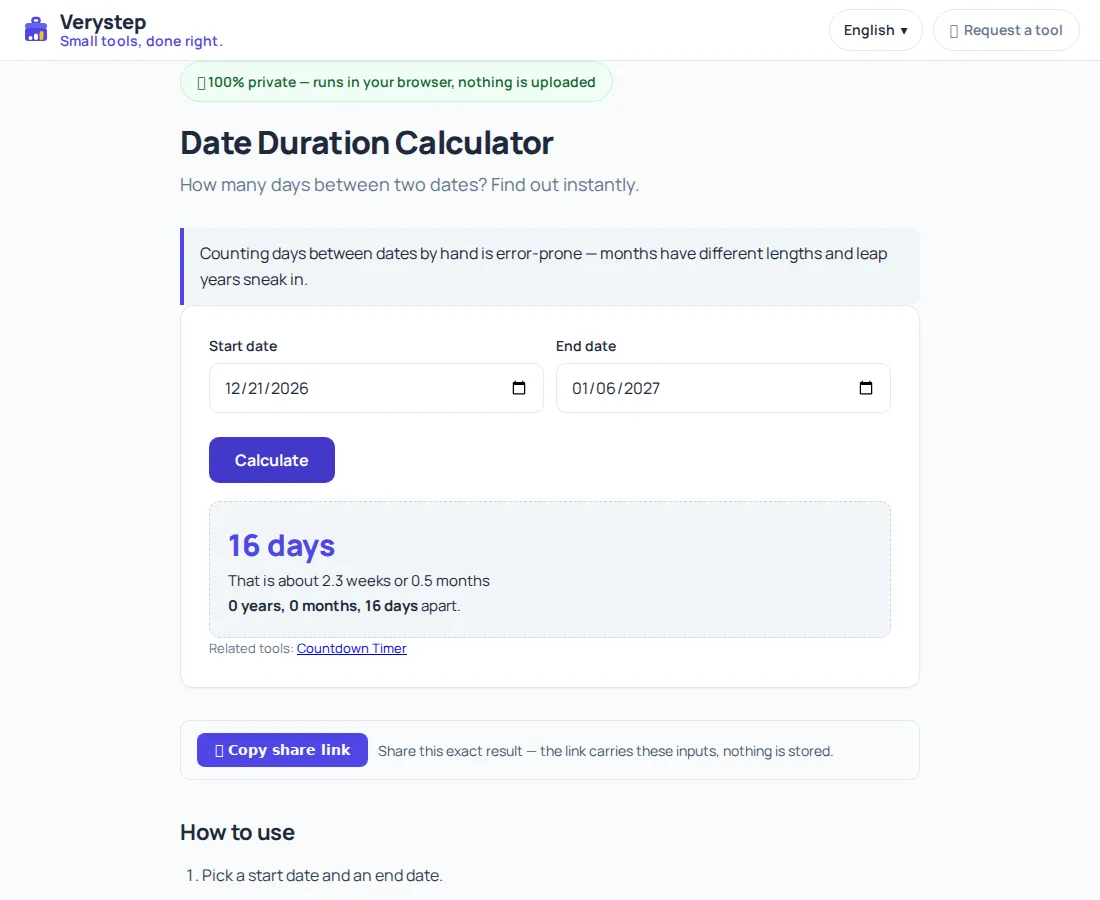
A business-day count is a weekday count with one jurisdiction’s public holidays removed, and the second layer is where cross-border promises go wrong. Take the same span — Monday, December 21, 2026 to Wednesday, January 6, 2027. It holds 16 calendar days and 12 weekdays. Remove each place’s holidays and you get five different answers: 10 business days on the US federal calendar, 9 in England and Wales, 8 in Scotland, 9 in Bavaria and 10 in Berlin. The Verystep Date Duration Calculator counts calendar days only, so the working method is: take the tool’s count, remove the weekend days inside the span, then remove the holidays of the jurisdiction that governs the deadline — not the holidays of the place you happen to sit in.
Two filters, and only one of them travels
Every business-day count is built in two layers. The first layer is the weekend filter: keep Monday to Friday, drop Saturday and Sunday. That layer is nearly the same in the United States, the United Kingdom and Germany, which is why people assume the whole calculation is universal. The second layer is the holiday filter: remove the public holidays that fall on weekdays. That layer is set jurisdiction by jurisdiction, sometimes inside one country, and it does not travel. A business day is not a property of a date. It is a property of a date plus a place.
The United States runs on the federal holiday schedule published by the Federal Reserve: Christmas Day on December 25 and New Year’s Day on January 1 anchor the year-end window, and state or company holidays can sit on top. The United Kingdom looks simpler and is not. GOV.UK publishes separate bank holiday tables, and the tables for England and Wales and for Scotland genuinely differ: Scotland keeps its own 2 January holiday, and both nations shift a holiday that lands on a weekend to a substitute weekday — in GOV.UK’s words, “If a bank holiday is on a weekend, a ‘substitute’ weekday becomes a bank holiday, normally the following Monday.” Germany splits the job further down. There is no single federal holiday list to download: public holidays are set by the law of each Land. Article 1 of Bavaria’s Feiertagsgesetz lists the statewide holidays as “Neujahr, Heilige Drei Könige (Epiphanias), Karfreitag, Ostermontag, der 1. Mai, Christi Himmelfahrt, Pfingstmontag, Fronleichnam, der 3. Oktober als Tag der Deutschen Einheit, Allerheiligen, Erster Weihnachtstag, Zweiter Weihnachtstag” — Epiphany on January 6 included. Berlin’s holiday law has no Epiphany at all. Same country, same week, different filter.

From a calendar-day count to a business-day count, step by step
Before you start, you need two things: the start and end dates of the window, and the answer to one question — which place’s calendar governs this deadline? The delivery country, the contracting entity’s jurisdiction or the counterparty’s location are the usual candidates. If the document names a place, that place’s table wins. Have a wall calendar or a calendar app open for the weekend step; counting Saturdays and Sundays from memory is how errors sneak in.
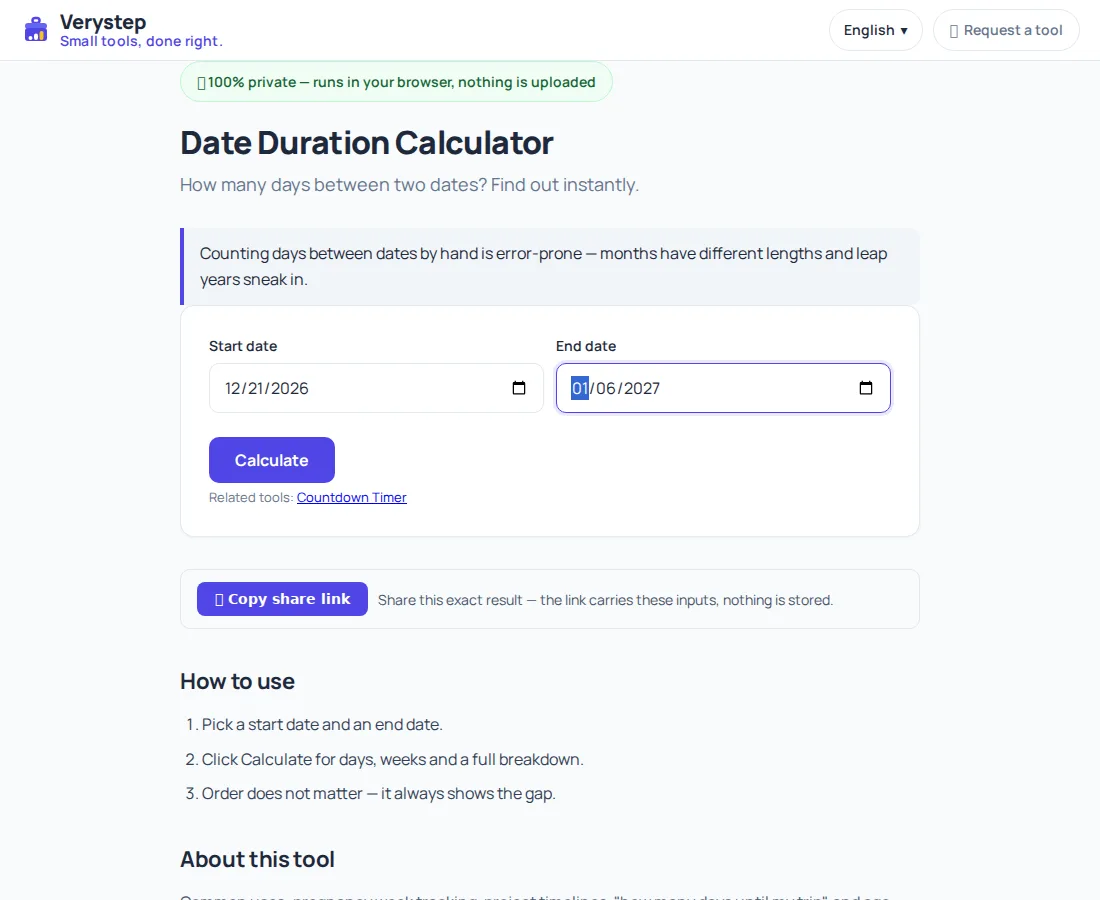
- Open the Date Duration Calculator, put the first date in “Start date” and the last date in “End date”, and press “Calculate”. Read the days figure, also shown in weeks and as a breakdown. Expected result: the raw calendar-day count of the span, weekends and holidays included. That is deliberate — the tool counts calendar days and does not subtract weekends or holidays, so this number is your starting material, not your answer.
- Count the weekend days that fall inside the span and subtract them from the tool’s figure. Work through the span day by day on a calendar and mark each Saturday and Sunday; in a span of two to three weeks there are usually four to six. Expected result: the weekday count — the number every jurisdiction shares before holidays enter the picture.
- Open the official holiday table of the governing jurisdiction: the Federal Reserve holiday schedule for a US federal deadline, the GOV.UK bank holiday table for the specific UK nation involved, or the holiday law of the specific German Land. Do not use a generic “public holidays in Germany” list; the Land is the unit that matters. Expected result: a dated list of that place’s holidays for the months your span covers.
- Subtract each listed holiday that falls on a weekday inside your span. Skip holidays that land on a Saturday or Sunday — the weekend step already removed those days, and subtracting twice understates the count. Watch for substitute days: when a UK holiday falls on a weekend, the day off moves to a weekday, and that weekday is the one to subtract. Expected result: the business-day count under the governing calendar.
- Sanity-check the method against a known week. Take any plain week with no holidays in any of the three systems — a mid-October week, say — and run it through the same steps: the tool should give 7 calendar days, the weekend step leaves 5, and no holiday comes off, so every calendar agrees on 5 business days. If your method cannot reproduce that boring result, the error is in the method, not in the calendars.
One habit makes all of this easier next time: when you quote a deadline, quote the calendar with it. “Ten business days (US federal holidays)” is a promise another person can verify. “Ten business days” on its own is an argument scheduled for later.
Worked example: December 21, 2026 to January 6, 2027, counted five ways
Take a realistic year-end delivery window: Monday, December 21, 2026 to Wednesday, January 6, 2027. Enter those dates in the calculator and it reports 16 days — 2 weeks and 2 days of calendar time. Inside that span sit two full weekends: Saturday, December 26 and Sunday, December 27, then Saturday, January 2 and Sunday, January 3. Four weekend days come off, leaving 12 weekdays. Every calendar agrees so far. Now the holiday layer does its damage, one jurisdiction at a time.
On the US federal calendar, two holidays fall on weekdays: Christmas Day, Friday, December 25, and New Year’s Day, Friday, January 1. Twelve minus two gives 10 business days. England and Wales remove three: Christmas Day on December 25, then Boxing Day — December 26 is a Saturday in 2026, so the bank holiday moves to its substitute day, Monday, December 28 — and New Year’s Day on January 1. Twelve minus three gives 9. Scotland removes four: the same December 25, December 28 and January 1, plus Monday, January 4, the substitute day for Scotland’s 2 January holiday, which falls on a Saturday in 2027. Twelve minus four gives 8.
Germany lands on both sides of the UK at once. Bavaria removes Christmas Day and New Year’s Day, and then one more that surprises people: Wednesday, January 6 is Epiphany, a statewide public holiday under Bavaria’s Feiertagsgesetz, and it is the last day of the span. Twelve minus three gives 9. Berlin’s law knows no Epiphany, so Berlin removes only December 25 and January 1 — 10 business days, level with the US. Note what did not matter: December 26 is a public holiday in both Bavaria and Berlin (Zweiter Weihnachtstag), but in 2026 it falls on a Saturday, already removed by the weekend step, so it changes nothing. The summary, span held constant: 16 calendar days, 12 weekdays — then 10 US federal, 9 England and Wales, 8 Scotland, 9 Bavaria, 10 Berlin. A four-day spread between the most and least generous readings of the same “business days” promise, produced entirely by geography.
Limits and boundaries: what this method cannot settle
First, the tool’s limit, stated plainly: the Verystep Date Duration Calculator counts calendar days. It does not know about weekends in your country, holidays in your Land or bank holidays in your nation, and it will not warn you that your span crosses Christmas. The adjustment method in this guide is manual on purpose — you supply the jurisdiction, the tool supplies the arithmetic.
Second, official holiday tables are a floor, not the whole building. Companies close on days that appear in no law: bridge days between a holiday and a weekend, company shutdowns between Christmas and New Year, a supplier’s inventory week. A count can be legally correct and operationally wrong, so for a delivery promise, confirm the counterparty’s actual working days, not just their country’s table.
Third, the hardest case: a contract that says “business days” and names no place. The working principle is that the calendar of the jurisdiction governing the deadline is the one that counts — the place whose law governs the contract, or where the obligation is performed. Which place that is can itself be disputed, and no calculator settles it. When the money justifies it, name the calendar in the document (“business days as observed in England and Wales”) and the ambiguity disappears. This guide explains how the counting works; it is general information, not legal advice, and it cannot interpret your contract.
The Verystep Date Duration Calculator takes a Start date and an End date and, on Calculate, shows the span in days, weeks and a full breakdown. Be clear about what that number is: it counts calendar days, every one of them — it does not subtract weekends or public holidays. That raw count is step one of the method in this guide; the weekend and holiday layers come off by hand, using the holiday table of the place that governs your deadline. Order does not matter, and everything runs in your browser: no dates are stored or uploaded.
Last verified November 25, 2026 — checked against the live Date Duration Calculator (English /dates/, Spanish /es/calculadora-de-dias/, Portuguese /pt/calculadora-de-dias/, French /fr/calculateur-dates/, German /de/datumsrechner/): the “Start date” and “End date” fields and the “Calculate” button; the result in days, weeks and a full breakdown; the tool counts calendar days only — it does not subtract weekends or public holidays; order does not matter; and its in-browser processing note (dates processed locally, nothing stored or uploaded). Worked example recomputed in Python (datetime) against the official tables below: Monday, December 21, 2026 to Wednesday, January 6, 2027 = 16 calendar days, 12 weekdays, and business days of 10 (US federal), 9 (England and Wales), 8 (Scotland), 9 (Bavaria) and 10 (Berlin); GOV.UK confirms for 2026–2027: England and Wales — 25 December, 28 December (Boxing Day substitute day) and 1 January; Scotland — 25 December, 28 December, 1 January and 4 January (2nd January substitute day); the Federal Reserve schedule confirms Christmas Day, December 25, 2026 and New Year’s Day, January 1, 2027; Article 1 of the Bavarian Feiertagsgesetz (BAYERN.RECHT) lists Heilige Drei Könige (Epiphanias) among Bavaria’s statewide holidays, while Berlin’s holiday law has no January 6 holiday. Sources: Federal Reserve Board — Holiday Schedule, https://www.federalreserve.gov/aboutthefed/k8.htm ; GOV.UK — UK bank holidays, https://www.gov.uk/bank-holidays ; Feiertagsgesetz (FTG) Bayern, Art. 1, BAYERN.RECHT, https://www.gesetze-bayern.de/Content/Document/BayFTG-1 . Not legal advice.
Frequently asked questions
Why did my supplier’s “ten business days” finish later than my ten business days?
Because the two counts ran on different holiday tables. In the December 21, 2026 to January 6, 2027 window, ten business days is not even available everywhere: Scotland has only 8 business days in the whole span, England and Wales and Bavaria have 9, the US federal calendar and Berlin have 10. If your supplier counted on a calendar with fewer holidays — or you counted on one with more — the same promise lands on different dates.
Does the Verystep date calculator count business days?
No. It counts calendar days between the Start date and the End date and shows the result in days, weeks and a breakdown. Weekends and public holidays are all included. To get a business-day count, subtract the weekend days in the span, then subtract the holidays of the jurisdiction that governs your deadline, as this guide walks through.
A UK deadline — should I use the England and Wales table or the Scotland table?
Use the table for the nation where the deadline is governed or performed. The tables differ: Scotland has a 2 January holiday that England and Wales do not, and substitute days can differ too. In the worked example that single extra Scottish holiday is exactly why Scotland ends at 8 business days while England and Wales end at 9.
A public holiday falls on a Saturday inside my span. Do I subtract it?
Not as a holiday — the weekend step already removed that day, and subtracting it again would double-count. But check the jurisdiction’s substitute-day rule before you move on: the UK moves a weekend bank holiday to a weekday, usually the following Monday, and that weekday does come off. Germany and the US handle weekend holidays differently again, so read the governing table, not a rule of thumb.
Is there one German holiday calendar I can use for the whole country?
No. German public holidays are set by each Land in its own holiday law, on top of a small shared core. Bavaria’s Feiertagsgesetz makes Epiphany (January 6) a statewide holiday; Berlin’s law does not have it. For a German deadline, identify the Land first — “Germany” is not specific enough to count business days.
More guides

The PPWR Empty Space Ratio: Why the 50% Cap Hits Your Shipping Box First
Ask a room of online sellers what the PPWR will change first and most will say labels. The duty with a number in it is quieter: from 2030 at the earliest, no more than half the volume of your shipping box may be empty — and the filler you stuff into it counts as empty.

Counting a Return Window: The EU 14-Day Cooling-Off Period Starts the Day After Delivery
A shop page says “14 days to return”. Fourteen days from when — the order, the dispatch, the delivery? And counted how — in calendar days or working days? EU law answers both questions, and the answers are not the ones most countdown banners use.

How to Check Gift Return Eligibility Without a Receipt
Black Friday is over, the gifts are changing hands, and some of them are the wrong size, the wrong color or the second one you own. There is no receipt — there never is with a gift — so the question is not “can I get my money back?” but “which route does this store actually offer someone in my position, and how long do I have?”