A Month Is Not Four Weeks: Period Conversions and the Anchor-Day Drift
“Monthly” and “every four weeks” sound like the same promise said two ways. They are not — and the difference is not rounding, it is two to three days per cycle, every cycle, in the same direction.

A week is the one tidy unit in the calendar: 7 days, always. A month is not a unit at all, just a name for a stretch of 28 to 31 days. Four weeks is exactly 28 days, so a four-week cycle only ever matches the shortest month, February in a non-leap year. The average month runs 365.25 ÷ 12 = 30.4375 days, which means a monthly cycle is on average 2.44 days longer than a four-week one. Run both from the same start date and they separate fast: a year holds 12 monthly charges but 13 four-week cycles (13 × 28 = 364 days, one day short of a common year, two short of a leap year). The second trap is the anchor day. A charge set for the 31st meets months that have no 31st, and each contract handles that collision differently — clamp to the last day, overflow into the next month, or skip — and the choice decides whether your anchor stays on the 31st or quietly slides to the 28th for the rest of the year.
Why the two cycles separate: 28 days against a 28-to-31-day month
Start with the one fact everything else follows from. Months do not have a length; they have lengths. January, March, May, July, August, October and December run 31 days. April, June, September and November run 30. February runs 28, or 29 in a leap year. A week, by contrast, never negotiates: 7 days, in February, in August, in leap years and out of them. Four weeks is therefore a fixed 28 days, and 28 days is the length of exactly one month in the whole calendar — a non-leap February.

Average the year out and the gap gets a number. A year averages 365.25 days once leap years are spread in, so the average month is 365.25 ÷ 12 = 30.4375 days — the Date Duration Calculator’s own quick reference rounds the same figure to 30.44. Set that against the 28-day four-week cycle and each cycle, on average, the monthly schedule falls 2.4375 days further behind the four-week one. Not much, once. But drift never reverses and never pauses, so add it up over a year: a common year is 52 weeks plus 1 day, a leap year 52 weeks plus 2. Thirteen four-week cycles total 364 days, which means a service billed every four weeks fits 13 charges into the span where a monthly service fits 12 — and the thirteenth lands on 30 January 2027 if the first went out on 31 January 2026. Same start, same “about a month” wording, one extra payment a year. That is the whole mechanism. No trick, no rounding error — just a 28-day ruler measuring a calendar that refuses to be 28 days long.
The anchor-day problem: what happens to a charge set for the 31st
Monthly billing has its own snag, and it bites anyone whose recurring date is the 29th, 30th or 31st. Seven months have a 31st; five do not. When the anchor day does not exist in the month that arrives, the billing system has to do something, and in practice contracts and payment processors pick one of three handlings. First, clamp: the charge moves to the last day the month does have, so a 31st anchor fires on 28 February, then — here is the part people miss — many systems keep the new day as the anchor, and March’s charge lands on the 28th too. The anchor has drifted and it does not drift back. Second, overflow: the system counts the missing days into the next month, so “31 February” becomes 3 March (February 2026 has 28 days; 31 − 28 = 3), and March then carries two charges close together. Third, skip: no charge at all in the short month, and the next one lands on 31 March as if nothing happened.
None of the three is exotic, and none is announced in the headline price. The plain-language guidance published for US federal writing makes the underlying point in general terms: a period stated in a contract should say exactly what it means — a calendar month, a number of days, a number of weeks — because readers cannot be expected to guess which unit a vague word like “monthly” is standing in for. Read your own agreement with that lens. If it says “every 28 days”, you are on the four-week ruler and the 13-charge year applies to you. If it says “monthly on the 31st”, look for the sentence about months without a 31st; that sentence, not the headline, decides your February. One regulatory note, stated carefully because it is often misstated: the US Federal Trade Commission’s Click-to-Cancel rule is not in force — the Eighth Circuit vacated it in July 2025 — so do not rely on it as current protection when you read a subscription contract.
Measure your own cycle with the calculator, step by step
Before you start, you need two things: the date of a real charge (or the date a period started) and the wording of the cycle from your contract or statement — “monthly”, “every 4 weeks”, “every 28 days”. The calculator takes a start date and an end date and returns the gap; order does not matter, so you cannot get a negative answer by swapping them.
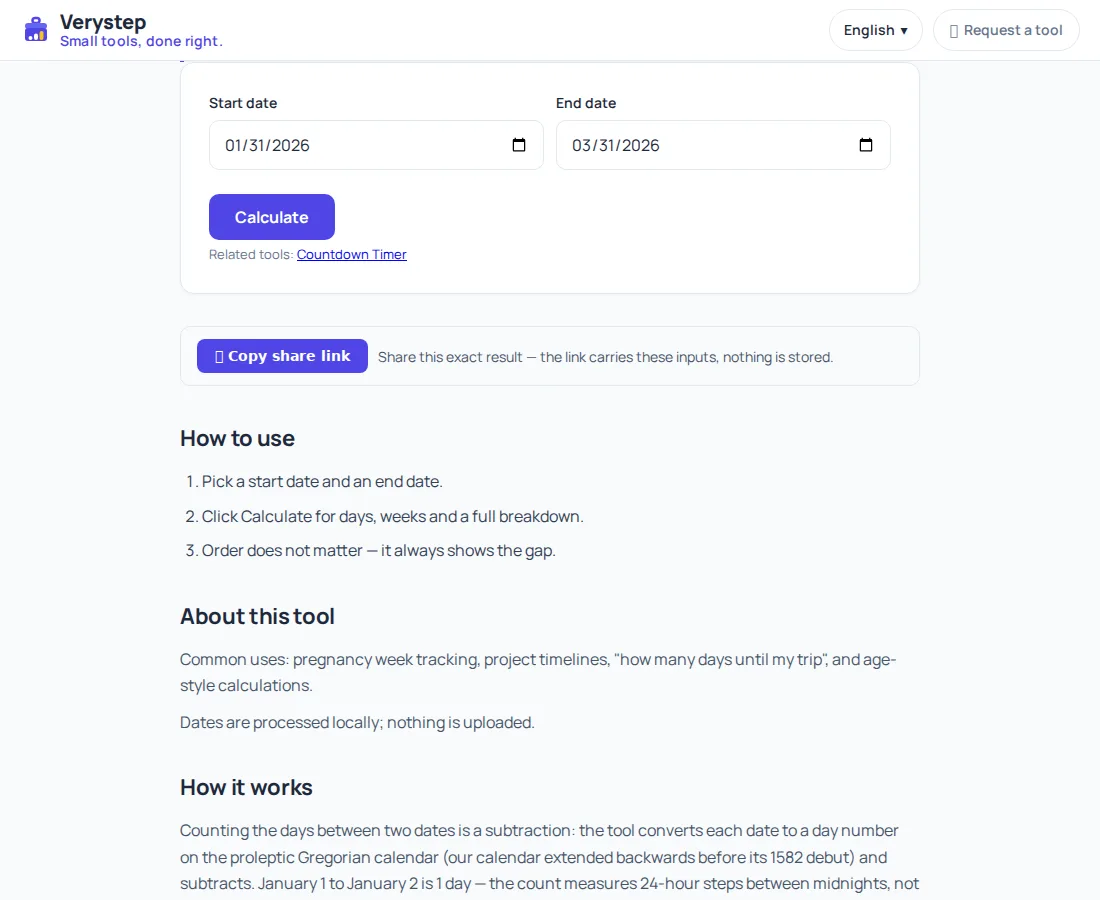
- Type the anchor date — the day the charge or period starts, say 31 January 2026 — in the Start date field. Expect a plain date picker; nothing is calculated yet, and nothing you type leaves the browser.
- Type the date you want to test in the End date field — for a first check, the same day one calendar month later, 28 February 2026 if your provider clamps. Expect both fields to sit side by side with the Calculate button ready.
- Click Calculate and read the total in days first. For 31 January to 28 February 2026 it shows 28 days. Expect the count to be exclusive — full days between the two dates — so a contract that counts both the first and last day means this figure plus one.
- Read the weeks line next: 28 days shows as exactly 4 weeks. That is the February coincidence, not the rule — this is the one month where “monthly” and “every four weeks” genuinely agree.
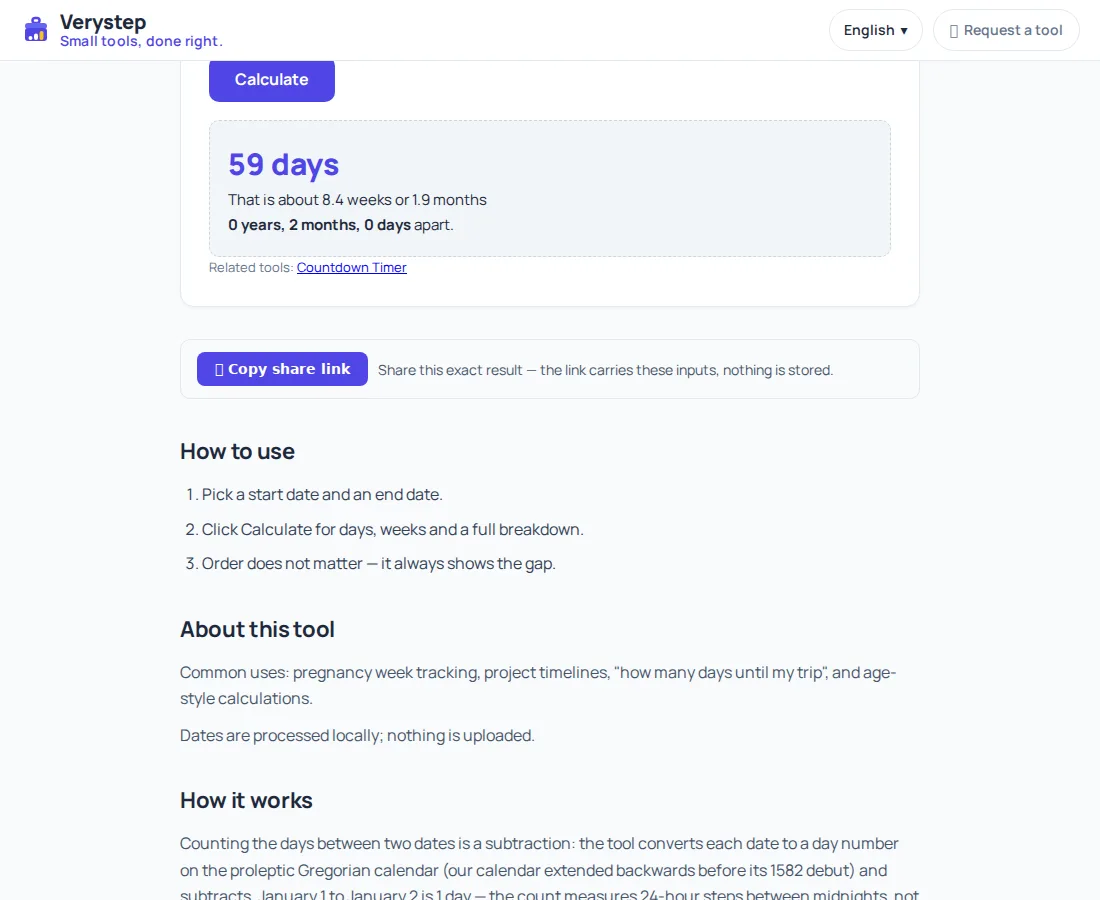
- Change the End date to 31 March 2026 and calculate again. Expect 59 days, shown as 8 weeks and 3 days: the clamped February plus a full 31-day March. Compare it with the 56 days (exactly 8 weeks) that two four-week cycles would cover — the three-day gap is the drift, made visible.
- Now test your real schedule: enter consecutive charge dates from your own statement as start and end, one pair at a time. Expect a true monthly cycle to alternate 28–31 days and a four-week cycle to read 28 every single time — the pattern in the day counts tells you which ruler you are actually being billed on, whatever the contract headline says.
Worked example: one anchor, three handlings, and a four-week rival
Take a subscription that starts on Saturday 31 January 2026, priced as “monthly”, anchored on the 31st. Under clamp handling with the anchor restored each month, the charges run 31 January, 28 February, 31 March, 30 April — each gap is the true length of the month just passed: 28 days, then 31, then 30. The calculator confirms the first two gaps directly: 31 January to 28 February is 28 days, and 31 January to 31 March is 59 days, which it breaks down as 8 weeks and 3 days.
Change one setting — clamp, but the clamped day becomes the new anchor — and the year changes shape. February’s charge lands on the 28th, March’s lands on 28 March, and every later charge follows on the 28th: 28 April, 28 May, and so on to 28 January 2027. No charge is missed and none is doubled, yet the anchor day you signed up for, the 31st, never comes back. Under overflow handling, February’s missing 31st turns into a charge on 3 March, and then March produces a second charge on the 31st — two payments three and a half weeks apart, 31 days after the January one and 28 days before the next gap closes. Under skip handling, February is simply silent, and the next charge is 31 March, 59 days after the first.
Now run the four-week rival alongside. A competing service billed every 28 days from the same 31 January 2026 start charges on 28 February, 28 March, 25 April, 23 May, and keeps stepping back through the calendar. Its twelfth cycle ends on 2 January 2027, and its thirteenth charge lands on 30 January 2027 — one day before the monthly service’s first anniversary charge. Count the year: 12 payments on the monthly plan, 13 on the four-week plan. At equal sticker prices the four-week plan costs a twelfth more per year, and you can see it coming a full year ahead with nothing but the day counts above.
Limits and boundaries: what a day count can and cannot settle
The calculator counts days between dates on the real calendar, leap years included, and derives weeks by dividing by 7 and the months-and-years breakdown by following the calendar. It does not read your contract, and it cannot tell you which handling — clamp, overflow or skip — your provider uses; only the agreement and the pattern in your past statements can. Treat the day counts as evidence, not as a verdict: a run of 28-day gaps proves a four-week cycle in fact, whatever the marketing called it.
Two counting cautions. The tool’s default is exclusive counting, the full days between the dates, which suits deadlines and durations; hotel-style and some billing conventions count both endpoints, which is the same figure plus one — mixing the two conventions manufactures a one-day “error” that is not there. And an average is not a schedule: 30.4375 days is the mean month, but no actual month has that length, so never project a real payment date from the average. This guide explains a mechanism and shows how to measure it. It is general information, not financial or legal advice, and it does not recommend one billing cycle over another — which cycle suits you depends on your own cash flow and contract, not on the arithmetic alone.
Sources: all date arithmetic in this guide was recomputed with calendar dates and checked twice (month lengths for 2026: 31, 28, 31, 30, 31, 30, 31, 31, 30, 31, 30, 31; 13 × 28 = 364; 365.25 ÷ 12 = 30.4375); plain-language guidance on stating time periods exactly, in the style of the US federal plain language guidelines at plainlanguage.gov; FTC Click-to-Cancel status: rule vacated by the US Court of Appeals for the Eighth Circuit, July 2025, and not in force.
The Verystep Date Duration Calculator takes a start date and an end date and shows the gap in days, in weeks, and as a full calendar breakdown. Order does not matter, leap years are handled by real calendar dates, and the count is exclusive — the number of full days between the two dates, so add 1 if your contract counts both endpoints. It runs entirely in your browser; the dates you type are never uploaded or stored.
Last verified November 28, 2026 — all arithmetic recomputed with python datetime against the 2026 calendar: month lengths 31, 28, 31, 30, 31, 30, 31, 31, 30, 31, 30, 31; 4 weeks = 28 days; average month 365.25 / 12 = 30.4375 days (the tool’s own reference rounds it to 30.44); a common year = 52 weeks + 1 day, a leap year 52 weeks + 2; 13 × 28 = 364 days; 31 Jan 2026 + 1 month under clamp = 28 Feb 2026; 31 Jan 2026 to 31 Mar 2026 = 59 days = 8 weeks 3 days; overflow of “31 February” lands on 3 Mar 2026 (31 − 28 = 3); a 28-day cycle from 31 Jan 2026 reaches its 12th cycle end on 2 Jan 2027 and its 13th charge on 30 Jan 2027. The live Date Duration Calculator checked at https://verystep.com/dates/ : two date fields (Start date, End date), a Calculate button, results in days, weeks and a full breakdown, order-independent, exclusive counting by default (inclusive = result + 1), average month shown in its quick reference as 30.44 days. FTC Click-to-Cancel: vacated by the Eighth Circuit in July 2025 and not in force — stated as such in the guide and not relied on. Plain-language framing follows the US federal plain language guidelines (plainlanguage.gov): state a time period in exact units. General information only — not financial or legal advice.
Frequently asked questions
Is “every 4 weeks” the same as “monthly”?
No. Four weeks is always 28 days. A month is 28 to 31 days and averages 30.4375, so the four-week cycle runs about 2.44 days shorter per cycle. Over a year that adds up to a whole extra cycle: 13 four-week charges fit in 364 days, against 12 monthly ones.
Why did my payment date move from the 31st to the 28th and never move back?
That is clamp handling with a sticky anchor. February has no 31st, so the charge moved to 28 February — and the system then treated the 28th as the new anchor day, so March and every later month followed on the 28th. The fix, if your provider allows it, is asking for the anchor to be restored each month.
How many days are there between 31 January and 31 March 2026?
59 days — 8 weeks and 3 days. February 2026 contributes 28 of them and March 31. You can check it in the calculator in seconds: start 2026-01-31, end 2026-03-31.
Does the calculator count the first and last day?
By default, no. It measures the full days between the two dates — Monday to Wednesday reads as 2 days. If your contract counts both endpoints, add 1 to the result. Just be consistent: compare like with like when you check a statement.
A service says “13 payments a year, one every 4 weeks”. Is that a trick?
It is arithmetic, not a trick — 13 × 28 days is 364, so thirteen cycles genuinely fit inside a year. Whether it is good value depends on the price per cycle compared with a monthly plan’s price, which is a question about your budget, not about the calendar.
More guides

The PPWR Empty Space Ratio: Why the 50% Cap Hits Your Shipping Box First
Ask a room of online sellers what the PPWR will change first and most will say labels. The duty with a number in it is quieter: from 2030 at the earliest, no more than half the volume of your shipping box may be empty — and the filler you stuff into it counts as empty.

Counting a Return Window: The EU 14-Day Cooling-Off Period Starts the Day After Delivery
A shop page says “14 days to return”. Fourteen days from when — the order, the dispatch, the delivery? And counted how — in calendar days or working days? EU law answers both questions, and the answers are not the ones most countdown banners use.

How to Check Gift Return Eligibility Without a Receipt
Black Friday is over, the gifts are changing hands, and some of them are the wrong size, the wrong color or the second one you own. There is no receipt — there never is with a gift — so the question is not “can I get my money back?” but “which route does this store actually offer someone in my position, and how long do I have?”