SB 942’s Five Latent-Disclosure Fields, in Plain English
The disclosure your audience never sees is the one California asks for first — five facts, embedded in the file itself.
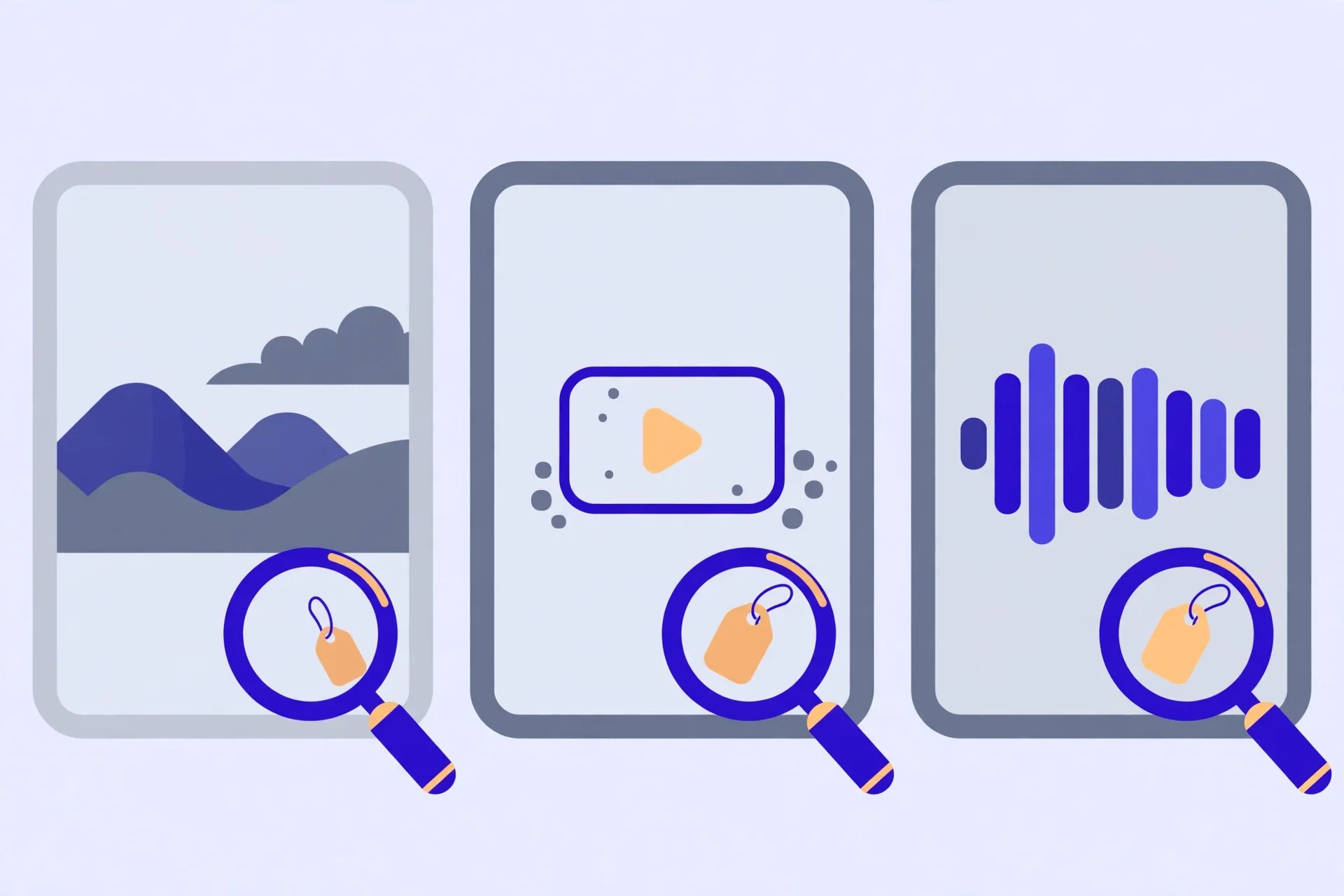
Under § 22757.3(b) of California’s AI Transparency Act, a covered provider’s latent disclosure in image, video and audio content must convey five things: (1) the provider’s name, (2) the GenAI system’s name and version, (3) the time and date of creation or alteration, (4) a unique identifier, and (5) whether the system created or altered the content — the field SB 1000 added when it took effect on 30 September 2026, the same amendment that deleted the old 1-million-user threshold and the visible-label alternative. The duties have been operative since 2 August 2026. This guide is not legal advice.
“Latent” means hidden in the content itself
Start with the word. A latent disclosure is not a label your audience sees. It is provenance information carried inside an image, video or audio file itself — embedded in the content, meant to be read back later by a detection tool, not by a person glancing at a caption.
That distinction used to have a sibling. Earlier versions of California’s AI Transparency Act let providers offer a visible — “manifest” — disclosure instead. SB 1000 deleted that option. If you are working from a pre-September 2026 guide that tells you a visible label is an alternative, that guide is out of date. The latent disclosure is now the duty, and it has five required fields.
Who owes this, and since when
The duty falls on a “covered provider”: a person that creates, codes, or otherwise produces a generative AI system that is publicly accessible within California (Business & Professions Code § 22757.1(e)). Read that again and notice what is missing — any threshold. The original Act limited the definition to systems with more than a million monthly visitors or users; SB 1000 deleted that threshold entirely. No user count, revenue figure or company size takes a provider out of the definition.
The provider duties have been operative since 2 August 2026. They attach to image, video and audio content the system created or altered — with a carve-out for minor modifications such as brightness, contrast, sharpening, resizing, cropping, format conversion or denoising, which do not count. And if the line between “we built this system” and “we merely embed or resell someone else’s” is unclear in your case, that is a needs-legal-review answer, not a guess — the checker below is built to say exactly that.
The five fields, one by one
Section 22757.3(b) lists what the latent disclosure must convey, to the extent technically feasible. Five items:
| # | Field | In plain English |
|---|---|---|
| 1 | The name of the covered provider | Who stands behind the system — the company or person the law can point to. |
| 2 | The name and version number of the GenAI system | Which system, and which version of it. Not “our AI” — the named tool, at the version that did the work. |
| 3 | The time and date of the creation or alteration | When this piece of content was made or changed. |
| 4 | A unique identifier | Something that singles out this disclosure — this output, this event — from every other one. |
| 5 | Whether the system created or altered the content | New with SB 1000: the disclosure says which of the two happened — generated from scratch, or an alteration of existing content. From 2029 it must also say whether the system is designed primarily as assistive technology. |
Fields 1 to 4 are identity and bookkeeping: who, what, when, which one. Field 5 is the one people miss, because it is the newest — summaries written before SB 1000 list only four fields, and a disclosure built to those summaries is now one field short.
What else “latent” demands
The fields are only half the requirement. The same paragraph sets three quality bars for how the disclosure is carried. It must be permanent or extraordinarily difficult to remove. It must be detectable by the Act’s disclosure verification tool. And it must be consistent and interoperable with widely accepted industry standards for provenance — the statute’s own example is the C2PA Content Credentials approach.
The companion tool matters: under § 22757.2, a covered provider must also offer a free, publicly accessible verification tool that lets anyone assess whether image, video or audio was created or altered by its system — by upload or URL, with API support — or direct users to a compliant third-party tool clearly reachable from its interface. Fields nobody can read back would be theatre; the tool makes them evidence.
If you license your system to others, § 22757.3(c) requires you to contractually require licensees to maintain the disclosure capability. The post-SB 1000 mechanics are brisk: learn that an identifiable licensee has modified the system into noncompliance, and you have 72 hours to terminate its authorisation or notify it; the licensee must then comply or stop, and report back within 96 hours; unresolved cases go to the Attorney General.
The cost of getting it wrong
The civil penalty is $5,000 per violation, and each day counts as a discrete violation, so an unaddressed gap accumulates daily rather than sitting still. Actions are brought by the Attorney General, a city attorney or county counsel — there is no private right of action, which limits who can sue but not what it can cost.
Keep the calendar straight, too: large online platforms and GenAI hosting platforms have their own duties from 1 January 2027, capture device manufacturers from 1 January 2028, and a temporary exemption for systems designed primarily as assistive technology runs until 1 January 2029 — falsely claiming it costs $50,000 per violation.
A plain-English self-check
- Do we create, code or otherwise produce a GenAI system that is publicly accessible in California? If yes, assume “covered provider” is possibly your label — size is no defence since SB 1000.
- Does it create or alter image, video or audio content, beyond minor modifications? Text alone is not where these disclosure duties attach.
- Does our output carry all five fields — provider name, system name and version, time and date, unique identifier, and created-or-altered?
- Would the disclosure survive ordinary handling — permanent or extraordinarily difficult to remove — and can a verification tool actually detect it?
- Is our free verification tool live and reachable, and do our licensee contracts require the capability to be maintained?
Any “not sure” in that list — above all on the provider boundary — is a needs-legal-review result. This guide explains the fields; it is not legal advice, and no checklist can tell you that you are compliant.
The Verystep SB 942 Scope Checker asks the covered-provider questions above and returns a starting point — likely a covered provider, likely not, or needs legal review where the boundary is unclear. It never pronounces you compliant, and it runs in your browser.
Last verified October 25, 2026 — written only from this site’s SB 942 research baseline (California Legislative Information official texts for SB 942, AB 853, SB 1000 and AB 2713) and kept consistent with the checker below. Not legal advice.
Frequently asked questions
What are the five latent-disclosure fields?
The name of the covered provider; the name and version number of the generative AI system; the time and date of the creation or alteration; a unique identifier; and whether the system created or altered the content. The fifth field was added by SB 1000 — four-field summaries predate it.
Is a visible “AI-generated” label enough instead?
No. The manifest (visible) disclosure option was deleted by SB 1000, effective 30 September 2026. The latent disclosure inside the content is the requirement; a visible label may still be good practice, but it is not the statutory substitute it once was.
We’re a small provider. Does the Act still reach us?
Possibly, yes. SB 1000 deleted the original threshold of more than 1,000,000 monthly visitors or users from the covered-provider definition. What remains is functional: creating, coding or otherwise producing a GenAI system that is publicly accessible within California.
Does the duty cover text our system generates?
The disclosure duties discussed here attach to image, video and audio content created or altered by the system. Minor modifications — brightness, contrast, sharpening, resizing, cropping, format conversion, denoising and the like — do not count as alterations for this purpose.
What happens if the disclosure is missing?
A civil penalty of $5,000 per violation, with each day treated as a discrete violation. Enforcement sits with the Attorney General, a city attorney or county counsel; there is no private right of action. Whether you are a covered provider at all can be a needs-legal-review question — this guide is not legal advice.
More guides
BMI, BMR and TDEE: Three Numbers, Three Different Jobs
One is a ratio, one is an idling cost, one is a daily total. Compare them as if they were the same kind of number and every one of them will mislead you.

Time Zone Math: Why Your Meeting Keeps Landing at 3 A.M.
Nobody on your team is bad at arithmetic. The offset they memorised quietly expired — that's the whole story behind the 3 a.m. meeting.
JSON Without Tears: Structure, and the Five Errors Everyone Makes
One missing comma can break a whole API call — and the error message will blame the wrong line. Here's the tree underneath the text, and the five mistakes that account for nearly every broken file.