Verystep Guides Verystep Guides
Percentages Without the Guessing: Of, Off and Change
Almost every percentage error is answering the wrong question well.

The % sign does three jobs. A slice: X% of Y is Y × X/100 — 15% of 240 is 36. A share: part ÷ whole × 100 — 45 is 25% of 180. A change: (new − old) ÷ old × 100, anchored on the old value — 80 to 100 is +25%, and back is −20%, not −25%. A rate moving from 4% to 5% gained 1 percentage point, which is a 25% relative rise; and stacked percents multiply rather than add, so 20% off twice is 36% off in total. Worked arithmetic only; not financial advice.
One symbol, three different questions
Most percentage mistakes are not arithmetic mistakes. The adding-up is fine. The problem sits one step earlier: three different questions share the same % sign, and it is easy to answer the wrong one.
Question one: what is X% of something? A slice of a known whole — 15% of 240. Question two: something is what percent of something else? A share — 45 out of 180, expressed as a percent. Question three: by what percent did something change? A move from an old value to a new one — 80 up to 100.
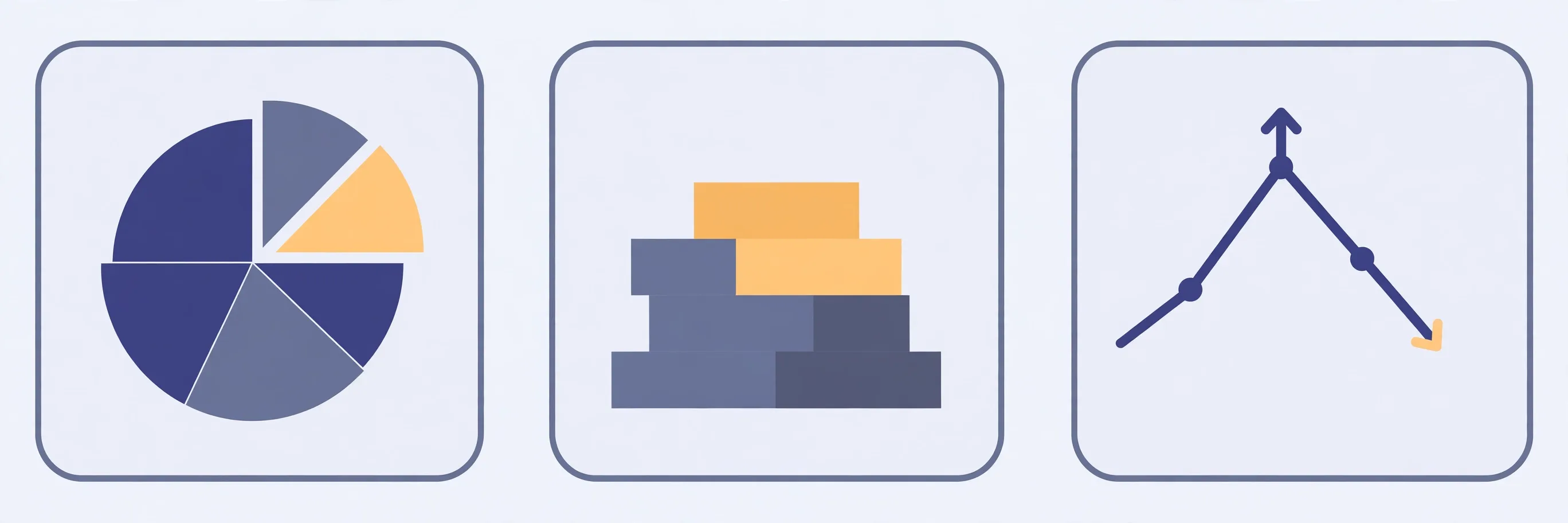
Keep those three apart and the rest is bookkeeping. Mix them up and you get the classic errors: a “20% rise” that was really 25%, a discount stacked wrong, a rate that “went up 1%” when it went up a point. Each question gets its own section below.
“Of”: take a slice of a whole
Percent means per hundred. 15% is 15 out of every 100 — as a plain number, 0.15. So “15% of 240” is one multiplication: 240 × 0.15 = 36. That is the whole method. Divide the percent by 100, multiply by the amount.
Two shortcuts cover most shop-floor cases. 10% of anything is that thing with the decimal point moved one place left: 10% of 240 is 24. Build from there — 5% is half of 10% (12), 15% is 10% plus 5% (24 + 12 = 36), 20% is double 10% (48). You will rarely need more than 10%, halved and doubled.
Discounts are this question wearing a coat. “25% off $80” asks for 25% of 80, which is $20 — and the part people forget: $20 is the amount off, not the price. You pay 80 − 20 = $60. Or skip a step: paying 75% of the price is the same $60, because 100% − 25% = 75%.
“Is what percent”: find the share
Now the percent itself is the unknown. You have a part and a whole, and you want the part restated per hundred. Divide the part by the whole, then multiply by 100: 45 ÷ 180 = 0.25, so 45 is 25% of 180.
Order matters here. Part on top, whole underneath. Flip them and you get 180 ÷ 45 = 4, or “400%” — a number that should set off alarms whenever the part is smaller than the whole. A share of a bigger whole cannot top 100%. If yours does, you divided backwards.
This question also runs in reverse. Told that 36 is 15% of something, you can recover the whole: 36 ÷ 0.15 = 240. Same three numbers, arranged by which one is missing. That is really all that is going on in this guide — one relationship, three unknowns, take your pick.
Change: the old value is the anchor
Percentage change compares a move against where you started. Take new minus old, divide by the old value, multiply by 100. From 80 to 100: the move is +20, and 20 ÷ 80 = 25%. The price rose 25%.
Not 20%. That wrong answer comes from dividing by 100 — the new value, or just the rounder number. Resist it. The base of a change is always the starting point, because the claim is “compared with before”, and before was 80.
The anchor rule produces the asymmetry that trips everyone once. Rise from 80 to 100: +25%. Fall back from 100 to 80: the move is −20, the base is now 100, so −20%. Same road, different percentages in each direction. Nothing is broken; the yardstick changed because the starting point changed. A 50% gain followed by a 50% loss does not cancel, either: 100 up to 150, then down 50% of 150 — 75 — lands you at 75, a quarter below where you began.
Percentage points are not percent
When the thing changing is itself a percent, English needs two different phrases, and headlines routinely swap them. A rate moving from 4% to 5% rose by 1 percentage point. In relative terms it rose 25% — 1 divided by the starting 4.
Both statements are true. They answer different questions. The point figure describes the gap between the two rates; the percent figure describes the gap relative to where the rate started. Trouble starts when a point change gets reported as a percent change: “up 1%” for a 4%-to-5% move understates the relative shift by a factor of 25.
Rule of thumb: subtracting one percent from another gives points, never percent. If you want the percent change of a rate, you are back in the previous section — difference divided by the old value.
Stacked percents do not add
“20% off, then an extra 20% off” is not 40% off. The second discount applies to the already-cut price, not the original. On $100: first cut leaves $80, the second takes 20% of 80 — $16 — leaving $64. Total saved: 36%, not 40%.
Each step rebases the next. That is the anchor rule again, working quietly: after the first change, the “old value” for the second change is the new price. Any chain of percents — discounts, markups, growth over several years — multiplies step by step instead of adding. Two 10% rises make 1.10 × 1.10 = 1.21, a 21% rise, not 20%.
Close enough for a rough guess, sometimes. Wrong enough to matter on an invoice, a contract, or a quote you have to honour.
Work it in this order
- Name the question first: a slice of a whole, a share of a whole, or a change from an old value. The wording gives it away — “of”, “out of”, and “from … to” are the tells.
- For a slice: divide the percent by 100 and multiply. 15% of 240 is 240 × 0.15 = 36.
- For a share: part divided by whole, times 100. 45 out of 180 is 25% — and if a share of a smaller part tops 100%, you divided backwards.
- For a change: new minus old, divided by the old value, times 100. 80 to 100 is +25%; back down is −20%.
- For stacked changes, apply them one at a time and let each result become the next base. Never add the percents.
- Sanity-check the size. A slice smaller than its percent of a round hundred, a share over 100% for a part of a whole, a “round trip” that claims to cancel — each means the wrong question got answered.
That is the entire subject, honestly. Percentages feel slippery because one symbol does three jobs and the base keeps moving. Pin down which job, pin down the base, and the arithmetic is the easy part.
The Verystep Percentage Calculator has one tab per question in this guide: X% of Y, X is what % of Y, and % change from one value to another, with the same formulas worked above. It runs in your browser and stores nothing. It shows the arithmetic for the numbers you enter; what those numbers mean for a price, a grade or a bill is your call, not the tool’s.
Last verified November 13, 2026 — the three formulas (X% of Y, X as a percent of Y, percentage change) and every worked example cross-checked against the percentage calculator below, which uses the same formulas; percentage-point wording follows standard usage. Worked arithmetic only; not financial advice.
Frequently asked questions
How do I calculate 20% of 80?
Turn the percent into a decimal and multiply: 80 × 0.20 = 16. Or take 10% (8) and double it.
What percent is 30 of 120?
Divide the part by the whole and multiply by 100: 30 ÷ 120 = 0.25, so 30 is 25% of 120. If a share of a larger whole comes out over 100%, the division was backwards.
Why is going from 100 to 80 a 20% drop, but 80 to 100 a 25% rise?
Percentage change is anchored on the starting value. The move is 20 either way, but 20 ÷ 100 = 20% on the way down and 20 ÷ 80 = 25% on the way up. The yardstick changes with the starting point.
Is a rise from 4% to 5% a 1% increase?
No. It is an increase of 1 percentage point. As a relative change it is 1 ÷ 4 = 25%. Subtracting two percents gives points; a percent change needs the difference divided by the old value.
Does 20% off plus an extra 20% off equal 40% off?
No — 36% off in total. On $100 the first cut leaves $80 and the second removes 20% of $80 ($16), leaving $64. Each discount applies to the price left by the one before it.
More guides

How to Use an Auto Loan Calculator to Compare Two Offers
Two dealers can quote payments that look almost identical and still be selling you loans that cost hundreds of dollars apart. The calculator shows you where the gap hides.

How to Build a Debt Payoff Order: Avalanche vs Snowball, Step by Step
Paying extra money toward debt only works if the extra money has a target. This guide builds that target: an ordered list, made two different ways, so you can see exactly where each spare dollar goes.

How to Project Compound Growth (and Read the CAGR Mode)
This calculator does two jobs in one place: it projects a balance forward at a rate you set, and it works backwards from two balances to the steady rate that links them.