Verystep Guides Verystep Guides
How to Calculate CBM for a Shipment, Step by Step
CBM disputes are rarely about the formula. They are about a tape measure used too early, a count typed once and never checked, and an invoice nobody recomputed.
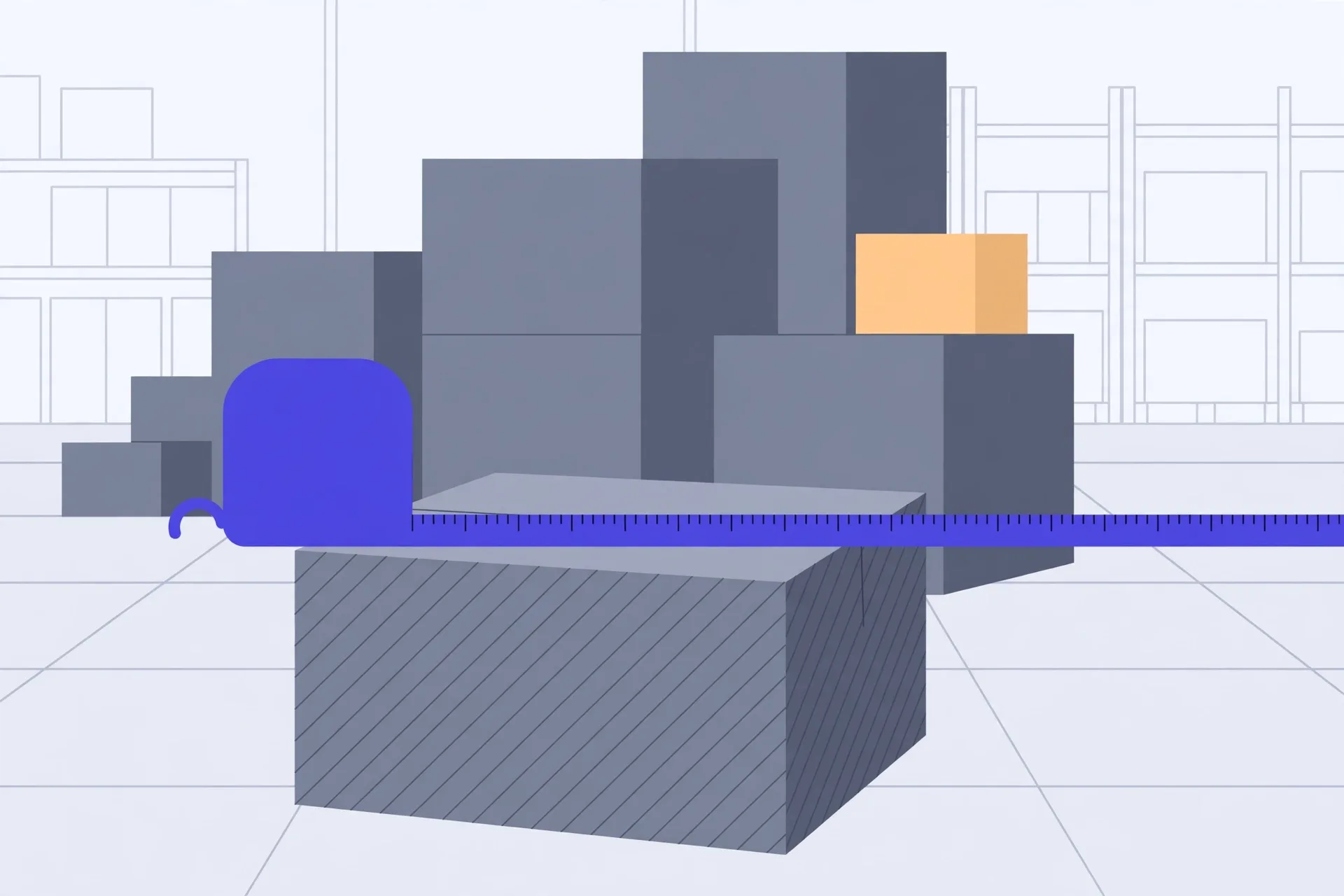
This is the operations routine, start to finish. Pack a carton the way it will travel, tape it shut, then measure the outside at the widest points — bulges count. Round each dimension up the way your carrier states. Enter the length, width and height per carton, the number of cartons, and the gross weight per carton into the calculator, and read back the total CBM, cubic feet, total gross weight and volumetric weight. Then do the step most people skip: recompute the CBM on your carrier or forwarder invoice from the dimensions printed on it, and query any line that does not match your own run. For the concept behind volumetric weight, see the companion guide linked below — this page stays on measuring, entering and checking.
An operations routine, not a theory lesson
If you need the idea behind volumetric weight explained, read the concept guide at /guides/cbm-and-volumetric-weight/ — this page assumes that part and covers the doing: measuring, entering, and checking a real shipment.
That split matters because the errors in practice are not conceptual. Nobody overpays because they misunderstood a definition. They overpay because the dimensions came from the empty carton spec sheet, because someone measured before the carton was packed and bulging, or because the invoice said 6.8 CBM and nobody recomputed it. So work in the order below: pack first, measure second, calculate third, reconcile last. Every step uses the packed carton in front of you, not the tidy numbers from a supplier catalogue.
Measure and calculate in seven steps
You will need a tape measure, your packing list, and the calculator open. Do the measuring for one fully packed carton of each type in the shipment, then let the tool handle the arithmetic.
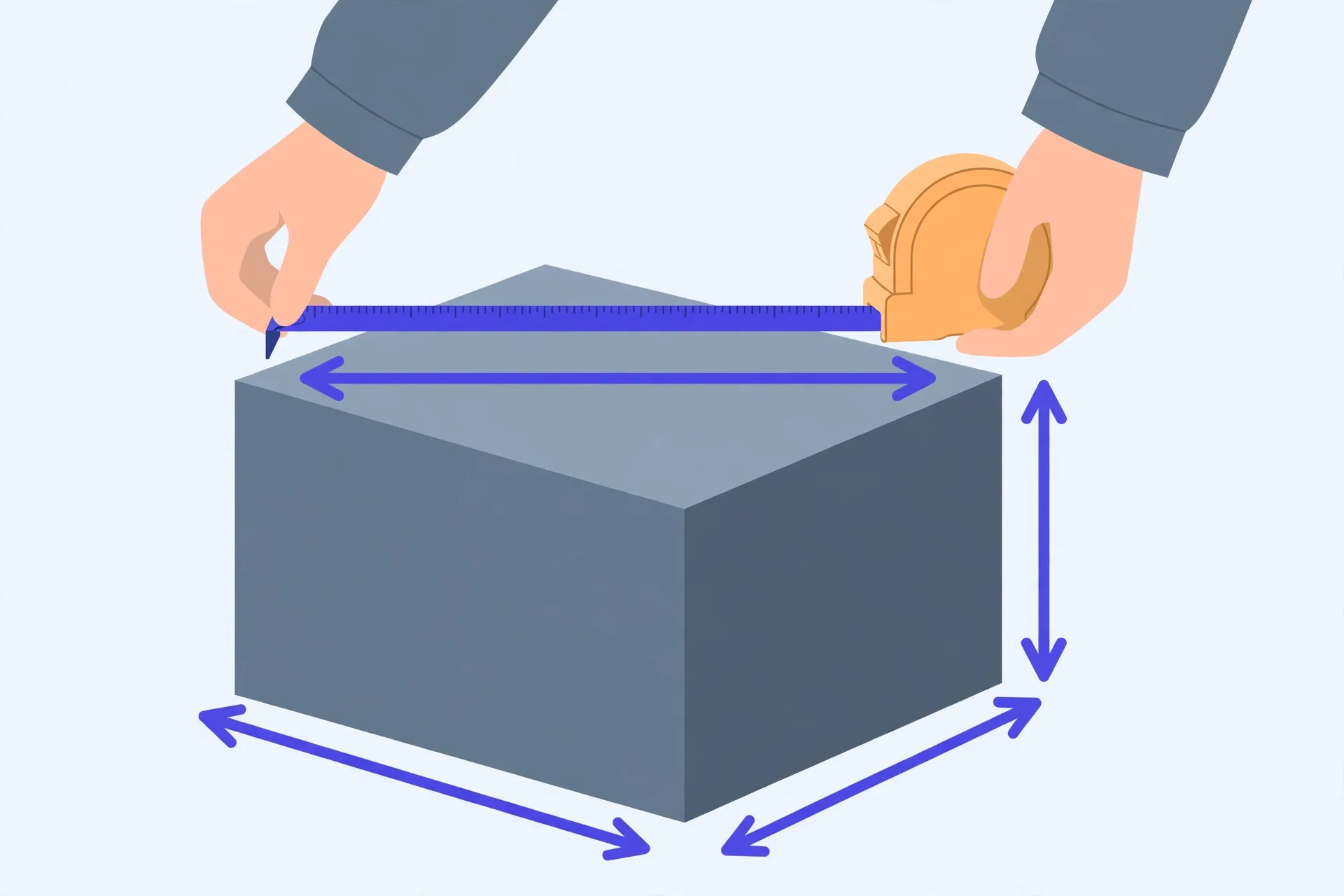
- Pack one carton fully, tape it shut, and measure its outer length, width, and height at the widest points.
- Round each dimension up to the next whole centimetre, or to the step your carrier states, before you write it down.
- Enter the length, width, and height in the calculator and set the unit to centimetres or inches to match your tape.
- Enter the number of cartons and the gross weight per carton, in kilograms or pounds, for cartons packed the same way.
- Read the total CBM, cubic feet, total gross weight, and volumetric weight the calculator returns.
- Recompute the carrier CBM from the dimensions on their invoice and flag any line where their figure differs from yours.
- Re-measure and re-run the numbers if the cartons go onto a pallet, because pallet height and overhang change the dimensions.
A few notes on the steps. Step one says widest points on purpose: a packed carton bulges, tape ridges stick up, and corners are rarely square. Measure across the bulge, not beside it. Step two is a check-your-carrier point — many carriers round each dimension up to the next centimetre and the volume up to the next 0.01 CBM, but the exact practice is theirs, so confirm it in their terms or on their rate sheet and match it in your own run. If your shipment mixes carton types, run each type as its own calculation and add the CBM totals. Do not average the sizes.
A worked run: 50 cartons at 60 × 40 × 50 cm
Say you have 50 identical cartons, each measuring 60 × 40 × 50 cm packed, with a gross weight of 15 kg per carton. One carton is 60 × 40 × 50 = 120,000 cubic centimetres, which is 0.12 CBM. Enter those dimensions, set the count to 50, and enter 15 kg as the weight per carton. The calculator returns 6.00 CBM in total — 0.12 × 50 — plus about 211.9 cubic feet, and a total gross weight of 750 kg.
It also returns a volumetric weight. At the air divisor of 6000, one carton gives 60 × 40 × 50 / 6000 = 20 kg. Your actual carton weighs 15 kg. Put side by side, 20 kg is the higher figure, so on an air quote built that way the chargeable weight per carton is the 20 kg figure, and across 50 cartons that is 1,000 kg against 750 kg of actual weight. You do not need to settle which figure a given carrier will bill until you see their quote — but you do need both numbers from your own run before the quote arrives, so you can tell at a glance which basis they used and whether it matches your cartons.
Reconcile the result against the invoice
When the carrier or forwarder invoice lands, do not compare totals first. Compare inputs. Find the dimensions printed on their line for your shipment and recompute the CBM from those dimensions yourself: length × width × height, times the carton count. If their dimensions match yours but their CBM does not match your recomputation, that is an arithmetic query, and it is an easy one to raise with the maths attached. If their dimensions differ from yours, the query is about measuring — ask how and when they measured, and send your packed-carton measurements with a photo of the tape in place.
Watch the count, too. A count error scales everything: bill 55 cartons instead of 50 on the worked example and the CBM jumps from 6.00 to 6.60 without a single dimension changing. Check the count on the invoice against your packing list and the warehouse receipt before you query dimensions. And keep your calculator run — screenshot or note the inputs and outputs with the date. A query raised a week later, from memory, goes nowhere. A query raised with your measured inputs beside their printed ones usually settles in one exchange.
Common errors, and what they cost
Inner dimensions are the most expensive habit on this list. The inside of the carton is smaller than the outside by the thickness of the board on every side, and carriers bill the outside. If your numbers came from a supplier listing, check whether they quoted inner or outer sizes before you enter them. Next, unit mix-ups: a carton measured in inches and entered as centimetres shrinks the shipment on paper by a huge factor, and the reverse inflates it. Read the unit selector out loud before you hit calculate. It takes two seconds.
Then the quiet ones. Forgetting the count multiplier — entering one carton and reporting 0.12 CBM for a 50-carton shipment — still happens, and it survives because the number looks plausible out of context. Always sanity-check the total: does this CBM make sense for this many cartons? Last, pallets. Loose cartons and palletised cartons are different shipments dimensionally. A pallet adds its own height, cartons can overhang or sit inside the pallet footprint, and wrapping adds a little more. If the goods will travel on a pallet, measure the finished pallet as its own unit and run that, instead of sending the loose-carton figure and hoping the difference is small.
The Verystep CBM Calculator takes the length, width and height per carton, the number of cartons, and the gross weight per carton — in centimetres or inches, kilograms or pounds — and returns total CBM, cubic feet, total gross weight and volumetric weight, with a container fit link for 20GP and 40HQ loads. Enter your packed, measured cartons, not the sizes on the empty box.
Last verified November 16, 2026 — steps, fields and worked figures checked against the Verystep CBM Calculator.
Frequently asked questions
Should I measure the carton before or after packing it?
After. Pack it fully, tape it shut, then measure. A packed carton bulges at the sides and the tape adds a ridge on top, and carriers measure the carton as it travels, not the empty box. Measuring before packing understates every dimension, and the gap shows up later as a higher CBM on the invoice that you cannot dispute.
Do I use the inner or outer dimensions?
Outer, always. Carriers bill on the space the carton takes up, which is its outside length, width and height at the widest points. Inner dimensions from a supplier listing understate the volume on every side. If a listing does not say which it quotes, measure a packed carton yourself and use your own figures.
How should I round the dimensions?
Round up, the way your carrier states in their terms or rate sheet. A common practice is up to the next whole centimetre per dimension and up to the next 0.01 CBM on volume, but carriers differ. Match their stated practice in your own calculation, so your figure and theirs are built the same way and any remaining gap is real.
My invoice shows a higher CBM than my calculation. What do I check first?
Check the inputs in this order: carton count, then the dimensions printed on their line, then their arithmetic. Recompute their CBM from their printed dimensions. If the maths is wrong, query it with your recomputation attached. If their dimensions differ from yours, ask how they measured and send your packed-carton measurements, ideally with a photo.
The cartons are going on a pallet. Can I still use the loose-carton figure?
No — treat the finished pallet as the unit. Pallet height, overhang and wrapping all change the dimensions the carrier will measure. Measure each finished pallet at its widest points, run that as your calculation, and keep the loose-carton run only as a reference for how much the palletising added.
More guides

How to Use an Auto Loan Calculator to Compare Two Offers
Two dealers can quote payments that look almost identical and still be selling you loans that cost hundreds of dollars apart. The calculator shows you where the gap hides.

How to Build a Debt Payoff Order: Avalanche vs Snowball, Step by Step
Paying extra money toward debt only works if the extra money has a target. This guide builds that target: an ordered list, made two different ways, so you can see exactly where each spare dollar goes.

How to Project Compound Growth (and Read the CAGR Mode)
This calculator does two jobs in one place: it projects a balance forward at a rate you set, and it works backwards from two balances to the steady rate that links them.