CBM and Volumetric Weight: How Freight Actually Charges You
Freight charges for space as much as for weight. Two formulas — and one divisor — decide which one your shipment pays for.
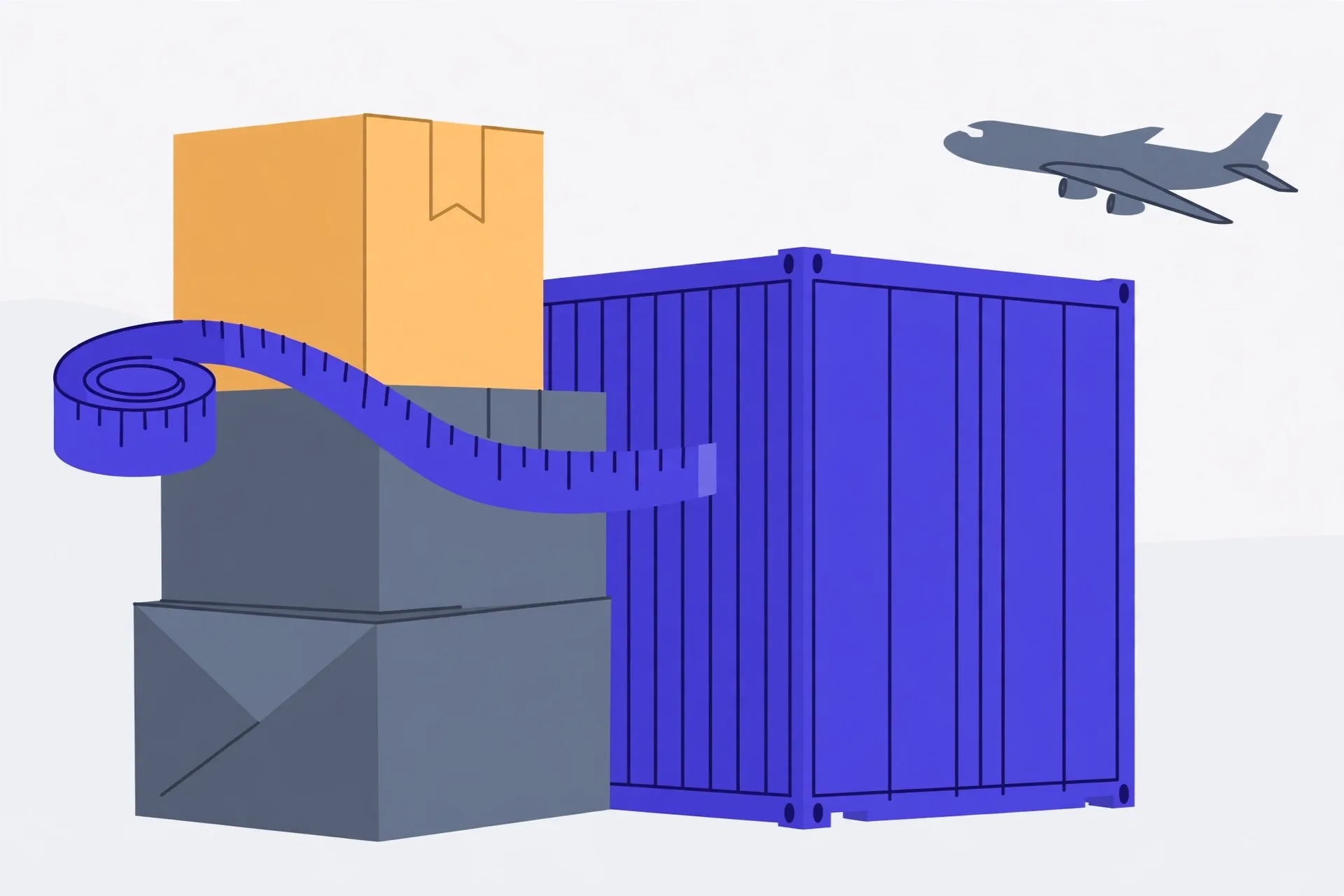
CBM is volume in cubic metres: length × width × height in centimetres, divided by 1,000,000 — a 60 × 40 × 40 cm carton is 0.096 CBM. Volumetric weight turns that same volume into kilograms (cm³ divided by 5,000 for express couriers or 6,000 for air freight and many couriers), and carriers charge for whichever is greater: the scale weight or the volumetric weight. Ocean freight is priced mainly on the CBM itself — a 20GP container holds about 33 CBM nominally, 25–28 loadable in practice — while air and courier bills are where the divisor decides. Measure the outside of the carton, bulge included.
Two numbers, one carton
Every freight quote is built from two different measurements of the same box. The first is the one on the scale: gross weight. The second is the space the box takes up, and freight has two ways of charging for it. CBM states the space directly, in cubic metres. Volumetric weight translates that same space into kilograms, so a carrier can line it up against the scale weight and charge for whichever is greater.
The reason is simple physics and economics. A plane or a delivery van fills up by space long before it reaches its weight limit. A van full of pillows is “full” while carrying almost nothing the scale would notice. Volumetric pricing is how carriers charge for the air inside your carton — and it is why a light, bulky shipment can cost more than a heavy, compact one.
CBM: the volume itself
CBM per carton is length × width × height in centimetres, divided by 1,000,000. A 60 × 40 × 40 cm carton is 96,000 cm³, which is 0.096 CBM. Working in inches? Convert each side to centimetres first (× 2.54), or divide the cubic inches by 61,023.7. And if a US warehouse quotes you cubic feet instead, multiply CBM by 35.3147 — one CBM is 35.3147 cu ft.
Totals scale by carton count. Two hundred cartons of 50 × 35 × 35 cm at 9 kg each come to 12.25 CBM and 1,800 kg of gross weight. That total CBM is the number ocean freight is priced on, and it is how you sanity-check a container: a 20GP container has about 33 CBM of internal volume, of which roughly 25–28 CBM can actually be loaded depending on carton sizes and how well they stack; a 40HQ holds about 76 CBM nominally. If your shipment totals 30 CBM, no packing skill will put it in one 20GP.
Volumetric weight: volume wearing a weight costume
Volumetric (or dimensional) weight is the same multiplication with a different divisor: length × width × height in centimetres, divided by 5,000 or 6,000. Express couriers generally use 5,000; air freight and many couriers use 6,000. The smaller divisor produces the larger weight, which is exactly why the divisor matters:

| One 60 × 40 × 40 cm carton | Result |
|---|---|
| Volume | 0.096 CBM |
| Volumetric weight at ÷ 5,000 | 19.2 kg |
| Volumetric weight at ÷ 6,000 | 16.0 kg |
| Scale (gross) weight in this example | 12 kg |
| Chargeable weight with a ÷ 5,000 courier | 19.2 kg — the volumetric figure wins |
Same carton, same contents, two different bills depending on a single number in the carrier’s tariff. Before comparing quotes, check which divisor each carrier applies — a cheaper per-kilo rate on a 5,000 divisor can lose to a higher rate on 6,000 for bulky freight.
Chargeable weight: the greater of the two
The rule itself is one line: chargeable weight is the greater of gross weight and volumetric weight. Applied to the 200-carton shipment above, the volumetric total at ÷ 5,000 is 2,450 kg against 1,800 kg on the scale — so a courier bills 2,450 kg, while an ocean forwarder bills the 12.25 CBM. To work your own shipment through:
- Measure the outside of the carton, at its longest points, bulge included. Carriers measure the carton as presented and bill on the largest dimensions they record.
- Compute the CBM per carton, then multiply by the carton count for the total.
- Compute the volumetric weight using your carrier’s divisor — 5,000 or 6,000 — not a generic one from the internet.
- Compare the totals. For air and courier pricing, the greater figure is what you will be charged on; keep the CBM figure for ocean quotes and container planning.
- If volumetric weight wins, fix the box before you negotiate the rate. That is where the money is, as the next section shows.
The cheapest kilogram is the box you don’t ship
Because volumetric weight is charged on dimensions, repacking beats haggling. Take the calculator’s own example: moving the same product from a 60 × 40 × 40 cm carton into a 55 × 38 × 36 cm carton drops the volumetric weight at ÷ 6,000 from 16 kg to 12.5 kg per carton. Across 500 cartons, that is 1,750 kg of billable weight that simply stops existing — no rate negotiation achieves that.
The same logic rewards every centimetre: cartons sized to the product instead of to the shelf, soft goods compressed, items nested instead of boxed separately. Two cautions before you bank the savings. Carriers apply their own rounding to dimensions and chargeable weight after the formula, so check the rounding rules in the tariff. And a tighter box still has to protect what is inside it — a carton that arrives crushed was not cheaper at any divisor. But as a rule, when freight charges surprise people, the surprise is almost never the rate. It is the air they paid to move.
The Verystep CBM Calculator takes one carton’s dimensions and count and returns total CBM and cubic feet, total gross weight, and the volumetric weight at both the 5,000 and 6,000 divisors — so you can see which figure a carrier will charge on before you ask for a quote. It runs in your browser; no shipment details are uploaded.
Last verified October 27, 2026 — formulas, divisors and container figures are those used by the calculator below (CBM = L × W × H in cm ÷ 1,000,000; volumetric divisors 5,000 and 6,000; 1 CBM = 35.3147 cu ft; 20GP ≈ 33 CBM nominal).
Frequently asked questions
What is CBM?
Cubic metres — the volume of a carton, length × width × height. With dimensions in centimetres, divide by 1,000,000: a 60 × 40 × 40 cm carton is 0.096 CBM. Freight quotes, warehouse space and container capacity are all measured in CBM, and one CBM is 35.3147 cubic feet.
How is volumetric weight calculated?
Multiply the carton’s length, width and height in centimetres and divide by the carrier’s divisor: 5,000 for express couriers, 6,000 for air freight and many other couriers. The same 60 × 40 × 40 cm carton is 19.2 kg volumetric at ÷ 5,000 and 16 kg at ÷ 6,000.
Why do couriers use 5,000 and airlines 6,000?
The divisor converts volume into an equivalent weight, and a smaller divisor produces a higher volumetric weight. Express networks are the most space-constrained, so they use 5,000; general air freight traditionally uses 6,000. Always check which divisor your carrier applies before comparing per-kilo rates.
How many CBM fit in a 20ft container?
A 20GP container has about 33 CBM of internal volume, and in practice roughly 25–28 CBM can be loaded, depending on carton sizes and how well they stack. A 40HQ holds about 76 CBM nominally.
Should I measure the inside or the outside of the carton?
The outside, at the longest points. Carriers measure the carton as presented, including any bulge, and bill on the largest dimensions they record — so those are the dimensions to calculate with.
More guides
BMI, BMR and TDEE: Three Numbers, Three Different Jobs
One is a ratio, one is an idling cost, one is a daily total. Compare them as if they were the same kind of number and every one of them will mislead you.

Time Zone Math: Why Your Meeting Keeps Landing at 3 A.M.
Nobody on your team is bad at arithmetic. The offset they memorised quietly expired — that's the whole story behind the 3 a.m. meeting.

JSON Without Tears: Structure, and the Five Errors Everyone Makes
One missing comma can break a whole API call — and the error message will blame the wrong line. Here's the tree underneath the text, and the five mistakes that account for nearly every broken file.